

Arc and Sector of a Circle
A circle is a closed curve where every point is at the same distance from the centre. An arc is a part of the circumference of a circle, while a sector is the region enclosed between two radii and an arc. An arc and a sector of a circle are fundamental concepts in geometry that help in measuring the parts of a circle. Understanding their formulas makes solving problems involving angles and lengths much easier. In this guide, you will learn the definition of an arc and a segment of a circle, the relation between them and solved problems for easy understanding.
Table of Contents
- What is an Arc and a Sector of a Circle
- Types and Properties of an Arc and a Sector of a Circle
- Relationship between Arc and Sector of a Circle
- Real-World Applications of an Arc and a Sector of a Circle
- Solved Examples on an Arc and a Sector of a Circle
- Frequently Asked Questions on Arc and Sector of a Circle

What is an Arc and a Sector of a Circle
You already know that a circle is a closed curve where every point is at the same distance from the centre. Now let us learn about two important parts of a circle: the arc and the sector.
-
Arc of a Circle: An arc is any part of the circumference (boundary) of a circle.
- Sector of a Circle: A sector is the region enclosed between two radii and the arc connecting their endpoints.
Know more about related topics:
Types and Properties of an Arc and a Sector of a Circle
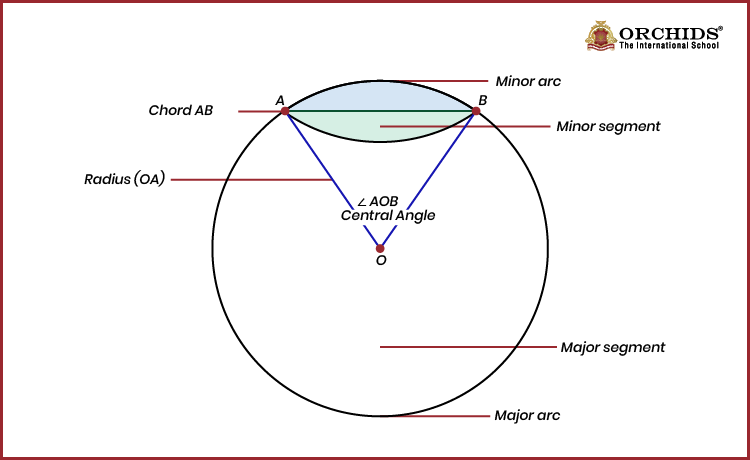
Major and minor arcs:
Let A and B be two points on a circle; they divide the circumference (boundary) into two arcs:
-
Minor arc (AB): Minor arc AB is the shorter part of the circumference.
-
Major arc (AB): Major arc AB is the longer part of the circumference.
-
A minor arc + a major arc = the full circumference of the circle.
Major and minor segments:
Let A and B be two points on a circle; they divide the circumference (boundary) into two arcs:
-
Minor sector: A minor sector is the region enclosed between two radii and the minor arc connecting their endpoints. The smaller slice of the circle. Its central angle is less than 180°.
-
Major sector: A major sector is the region enclosed between two radii and the major arc connecting their endpoints. The larger slice of the circle. Its central angle is more than 180°.
-
Minor sector + major sector = full circle.
-
Quadrant: The sector with a central angle of 90° is called a quadrant (one-quarter of the circle).
-
Semicircle: The sector with central angle = 180° is called a semicircle (one-half of the circle).
Relationship between Arc and Sector of a Circle
An arc and its corresponding sector are both determined by the same central angle (θ) and radius (r) of a circle.
The relationship between an arc and a sector is the following:
Area of a sector = × r × l
Where r = radius and l = arc length.
This formula summarises that:
-
The area of a sector is directly proportional to its arc length.
-
If the arc length increases, the sector area also increases (for the same radius).
Real-World Applications of an Arc and a Sector of a Circle
-
Pie Charts: Each slice of a pie chart is a sector, where the central angle represents what fraction of the whole a category makes up.
-
Clock Faces: The hands of a clock sweep out sectors as time passes. The minute hand travels the full 360° every hour.
-
Pizza and Cake Slices: Cutting a circular pizza into equal slices produces equal sectors, resulting in the same area in every piece.
-
Windscreen Wipers: A car's windscreen wiper sweeps back and forth across a sector-shaped area, clearing only that portion of the glass.
Solved Examples on an Arc and a Sector of a Circle
Example 1: Two points, P and Q, are on a circle. The minor arc PQ is 7 cm, and the total circumference is 23 cm. Find the major arc PQ.
Solution: Circumference of the circle = 23 cm
Length of the minor arc = 7 cm.
Length of major arc = Circumference - length of minor arc = 23 - 7 = 16 cm.
Example 2: A pizza is cut into 8 equal slices. What is the central angle of each slice?
Solution: A pizza is a full circle. ∴ Central angle of each = 360°. It is cut into 8 equal slices.
∴ The centre of each slice = 360° ÷ 8 = 45°.
Example 3: A sector has a central angle of 120°. What fraction of the circle does it cover?
Solution: The central angle of the sector is 120°.
360° ÷ 120° = 3. ∴ the sector is ⅓ of the entire circle.
Frequently Asked Questions on Arc and Sector of a Circle
1. What is the difference between a minor arc and a major arc?
When two points are there in a circle, the minor arc is the shorter part of the circumference, while the major arc is the longer part of the circumference connecting both points.
2. Where do we see arcs and sectors in real life?
In real life arcs and sectors can be seen in pie charts, clock faces, pizza slices, fan blades, windscreen wipers, protractors, and circular gardens with pathways.
3. What is a quadrant?
A quadrant is a sector with central angle equal to 90°
Numbers make sense when they're taught right. To see how Orchids The International School turns Maths from intimidating to intuitive, reach out to our admissions team.


Admissions Open for 2026-27
What type of concept pages would you prefer?
CBSE Schools In Popular Cities
- CBSE Schools in Bangalore
- CBSE Schools in Mumbai
- CBSE Schools in Pune
- CBSE Schools in Hyderabad
- CBSE Schools in Chennai
- CBSE Schools in Gurgaon
- CBSE Schools in Kolkata
- CBSE Schools in Indore
- CBSE Schools in Sonipat
- CBSE Schools in Delhi
- CBSE Schools in Rohtak
- CBSE Schools in Bhopal
- CBSE Schools in Aurangabad
- CBSE Schools in Jabalpur
- CBSE Schools in Jaipur
- CBSE Schools in Jodhpur
- CBSE Schools in Nagpur
- CBSE Schools in Ahmednagar
- CBSE School In Tumkur











Orchids The International School is one of India's leading chains of CBSE and ICSE schools, with 130+ schools across the country.