

CDLV Roman Numerals
CDLV Roman numerals represent the number 455. This number is formed using the symbols C (100), D (500), L (50), and V (5). In CD, the subtraction rule is applied, where C (100) is placed before D (500) to show 400 (500 − 100). The remaining part LV follows the addition rule, where 50 and 5 are added together. When combined, CDLV = 400 + 50 + 5 = 455. Understanding CDLV Roman numerals helps learners easily read and write numbers by using both addition and subtraction rules, which are commonly seen in clocks, chapters, and numbering systems.
Table of Contents
- How to Write CDLV Roman Numerals in Numbers?
- Numbers Related to CDLV Roman Numerals
- Basic Rules for Writing Roman Numerals
- Solved Examples on CDLV Roman Numerals
- Practice Questions on CDLV Roman Numerals
- Conclusion
- Frequently Asked Questions on CDLV Roman Numerals

How to Write CDLV Roman Numerals in Numbers?
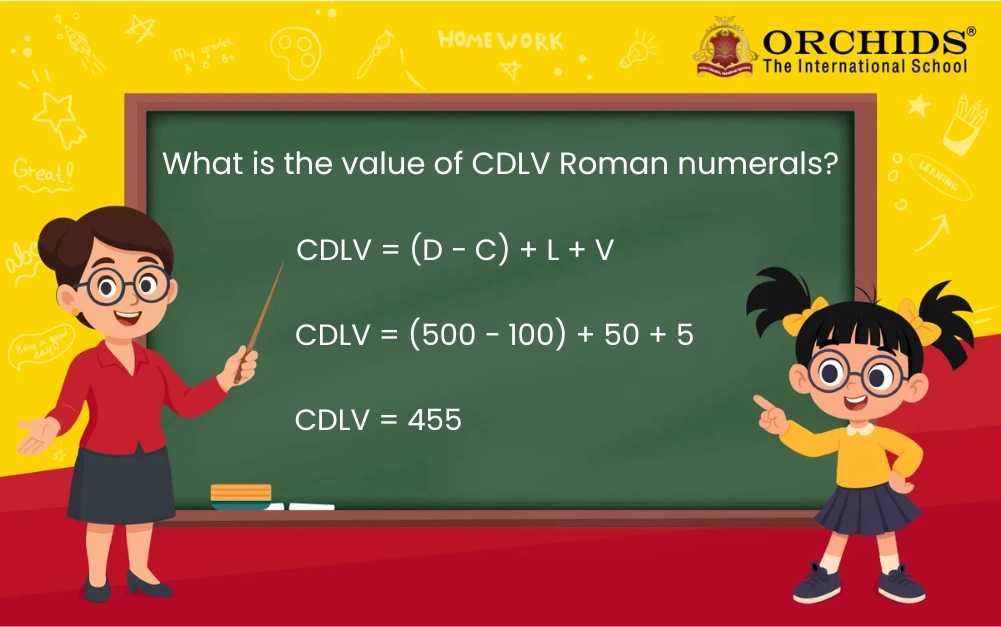
To find the value of CDLV Roman numerals, we break the numeral into parts and apply the correct rules.
Step 1: Know the Values
-
C = 100
-
D = 500
-
L = 50
-
V = 5
Step 2: Apply the Rule
When a smaller symbol comes before a larger one, we subtract it. So, C before D means subtraction.
Step 3: Calculate
-
CDLV = (D − C) + L + V = CD + L + V
-
CDLV = (500 − 100) + 50 + 5 = 400 + 50 + 5 = 455
Know more about related topics:
Numbers Related to CDLV Roman Numerals
Basic Rules for Writing Roman Numerals
-
Roman numerals use letters like I (1), V (5), X (10), L (50), C (100), D (500), and M (1000) to represent numbers.
-
The numeral CDLV is formed using four symbols: C, D, L, and V.
-
Their values are: C = 100, D = 500, L = 50, and V = 5.
-
Here, the subtraction rule is applied: when C is placed before D, it means 500 − 100 = 400.
-
Now add the remaining values: 400 + 50 + 5 = 455
-
So, the Roman numeral CDLV represents the number 455.
Solved Examples on CDLV Roman Numerals
Example 1: Addition of CDLV and MCC
Solution:
CDLV = 400 + 50 + 5 = 455
MCC = 1000 + 200 = 1200
Now, add the values:
455 + 1200 = 1655
Convert 1655 into Roman numerals:
1655 = 1000 + 600 + 50 + 5 = M + DC + L + V = MDCLV
Final Answer:
CDLV + MCC = MDCLV
Example 2: Multiplication of CDLV and IV
Solution:
CDLV = 455
IV = 4
Now, multiply:
455 × 4 = 1820
Convert 1820 into Roman numerals:
1820 = 1000 + 800 + 20 = M + DCCC + XX = MDCCCXX
Final Answer:
CDLV × IV = MDCCCXX
Example 3: Subtraction of CL from CDLV
Solution:
CDLV = 455
CL = 100 + 50 = 150
Now, subtract:
455 − 150 = 305
Convert 305 into Roman numerals:
305 = 300 + 5 = CCC + V = CCCV
Final Answer:
CDLV − CL = CCCV
Example 4: Division of CDLV by X
Solution:
CDLV = 455
X = 10
Now, divide:
455 ÷ 10 = 45
Convert 45 into Roman numerals:
45 = 40 + 5 = XL + V = XLV
Final Answer:
CDLV ÷ X = XLV
Practice Questions on CDLV Roman Numerals
1. Add CDLV and XLV, then write the final answer in Roman numerals.
2. Write the numerical value of CDLV Roman numerals.
3. Express the number 455 using Roman numerals.
4. Which is greater: CDLV or CDL?
5. Find the difference: CDLV − L
Conclusion
CDLV Roman numerals represent the number 455. It is created by combining CD (400), L (50), and V (5). In CD, the smaller value C is placed before D, which means 500 − 100 = 400. The remaining symbols L and V are added to complete the number. This example shows how Roman numerals follow clear rules using both subtraction and addition to form numbers correctly. Learning CDLV Roman numerals makes it easier to understand how different symbols come together to represent larger values.
Explore CDLV Roman numerals with simple steps and easy explanations at Orchids International School.
Numbers make sense when they're taught right. To see how Orchids The International School turns Maths from intimidating to intuitive, reach out to our admissions team.
Frequently Asked Questions on CDLV Roman Numerals
1. What is the value of CDLV in Roman numerals?
CDLV represents the number 455. It is formed by combining CD (400), L (50), and V (5).
2. How is 455 written as CDLV in Roman numerals?
We write 455 as CDLV by adding the symbols:
400 = CD, 50 = L, and 5 = V
So, 455 = CDLV.
3. How do you convert CDLV into numbers?
Break the numeral into parts: CD = 400, L = 50, V = 5
Add them together: 400 + 50 + 5 = 455.
4. What should be subtracted from CDLV to get CCXLVI?
CDLV = 455 and CCXLVI = 246
Now subtract: 455 − 246 = 209
209 in Roman numerals is CCIX.
5. What is the remainder when CDLV is divided by XI?
CDLV is 455, and XI is 11. When divided, the remainder is 4, which is written as IV in Roman numerals.
Related Links


Admissions Open for 2026-27
What type of concept pages would you prefer?
CBSE Schools In Popular Cities
- CBSE Schools in Bangalore
- CBSE Schools in Mumbai
- CBSE Schools in Pune
- CBSE Schools in Hyderabad
- CBSE Schools in Chennai
- CBSE Schools in Gurgaon
- CBSE Schools in Kolkata
- CBSE Schools in Indore
- CBSE Schools in Sonipat
- CBSE Schools in Delhi
- CBSE Schools in Rohtak
- CBSE Schools in Bhopal
- CBSE Schools in Aurangabad
- CBSE Schools in Jabalpur
- CBSE Schools in Jaipur
- CBSE Schools in Jodhpur
- CBSE Schools in Nagpur
- CBSE Schools in Ahmednagar
- CBSE School In Tumkur











Orchids The International School is one of India's leading chains of CBSE and ICSE schools, with 110+ schools across the country.