

Case Study for Class 10 Maths Chapter 14 ‘Probability’
The Case Study Questions for Class 10 Maths Chapter 14 "Probability" include short, real life problem situations that have clear answers and step by step solutions to help students gain confidence for exams. It covers important topics including understanding the concept of probability and its meaning, calculating the probability of simple events using the formula P(E) = number of favorable outcomes/total number of outcomes, finding the probability of complementary events (P(E) + P(not E) = 1), determining the probability of certain events (probability = 1) and impossible events (probability = 0), solving problems involving coins, dice, and cards, understanding experimental probability based on actual observations, calculating theoretical probability based on possible outcomes, finding the probability of multiple events occurring together, analyzing real-world scenarios like weather forecasting and game outcomes, and applying probability concepts to everyday situations like lottery chances, sports predictions, and risk assessment. These practice questions help the students in better understanding of the concepts, handling probability problems smoothly and to be faster and accurate for their board exams. A free PDF is included for offline timed practice.
Introduction to Case Study Questions on Probability
Understanding Probability
Probability is a numerical measure of how likely an event is to happen. It is always a value between 0 and 1, where 0 means the event is impossible and 1 means the event is certain to happen.
Probability Formula: P(E) = Number of Favourable Outcomes ÷ Total Number of Possible Outcomes
P(E) = n(E) ÷ n(S)
where E is the event, n(E) is the count of outcomes that satisfy the event, and n(S) is the total count of all outcomes in the sample space.
.webp "probability scale")
Outcomes and Events
- An outcome is a single possible result of a probability experiment. When you roll a dice, each of the six faces showing a number is one outcome.
- An event is a specific result or group of results that you are interested in. "Getting an even number" when rolling a dice is an event that includes the outcomes 2, 4, and 6.
- Two events are called complementary events if one event happening means the other event definitely does not happen, and together they cover every possible outcome. The probability of an event and its complement always add up to exactly 1.
- P(E) + P(not E) = 1, which means P(not E) = 1 − P(E)
Sample Space
The sample space is the complete set of all possible outcomes of a probability experiment. Writing out the sample space completely and correctly before answering any question is the single most important step in solving probability case studies.
Common sample spaces used in Class 10 case studies:
- Tossing one coin: S = {H, T}, total = 2 outcomes
- Tossing two coins: S = {HH, HT, TH, TT}, total = 4 outcomes
- Rolling one dice: S = {1, 2, 3, 4, 5, 6}, total = 6 outcomes
- Rolling two dice: total = 6 × 6 = 36 outcomes
- Standard deck of cards: total = 52 cards
Favourable Outcomes
Favourable outcomes are the specific outcomes within the sample space that satisfy the event being asked about. Counting these correctly without missing any and without counting any twice is the key skill tested in probability case study questions.
Experimental and Theoretical Probability
Theoretical probability is based on logic and the assumption that all outcomes are equally likely. It is calculated using the formula before any experiment takes place.
Experimental probability is based on actual data collected by repeating an experiment many times. It is calculated as:
Experimental Probability = Number of times event occurred ÷ Total number of trials
As the number of trials increases, experimental probability tends to get closer and closer to theoretical probability. This is an important principle for real-life probability word problems involving historical data.

Case Study 1: Tossing Coins During a Game
During a school fair, a game stall offers a coin tossing game for students. The stall has two activities. In the first activity, one fair coin is tossed and a student wins a prize if they get heads. In the second activity, two fair coins are tossed simultaneously and a student wins a bigger prize if both coins show the same face (both heads or both tails). A maths teacher standing nearby decides to use this situation to ask students probability questions as a fun revision activity for Class 10 Chapter 14.
Questions:
(i) What is the sample space when one coin is tossed?
(ii) What is the probability of winning the first activity (getting heads on one coin)?
(iii) What is the sample space when two coins are tossed simultaneously?
(iv) What is the probability of winning the second activity (both coins showing the same face)?
(v) What is the probability of NOT winning the second activity?
Solution:
Answer 1: When one fair coin is tossed, there are two equally likely outcomes - the coin lands heads up or tails up.
Sample space S = {H, T} Total number of outcomes = 2
Answer 2: Favourable outcome for winning = getting Heads = 1 outcome.
P(Heads) = 1 ÷ 2 = 1/2
There is a 50 percent chance of winning the first activity.
Answer 3: When two coins are tossed simultaneously, each coin independently produces Heads or Tails.
All possible combined outcomes: Heads-Heads, Heads-Tails, Tails-Heads, Tails-Tails
Sample space S = {HH, HT, TH, TT} Total number of outcomes = 4
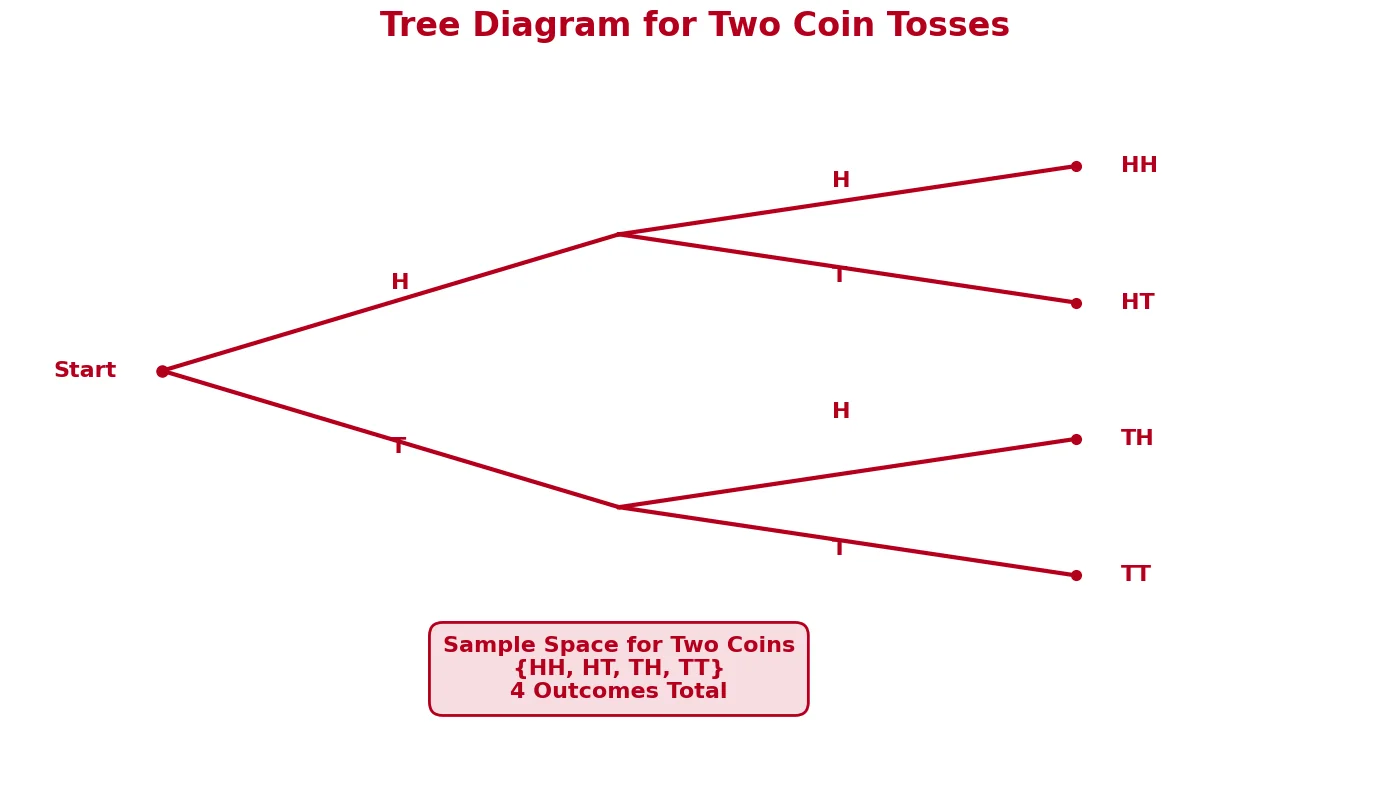
Answer 4: Outcomes where both coins show the same face: HH (both Heads) and TT (both Tails). Favourable outcomes = 2
P(Both same) = 2 ÷ 4 = 1/2
Answer 5: P(Not winning second activity) = 1 − P(Winning) = 1 − 1/2 = 1/2
The probability of not winning equals the probability of winning in this activity because exactly half the outcomes satisfy the event and half do not.
Case Study 2: Rolling Dice in a Board Game
A group of Class 10 students are playing a popular board game during their lunch break. The game requires players to roll a single standard six-faced dice on each turn. Player A needs to roll a number greater than 4 to move to the winning square. Player B needs to roll a prime number to avoid going back three spaces. Player C needs to roll an odd number to collect a bonus token. Their maths teacher overhears the game and asks the players to calculate their probabilities before their next turns as a quick revision exercise for Chapter 14 Probability.
Questions:
(i) Write the sample space for rolling one standard dice.
(i) What is the probability that Player A rolls a number greater than 4?
(iii) What is the probability that Player B rolls a prime number?
(iv) What is the probability that Player C rolls an odd number?
(v) What is the probability of rolling either a 1 or a 6?
Solution:
Answer 1: A standard dice has six faces numbered from 1 to 6.
Sample space S = {1, 2, 3, 4, 5, 6} Total number of outcomes = 6
Answer 2: Numbers greater than 4 on a standard dice: 5 and 6. Favourable outcomes = 2
P(Greater than 4) = 2 ÷ 6 = 1/3
Player A has a one in three chance of moving to the winning square.
Answer 3: Prime numbers on a standard dice: 2, 3, and 5 are prime (a prime number has exactly two factors: 1 and itself; note that 1 is not prime). Favourable outcomes = 3
P(Prime number) = 3 ÷ 6 = 1/2
Player B has a 50 percent chance of rolling a prime number and avoiding the penalty.
Answer 4: Odd numbers on a standard dice: 1, 3, and 5. Favourable outcomes = 3
P(Odd number) = 3 ÷ 6 = 1/2
Player C has a 50 percent chance of collecting a bonus token.
Answer 5: Favourable outcomes for rolling 1 or 6: two outcomes (the number 1 and the number 6).
P(Rolling 1 or 6) = 2 ÷ 6 = 1/3
Case Study 3: Selecting Cards from a Deck
A card game is being set up by a group of students for their school annual function. They use a standard well-shuffled deck of 52 playing cards. A standard deck contains four suits Hearts, Diamonds, Clubs, and Spades with 13 cards in each suit numbered Ace, 2 through 10, Jack, Queen, King. Hearts and Diamonds are red suits; Clubs and Spades are black suits. Each suit has three face cards: Jack, Queen, and King. One student, Aditya, draws a single card at random from the deck without looking. The teacher asks probability questions based on this scenario.
Questions:
(i) What is the total number of cards in the sample space?
(ii) What is the probability that Aditya draws a red card?
(iii) What is the probability that he draws a King?
(iv) What is the probability that he draws a face card?
((i) What is the probability that he draws a card that is neither a Heart nor a face card?
Solution:
Answer 1: A standard deck has 52 cards in total.
Sample space n(S) = 52
Answer 2: Red cards = Hearts (13 cards) + Diamonds (13 cards) = 26 red cards.
P(Red card) = 26 ÷ 52 = 1/2
Exactly half the deck is red and half is black.
Answer 3: There are 4 Kings in the deck one in each suit.
P(King) = 4 ÷ 52 = 1/13
Answer 4: Face cards are Jacks, Queens, and Kings. Each suit has 3 face cards, and there are 4 suits. Total face cards = 3 × 4 = 12
P(Face card) = 12 ÷ 52 = 3/13
Answer 5: We need cards that are NOT Hearts and NOT face cards.
Total Hearts = 13. Face cards not in Hearts = 3 (Jack, Queen, King) × 3 suits = 9 face cards in non-Heart suits.
Cards to EXCLUDE: 13 Hearts + 9 non-Heart face cards = 22 cards to exclude.
Cards that are neither Hearts nor face cards = 52 − 22 = 30
P(Neither Heart nor face card) = 30 ÷ 52 = 15/26
Case Study 4: Weather Prediction and Probability
Priya is a Class 10 student who follows the daily weather report with her family. Over a period of 30 days in the month of July, the local weather station recorded the following data: it rained on 18 days, it was partly cloudy without rain on 8 days, and it was completely sunny on 4 days. Based on this historical data, Priya's science and maths teacher asks the class to calculate the experimental probability of different weather conditions for the following day in July.
Questions:
(i) What is the experimental probability that the next day will be rainy?
(ii) What is the experimental probability that the next day will be sunny?
(iii) What is the experimental probability that the next day will NOT be rainy?
(iv) If the probability of rain on a day in August is known to be 3/5, what is the probability that it will not rain on a randomly chosen day in August?
(v) Verify that the experimental probabilities of all three weather conditions in July add up to 1.
Solution:
Answer 1: Total days observed = 30. Rainy days = 18.
Experimental P(Rain) = 18 ÷ 30 = 3/5 or 0.6
Based on past data, there is a 60 percent chance of rain on the next day in July.
Answer 2: Sunny days = 4.
Experimental P(Sunny) = 4 ÷ 30 = 2/15 or approximately 0.133
Answer 3: Days that were NOT rainy = cloudy days + sunny days = 8 + 4 = 12 days.
Experimental P(Not rainy) = 12 ÷ 30 = 2/5 or 0.4
Alternatively, using the complement rule: P(Not rainy) = 1 − P(Rainy) = 1 − 3/5 = 2/5
Answer 4: P(Rain in August) = 3/5
P(No rain in August) = 1 − 3/5 = 2/5
Answer 5: Sum = P(Rainy) + P(Cloudy) + P(Sunny)
= 18/30 + 8/30 + 4/30
= 30/30
= 1
All three experimental probabilities add up to 1, confirming the fundamental rule that the sum of probabilities across all possible outcomes in a sample space always equals 1.
Important Topics from Probability for Case Studies
Probability Formula
The probability formula P(E) = n(E) ÷ n(S) is the foundation of every probability calculation in Class 10 Chapter 14. Every case study question, regardless of its scenario, ultimately requires you to apply this formula with the correct values of n(E) and n(S). Memorise this formula and ensure you always write it down before substituting values in your examination answer.
Sample Space
The sample space is the complete collection of all possible outcomes of a probability experiment. Building the sample space correctly listing every outcome without repetition or omission is the single most important step in solving any probability case study. For multi-stage experiments (two coins, two dice), use systematic listing or a tree diagram to construct the sample space reliably.
Events
An event is a subset of the sample space a collection of one or more outcomes that satisfy a specific condition. Understanding how to identify which outcomes belong to an event (for example, which outcomes from a dice roll qualify as "prime numbers") is a key skill tested repeatedly across all probability case study questions with answers.
Equally Likely Outcomes
Equally likely outcomes are outcomes that have the same chance of occurring. When all outcomes in a sample space are equally likely, the theoretical probability formula applies directly. When outcomes are not equally likely (for example, a biased coin), the probability of each outcome must be given explicitly, and experimental probability based on observed data is more appropriate.
Probability Range
Every probability value must fall within the closed range from 0 to 1, including both endpoints. A probability of 0 represents an impossible event. A probability of 1 represents a certain event. Any calculated probability outside this range signals a definite error in either the identification of outcomes or the arithmetic. The sum of all individual event probabilities across the complete sample space always equals exactly 1, and this serves as a reliable verification check after completing any set of probability calculations.
Download Free PDF - Case Study: Class 10 Chapter 14 - Probability
Download PDF - Case Study for Class 10 Maths Chapter 14 Probability
Frequently Asked Questions on Case Study for Class 10 Maths Chapter 14 Probability
1. What are case study questions in Class 10 Maths Probability?
Case study questions are real-life situations based on probability concepts. They test your understanding of sample space, events, and probability calculations by asking multiple questions from a single scenario.
2. How can I score full marks in probability case study questions?
Write the sample space clearly, use the correct probability formula, show each calculation step, and simplify your final answer wherever possible.
3. Is a free PDF available for Probability case study questions?
Yes. You can download the free PDF on this page to practise the questions offline and revise before your exams.
4. Which topics are commonly asked in Class 10 Probability case studies?
Most case studies include coins, dice, playing cards, sample space, favourable outcomes, complementary events, and experimental probability based on real-life situations.
5. Where can I practise Class 10 Maths Probability case study questions with answers?
You can practise Class 10 Maths Probability case study questions with answers on this page. Each question comes with a simple step-by-step solution to help you understand the concepts and prepare confidently for your CBSE exams.
Numbers make sense when they're taught right. To see how Orchids The International School turns Maths from intimidating to intuitive, reach out to our admissions team.


Admissions Open for 2026-27
What type of concept pages would you prefer?
CBSE Schools In Popular Cities
- CBSE Schools in Bangalore
- CBSE Schools in Mumbai
- CBSE Schools in Pune
- CBSE Schools in Hyderabad
- CBSE Schools in Chennai
- CBSE Schools in Gurgaon
- CBSE Schools in Kolkata
- CBSE Schools in Indore
- CBSE Schools in Sonipat
- CBSE Schools in Delhi
- CBSE Schools in Rohtak
- CBSE Schools in Bhopal
- CBSE Schools in Aurangabad
- CBSE Schools in Jabalpur
- CBSE Schools in Jaipur
- CBSE Schools in Jodhpur
- CBSE Schools in Nagpur
- CBSE Schools in Ahmednagar
- CBSE School In Tumkur











Orchids The International School is one of India's leading chains of CBSE and ICSE schools, with 110+ schools across the country.