

Class 9 Maths Chapter 4 ‘Exploring Algebraic Identities’ Notes | Free PDF Download
Class 9 Maths Chapter 4 Exploring Algebraic Identities Notes Free PDF Download is prepared based on the latest CBSE and NCERT syllabus. These notes will help in school exams, board exams, and quick revision. They help students understand the chapter clearly, revise faster, and prepare for exams with confidence.
Introduction to Algebraic Identities
What Are Algebraic Identities?
An algebraic identity is an equation that is true for every value of the variables in it. For example, (a + b)² = a² + 2ab + b² is an identity because no matter what values you choose for a and b, both sides always give the same result. This is different from an equation like x + 3 = 7, which is only true when x = 4.

Key Terms to Remember
- Algebraic Expression: A combination of variables, constants, and arithmetic operations. Example: 3x² + 5x − 7.
- Variable: A letter that represents an unknown or changing value. Common variables: a, b, x, y.
- Constant: A fixed number in an expression that does not change. In 3x + 7, the number 7 is a constant.
- Coefficient: The numerical factor of a variable term. In 5x², the coefficient is 5.
- Identity: An equation that is true for all values of the variable. Both sides are equivalent expressions, not just equal for specific values.
Know more about related topics:
Important Algebraic Identities
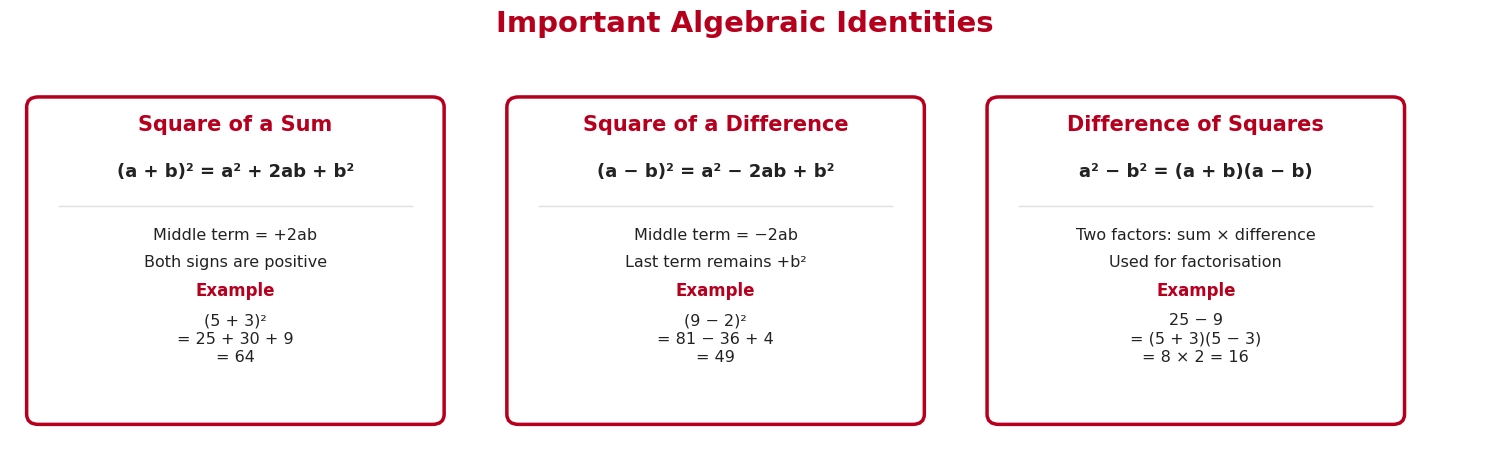
The three core algebraic identities for Class 9 are shown in the formula chart below. These form the foundation of all expansion and factorisation work in the chapter.
Square of a Sum
(a + b)² = a² + 2ab + b²
The square of the sum of two terms equals the square of the first term, plus twice the product of both terms, plus the square of the second term.
Example: (7 + 3)²
= 7² + 2(7)(3) + 3²
= 49 + 42 + 9 = 100.
Check: 10² = 100
Square of a Difference
(a − b)² = a² − 2ab + b²
The square of the difference of two terms equals the square of the first, minus twice the product of both, plus the square of the second. Note: the last term b² is always positive.
Example: (8 − 3)²
= 8² − 2(8)(3) + 3²
= 64 − 48 + 9 = 25.
Check: 5² = 25
Difference of Squares
a² − b² = (a + b)(a − b)
The difference of two perfect squares always factors into the product of the sum and the difference of the two terms.
Example: 9² − 4²
= (9 + 4)(9 − 4)
= 13 × 5 = 65.
Check: 81 − 16 = 65
Visual Understanding of Algebraic Identities
Geometric Interpretation of (a + b)²
The best way to understand (a + b)² = a² + 2ab + b² is to think of it as the area of a large square with side (a + b). Divide that square into four smaller regions. You get one a × a square, two a × b rectangles, and one b × b square. Add the areas: a² + ab + ab + b² = a² + 2ab + b².
².webp "geometric interpretation of (a+b)²")
Geometric Interpretation of (a − b)²
For (a − b)², imagine a square of side a. You want to remove a strip of width b from two sides to get a square of side (a − b). When you remove the corner regions, you subtract two rectangles of area ab but add back the corner b² that was subtracted twice. This gives: a² − ab − ab + b² = a² − 2ab + b².
².webp "geometric interpretation of (a−b)²")
Algebraic Identities Formula Chart
The chart below summarises all three identities together ideal for quick revision before exams.
Applications of Algebraic Identities
Simplifying Expressions
Identities let you replace a longer multiplication with a direct formula. Instead of expanding (x + 4)(x + 4) step by step, you recognise it as (x + 4)² and directly write x² + 8x + 16. This saves time and reduces errors.
Faster Calculations
Identities work brilliantly for mental arithmetic. To calculate 99², write it as (100 − 1)² = 10000 − 200 + 1 = 9801. To calculate 51 × 49, recognise it as (50 + 1)(50 − 1) = 50² − 1 = 2500 − 1 = 2499. These are standard exam uses of identities.
Expanding Algebraic Expressions
When an expression is written in factored form and you need its expanded form, apply the matching identity. For example, (2x + 3y)² expands directly as 4x² + 12xy + 9y² using the (a + b)² identity with a = 2x and b = 3y.
Expansion Using Algebraic Identities
Expanding Binomials
Identify which identity fits the form of the expression. Replace the variables a and b with the actual terms, then substitute into the formula.
Examples:
-
(x + 5)² = x² + 10x + 25 (use a = x, b = 5)
-
(3a − 2b)² = 9a² − 12ab + 4b² (use a = 3a, b = 2b)
-
(4x + 3y)(4x − 3y) = 16x² − 9y² (use a = 4x, b = 3y)
Simplifying Expressions Using Identities
If you see a pattern matching an identity, do not multiply term by term apply the formula directly. This avoids sign errors and saves steps, especially in exam conditions.
Factorisation Using Algebraic Identities
Factoring Difference of Squares
Any expression of the form a² − b² can be factored as (a + b)(a − b). The key is recognising two perfect square terms with a minus sign between them.
Examples:
-
x² − 16 = x² − 4² = (x + 4)(x − 4)
-
9y² − 25 = (3y)² − 5² = (3y + 5)(3y − 5)
-
4a² − 49b² = (2a)² − (7b)² = (2a + 7b)(2a − 7b)
Recognising Common Patterns
Before factorising, always check: are both terms perfect squares? Is there a subtraction sign between them? If yes, the difference of squares identity applies directly. Similarly, a perfect square trinomial (three terms with +2ab in the middle) can be compressed back into (a + b)².
Example: x² + 6x + 9 = x² + 2(x)(3) + 3² = (x + 3)²
Important Concepts from the Chapter
Relationship Between Expansion and Factorisation
Expansion and factorisation are reverse operations. Expanding takes a factored form like (a + b)² and opens it to a² + 2ab + b². Factorisation takes the expanded form and compresses it back. Knowing one identity gives you the tool for both directions.
Identifying the Correct Identity
Before solving, identify which of the three identities matches the structure of your expression. Check: is it a sum squared, a difference squared, or a difference of two squares? The structure tells you which formula to apply.
Pattern Recognition in Algebra
The skill this chapter builds is pattern recognition seeing that (2x + 5)² matches the (a + b)² structure, or that 49m² − 36n² is a difference of squares. This ability becomes the foundation for all algebraic manipulation in higher classes.
Common Mistakes Students Make
Sign Errors in Expansions
The most common error is writing (a − b)² = a² − 2ab − b². The last term b² is always positive, because (−b) × (−b) = +b². Never write it as minus b².
Similarly, (a + b)² is never a² + b². The middle term 2ab is always there and is always forgotten by students under exam pressure.
Incorrect Application of Identities
Students sometimes apply (a + b)² when the expression is actually (a + b)(a − b). Always check the signs before choosing the identity. If both factors are identical, it is a square. If one has a plus and one has a minus, it is the difference of squares.
Errors While Factorising Expressions
When factorising using a² − b² = (a + b)(a − b), students sometimes forget to take the square root of the terms. For 9x², the value of a is 3x, not 9x. Always extract the square root correctly before writing the factors.
Solved Examples for Quick Revision
Example Using (a + b)²
Expand (3x + 4y)².
Solution: Use (a + b)² = a² + 2ab + b² with a = 3x, b = 4y.
= (3x)² + 2(3x)(4y) + (4y)² = 9x² + 24xy + 16y²
Example Using (a − b)²
Evaluate 97² using an identity.
Solution: Write 97 = 100 − 3. Apply (a − b)² with a = 100, b = 3.
= 100² − 2(100)(3) + 3² = 10000 − 600 + 9 = 9409
Example Using a² − b²
Factorise 4m² − 81n².
Solution: Write as (2m)² − (9n)². Apply a² − b² = (a + b)(a − b) with a = 2m, b = 9n.
= (2m + 9n)(2m − 9n)
Exploring Algebraic Identities Notes PDF
Download PDF - Class 9 Maths Chapter 4 Exploring Algebraic Identities Notes
Numbers make sense when they're taught right. To see how Orchids The International School turns Maths from intimidating to intuitive, reach out to our admissions team.
Frequently Asked Questions on Class 9 Maths Chapter 4 Exploring Algebraic Identities Notes
1. What is an algebraic identity?
An algebraic identity is an equation that is true for all values of the variables involved. It helps simplify and solve algebraic expressions quickly.
2. What is the formula for (a + b)²?
(a + b)² = a² + 2ab + b²
3. What is the formula for (a − b)²?
(a − b)² = a² − 2ab + b²
4. How are algebraic identities used in factorisation?
Algebraic identities help rewrite algebraic expressions into factors, making calculations and equation solving easier.
5. Why are algebraic identities important?
Algebraic identities simplify complex calculations, help in factorisation, and form the foundation for higher algebra concepts.
6. What are the most important identities for exams?
The most important algebraic identities are:
- (a + b)² = a² + 2ab + b²
- (a − b)² = a² − 2ab + b²
- a² − b² = (a − b)(a + b)
- (a + b)³ = a³ + 3a²b + 3ab² + b³
- (a − b)³ = a³ − 3a²b + 3ab² − b³
Related Links


Admissions Open for 2026-27
What type of concept pages would you prefer?
CBSE Schools In Popular Cities
- CBSE Schools in Bangalore
- CBSE Schools in Mumbai
- CBSE Schools in Pune
- CBSE Schools in Hyderabad
- CBSE Schools in Chennai
- CBSE Schools in Gurgaon
- CBSE Schools in Kolkata
- CBSE Schools in Indore
- CBSE Schools in Sonipat
- CBSE Schools in Delhi
- CBSE Schools in Rohtak
- CBSE Schools in Bhopal
- CBSE Schools in Aurangabad
- CBSE Schools in Jabalpur
- CBSE Schools in Jaipur
- CBSE Schools in Jodhpur
- CBSE Schools in Nagpur
- CBSE Schools in Ahmednagar
- CBSE School In Tumkur











Orchids The International School is one of India's leading chains of CBSE and ICSE schools, with 130+ schools across the country.