

Coin Toss Probability: Formula, Outcomes, Examples & Practice Questions
The coin toss probability formula helps us find the chance of getting a head or a tail when a coin is flipped. A fair coin has two possible outcomes - Heads and Tails - and both are equally likely to occur. This simple concept helps students understand the basics of probability and solve everyday math problems. In this article, you will learn the coin toss probability formula, solved examples, and practice questions to build a strong foundation in probability.
Table of Contents
- What Is Tossing a Coin in Probability?
- Possible Outcomes of Tossing a Coin
- Probability of Tossing a Coin
- Tossing Two Coins in Probability
- Tossing Three Coins in Probability
- Probability Tree Diagram for Coin Tossing
- Formula for Tossing a Coin in Probability
- Solved Examples on Tossing a Coin
- Practice Questions on Tossing a Coin
- Word Problems on Tossing a Coin
- Frequently Asked Questions on Tossing a Coin Probability formula

What Is Tossing a Coin in Probability?
A coin toss is used in probability because it is a fair and random experiment. A fair coin has exactly two sides heads (H) and tails (T) and neither side is more likely to appear than the other.
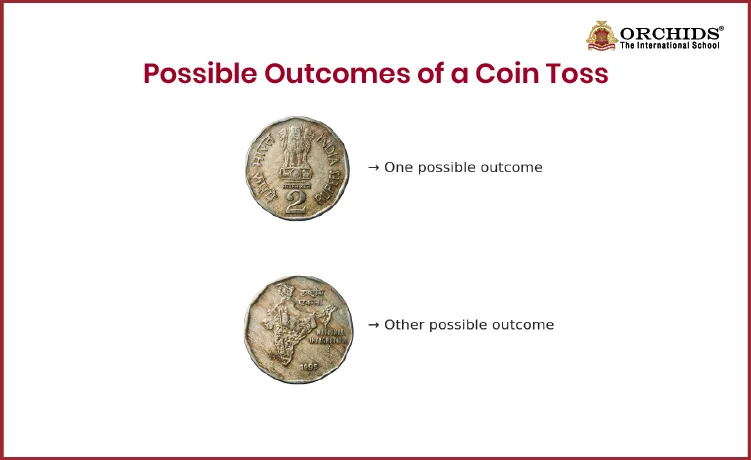
Each outcome has an equal chance of occurring.
Random Outcomes in a Coin Toss
Each coin toss is independent. The result of one toss does NOT affect the next toss. This makes it a random experiment you cannot predict the exact result in advance.
Possible Outcomes of Tossing a Coin
Sample Space of One Coin Toss
The sample space is the set of all possible outcomes.
One coin toss:
Sample Space (S) = {H, T}
Total outcomes = 2
H = Heads
T = Tails
Outcomes of Two Coin Tosses
Two coins tossed together:
Sample Space = {HH, HT, TH, TT}
Total outcomes = 4
HH = Both heads
HT = First head, second tail
TH = First tail, second head
TT = Both tails
Outcomes of Three Coin Tosses
Three coins tossed together:
Sample Space = {HHH, HHT, HTH, THH, HTT, THT, TTH, TTT}
Total outcomes = 8
Total outcomes formula: 2ⁿ
Where n = number of coins
1 coin → 2¹ = 2 outcomes
2 coins → 2² = 4 outcomes
3 coins → 2³ = 8 outcomes
Probability of Tossing a Coin
Formula for Probability
Number of favorable outcomes
P(Event) = _____________________________
Total number of possible outcomes
P(E) = n(E) / n(S)
Probability of Getting a Head
One coin toss:
Favorable outcome = {H} → 1 outcome
Total outcomes = 2
P(Head) = 1/2 = 0.5 = 50%
Probability of Getting a Tail
One coin toss:
Favorable outcome = {T} → 1 outcome
Total outcomes = 2
P(Tail) = 1/2 = 0.5 = 50%
Note: P(H) + P(T) = 1/2 + 1/2 = 1
(All probabilities must sum to 1)
Tossing Two Coins in Probability
Sample Space of Two Coin Tosses
TWO COIN TOSS TABLE:
| Coin 1 | Coin 2 | Outcome |
|---|---|---|
| H | H | HH |
| H | T | HT |
| T | H | TH |
| T | T | TT |
Total outcomes = 4
Probability of Different Outcomes
P(both heads) = P(HH) = 1/4
P(one head, one tail) = P(HT or TH) = 2/4 = 1/2
P(both tails) = P(TT) = 1/4
P(at least one head) = P(HH,HT,TH) = 3/4
P(exactly one head) = P(HT,TH) = 2/4 = 1/2
Probability Table
Tossing Three Coins in Probability
Sample Space
Sample Space = {HHH, HHT, HTH, THH, HTT, THT, TTH, TTT}
Total outcomes = 8
Probability of Getting Exactly One Head
Outcomes with exactly one head: {HTT, THT, TTH}
Favorable outcomes = 3
P(exactly one head) = 3/8
Probability of Getting Two Heads
Outcomes with exactly two heads: {HHT, HTH, THH}
Favorable outcomes = 3
P(exactly two heads) = 3/8
Probability of Getting Three Heads
Outcomes with three heads: {HHH}
Favorable outcomes = 1
P(three heads) = 1/8
Three Coin Probability Summary:
Probability Tree Diagram for Coin Tossing
Tree Diagram for One Toss
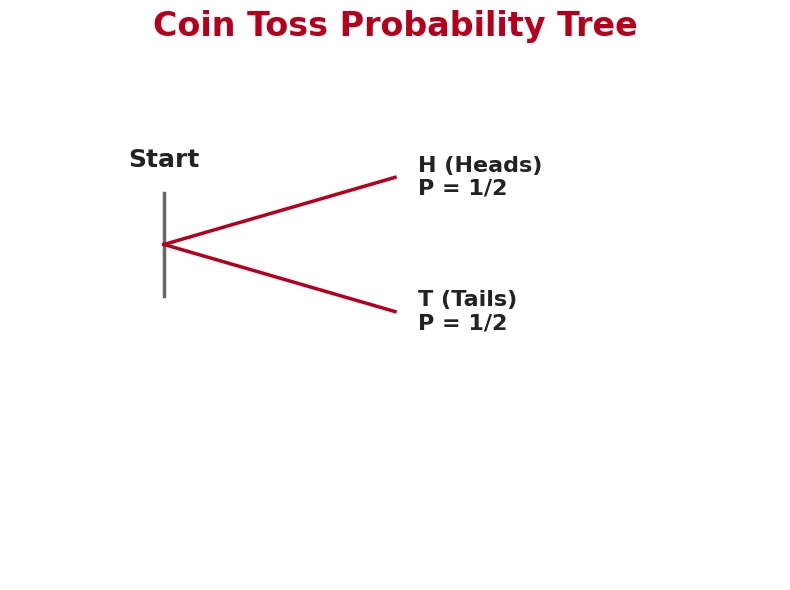
Tree Diagram for Two Tosses
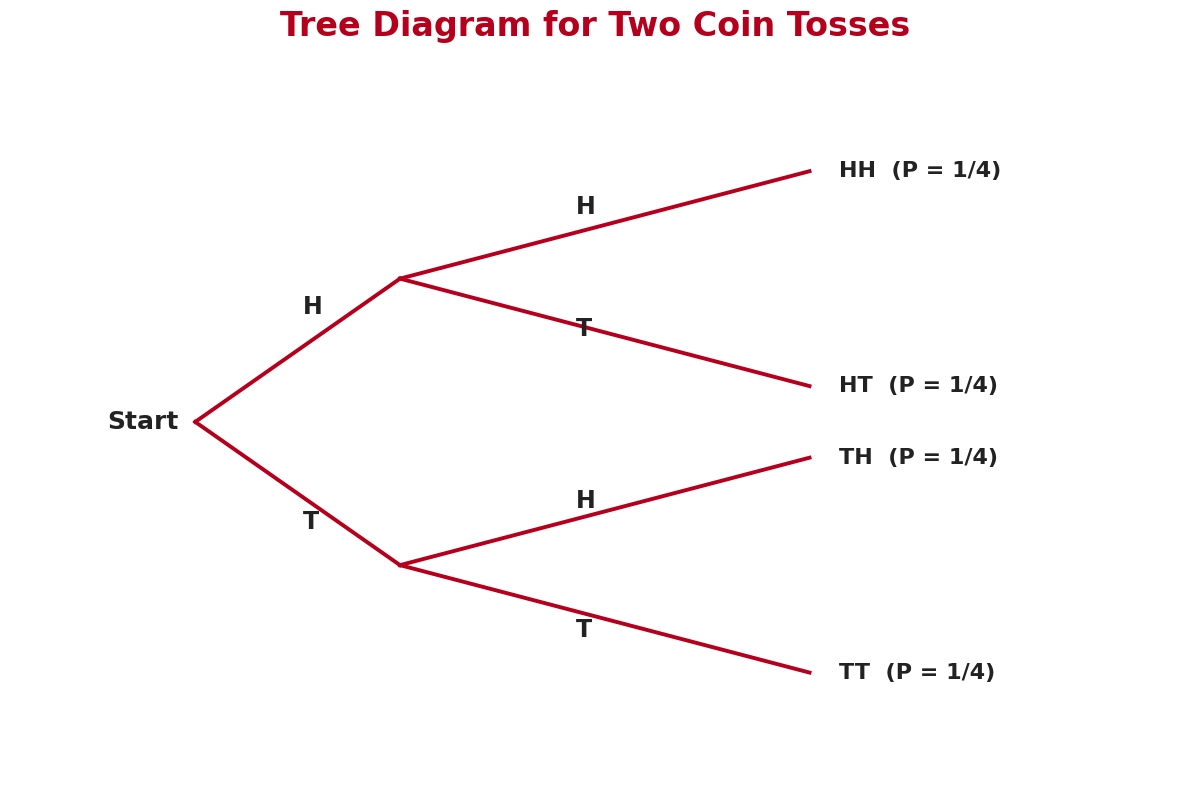
Total = 4 branches, each with P = 1/4
Sum = 4 × 1/4 = 1
Formula for Tossing a Coin in Probability
Probability Formula
P(Event) = n(E) / n(S)
Where:
n(E) = number of favorable outcomes
n(S) = total number of outcomes
Number of Outcomes Formula
Total outcomes for n coins = 2ⁿ
Examples:
1 coin: 2¹ = 2
2 coins: 2² = 4
3 coins: 2³ = 8
4 coins: 2⁴ = 16
10 coins: 2¹⁰ = 1024
Solved Examples on Tossing a Coin
Example 1: One Coin Toss
Question: A fair coin is tossed once. Find the probability of getting a tail.
Solution:
Sample Space = {H, T}
n(S) = 2
Favorable outcome = {T}
n(E) = 1
P(Tail) = 1/2
Answer: P(Tail) = 1/2
Example 2: Two Coin Tosses
Question: Two coins are tossed simultaneously. Find the probability of getting at least one head.
Solution:
Sample Space = {HH, HT, TH, TT}
n(S) = 4
Favorable outcomes = {HH, HT, TH} → 3 outcomes
P(at least one head) = 3/4
Answer: P(at least one head) = 3/4
Example 3: Three Coin Tosses
Question: Three coins are tossed at once. Find the probability of getting exactly two tails.
Solution:
Sample Space = {HHH, HHT, HTH, THH, HTT, THT, TTH, TTT}
n(S) = 8
Outcomes with exactly two tails:
{HTT, THT, TTH} → 3 outcomes
P(exactly two tails) = 3/8
Answer: P(exactly two tails) = 3/8
Practice Questions on Tossing a Coin
Basic Questions
Q1: What is the sample space when one coin is tossed?
Answer: {H, T}
Q2: What is the total number of outcomes when two coins are tossed?
Answer: 4 (= 2²)
Q3: Find P(getting all heads) when 3 coins are tossed.
Answer: 1/8
Q4: What is P(H) + P(T) for a fair coin?
Answer: 1/2 + 1/2 = 1
Multiple Choice Questions
Q5: A coin is tossed twice. What is P(both tails)?
a) 1/2 b) 1/4 c) 1/3 d) 3/4
Answer: b) 1/4
Q6: Three coins are tossed. P(at least one tail) = ?
a) 1/8 b) 3/8 c) 7/8 d) 5/8
Answer: c) 7/8
(Complement of all heads: 1 − 1/8 = 7/8)
Q7: Total outcomes when 4 coins are tossed?
a) 8 b) 12 c) 16 d) 4
Answer: c) 16 (= 2⁴)
Word Problems on Tossing a Coin
Q8: Ravi and Priya toss a coin to decide who bats first. What is the probability that Ravi wins the toss?
Solution:
P(Ravi wins) = P(getting the chosen side) = 1/2
Answer: 1/2
Q9: A teacher tosses two coins in class. Find P(getting exactly one tail).
Sample Space = {HH, HT, TH, TT}
Exactly one tail = {HT, TH} → 2 outcomes
P = 2/4 = 1/2
Answer: 1/2
Related Topics:
Frequently Asked Questions on Tossing a Coin Probability formula
1. What is the probability formula for tossing a coin?
The probability of an event is calculated using: Probability = Number of favourable outcomes ÷ Total number of possible outcomes
2. What is the probability of getting a head when tossing one coin?
A coin has two possible outcomes: Head (H) and Tail (T). The probability of getting a head is 1/2.
3. What is the probability of getting a tail when tossing one coin?
The probability of getting a tail is 1/2 because there are two equally likely outcomes.
4. What are the possible outcomes when two coins are tossed?
The possible outcomes are:
- HH
- HT
- TH
- TT
There are 4 possible outcomes.
5. What is the probability of getting two heads?
There is 1 favourable outcome (HH) out of 4 possible outcomes.
Probability = 1/4
6. What is the probability of getting one head and one tail?
The favourable outcomes are HT and TH.
Probability = 2/4 = 1/2
7. What are the total possible outcomes for multiple coins?
The total number of possible outcomes when tossing multiple coins is given by:
Total outcomes = 2ⁿ
where n is the number of coins tossed.
Examples:
- 1 coin: 2 outcomes (H, T)
- 2 coins: 4 outcomes (HH, HT, TH, TT)
- 3 coins: 8 outcomes
- 4 coins: 16 outcomes
This formula works because each coin has 2 possible outcomes Head (H) or Tail (T).
8. How do you calculate consecutive coin flip probabilities?
To calculate the probability of consecutive coin flips, multiply the probability of each individual flip because each toss is independent.
For a fair coin:
- Probability of Head (H) = 1/2
- Probability of Tail (T) = 1/2
Examples:
- Probability of getting HH = 1/2 × 1/2 = 1/4
- Probability of getting HTH = 1/2 × 1/2 × 1/2 = 1/8
- Probability of getting TTTT = (1/2)⁴ = 1/16
In general, the probability of getting a specific sequence of n coin flips is:
Probability = (1/2)ⁿ (for a fair coin).
9. A QA team flips a coin to decide whether to audit a batch today. What is the probability of getting heads on a fair coin?
Since a fair coin has two equal outcomes - heads and tails - each outcome has the same chance of happening. There is only one favorable outcome (heads) out of two possible outcomes.
So, the probability of getting heads is:
Probability = 1/2 = 0.5 = 50%
The probability of getting heads on a fair coin is 1/2 or 50%.
Numbers make sense when they're taught right. To see how Orchids The International School turns Maths from intimidating to intuitive, reach out to our admissions team.


Admissions Open for 2026-27
What type of concept pages would you prefer?
CBSE Schools In Popular Cities
- CBSE Schools in Bangalore
- CBSE Schools in Mumbai
- CBSE Schools in Pune
- CBSE Schools in Hyderabad
- CBSE Schools in Chennai
- CBSE Schools in Gurgaon
- CBSE Schools in Kolkata
- CBSE Schools in Indore
- CBSE Schools in Sonipat
- CBSE Schools in Delhi
- CBSE Schools in Rohtak
- CBSE Schools in Bhopal
- CBSE Schools in Aurangabad
- CBSE Schools in Jabalpur
- CBSE Schools in Jaipur
- CBSE Schools in Jodhpur
- CBSE Schools in Nagpur
- CBSE Schools in Ahmednagar
- CBSE School In Tumkur











Orchids The International School is one of India's leading chains of CBSE and ICSE schools, with 130+ schools across the country.