

Combination of Solids
A combination of solids also called a composite solid is a three dimensional object formed by joining two or more basic geometric shapes, such as cones, cylinders, spheres, hemispheres and prisms together. The total volume is the sum of the individual volumes, while the surface area is the sum of only the visible outer surfaces, excluding the hidden, touching faces where the shapes meet.
Table of Contents
- How are solids combined?
- Problem 1: Cylinder and Cone
- Problem 2: Cylinder and Hemisphere
- Problem 3: Cone and Hemisphere
- Problem 4: Capsule
- Problem 5: Solid Hemisphere on a Cube
- Frequently Asked Questions on Combination of Solids: Problems and Solutions

How are solids combined?
Two basic shapes are placed together so they share a common face. The result looks like one single solid, but you can always identify the individual parts. Below is a simple example a cone placed on top of a cylinder.
Know more about related topics:
Problem 1: Cylinder and Cone
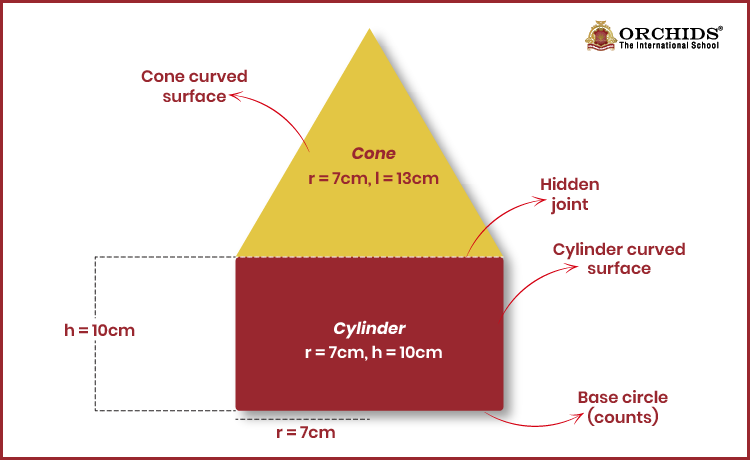
A solid is made by placing a cone on top of a cylinder. The radius of both shapes is seven centimetres. The height of the cylinder is ten centimetres and the slant height of the cone is thirteen centimetres. Find the total surface area of the combined solid.
Solution:
Step 1: Identify the visible surfaces
The cone sits on top of the cylinder. The circle where they meet is hidden on both sides, so it is not counted. The three visible outer surfaces are the slanted curved surface of the cone, the curved wall of the cylinder, and the flat base circle at the bottom of the cylinder.
Step 2: Find each surface area
The curved surface area of the cone uses the radius and the slant height. With radius seven and slant height thirteen, the curved surface of the cone works out to approximately 286.28 square centimetres.
The curved surface area of the cylinder uses the radius and the height. With radius seven and height ten, the curved surface of the cylinder works out to approximately 439.82 square centimetres.
The base circle of the cylinder uses the radius. With radius seven, the base circle works out to approximately 153.94 square centimetres.
Step 3: Add the visible surfaces
Total surface area = curved surface of cone + curved surface of cylinder + base circle
Total surface area = 286.28 + 439.82 + 153.94
Total surface area ≈ 880 square centimetres
Problem 2: Cylinder and Hemisphere
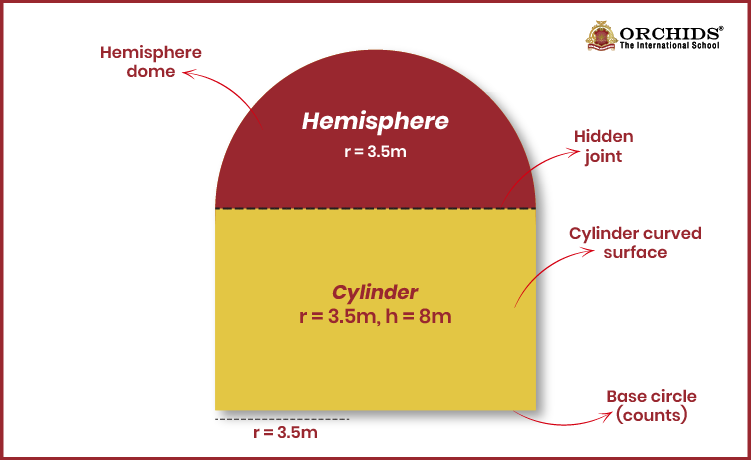
A water tank is shaped like a cylinder with a hemispherical dome on top. The radius of both the cylinder and the hemisphere is three and a half metres. The height of the cylindrical part is eight metres. Find the total surface area of the tank.
Solution:
Step 1: Identify the visible surfaces
The hemisphere sits on top of the cylinder. The flat circular face of the hemisphere and the top opening of the cylinder are both hidden at the joint. The three visible outer surfaces are the curved dome of the hemisphere, the curved wall of the cylinder, and the flat base circle at the bottom.
Step 2: Find each surface area
The curved surface of the hemisphere uses twice the value of pi multiplied by the radius squared. With radius three and a half, the curved dome surface works out to approximately 76.97 square metres.
The curved surface of the cylinder uses two multiplied by pi, the radius, and the height. With radius three and a half and height eight, the curved wall works out to approximately 175.93 square metres.
The base circle uses pi multiplied by the radius squared. With radius three and a half, the base circle works out to approximately 38.48 square metres.
Step 3: Add the visible surfaces
Total surface area = dome of hemisphere + curved wall of cylinder + base circle
Total surface area = 76.97 + 175.93 + 38.48
Total surface area ≈ 291.38 square metres
Problem 3: Cone and Hemisphere
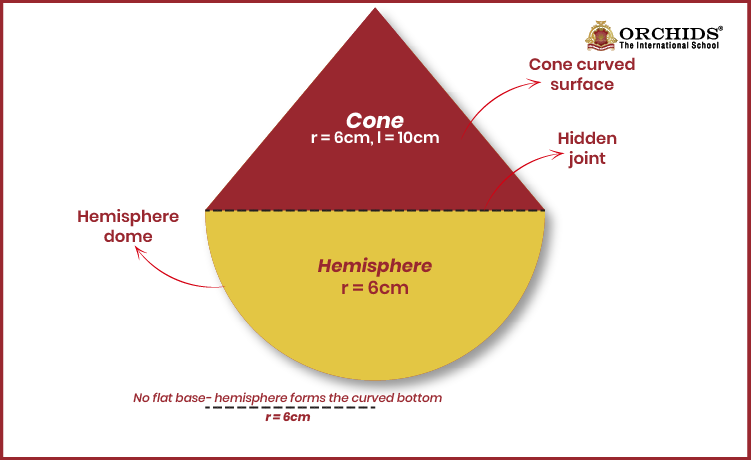
A toy is shaped like a spinning top. It is made by joining a cone on top of a hemisphere where both shapes have a radius of six centimetres. The slant height of the cone is ten centimetres. Find the total surface area of the toy.
Solution
Step 1: Identify the visible surfaces
The cone sits on the flat face of the hemisphere. That flat circular face is hidden on both sides at the joint. There is no flat base at the bottom either, because the hemisphere itself forms the rounded bottom of the toy. Only two surfaces are visible the slanted curved surface of the cone and the curved dome of the hemisphere.
Step 2: Find each surface area
The curved surface of the cone uses the radius and slant height. With radius six and slant height ten, the curved surface of the cone works out to approximately 188.50 square centimetres.
The curved surface of the hemisphere uses two multiplied by pi and the radius squared. With radius six, the curved dome works out to approximately 226.19 square centimetres.
Step 3: Add the visible surfaces
Total surface area = curved surface of cone + curved surface of hemisphere
Total surface area = 188.50 + 226.19
Total surface area ≈ 414.69 square centimetres
Problem 4: Capsule
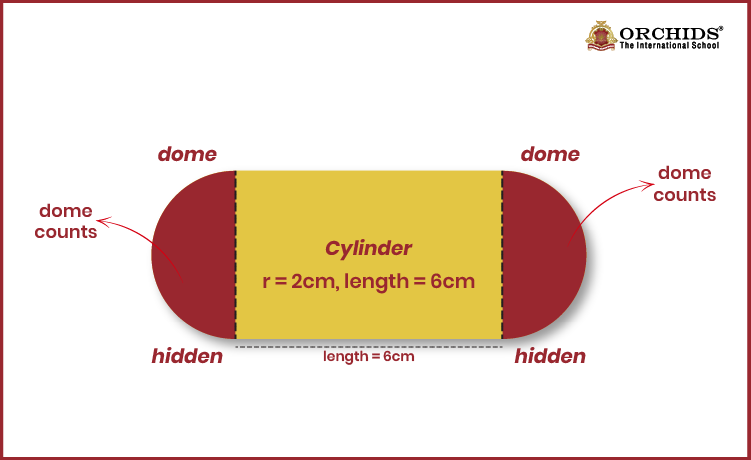
A medicine capsule is shaped like a cylinder with a hemisphere attached at each end. The radius of all three parts is two centimetres and the length of the cylindrical middle section is six centimetres. Find the total outer surface area of the capsule.
Solution:
Step 1: Identify the visible surfaces
Both flat faces of the hemispheres and both circular ends of the cylinder are hidden at the two joints. No flat faces are visible anywhere. The only visible surfaces are the curved wall of the cylinder and the two curved domes of the hemispheres.
Step 2: Simplify the two hemispheres
The two hemispheres together make one complete sphere. So instead of calculating two hemisphere surfaces separately, you can treat them as one full sphere surface. The surface area of a full sphere with radius two works out to approximately 50.27 square centimetres.
Step 3: Find the curved wall of the cylinder
The curved surface of the cylinder uses two multiplied by pi, the radius, and the length. With radius two and length six, the curved wall works out to approximately 75.40 square centimetres.
Step 4: Add the visible surfaces
Total surface area = curved wall of cylinder + surface of full sphere
Total surface area = 75.40 + 50.27
Total surface area ≈ 125.67 square centimetres
Problem 5: Solid Hemisphere on a Cube
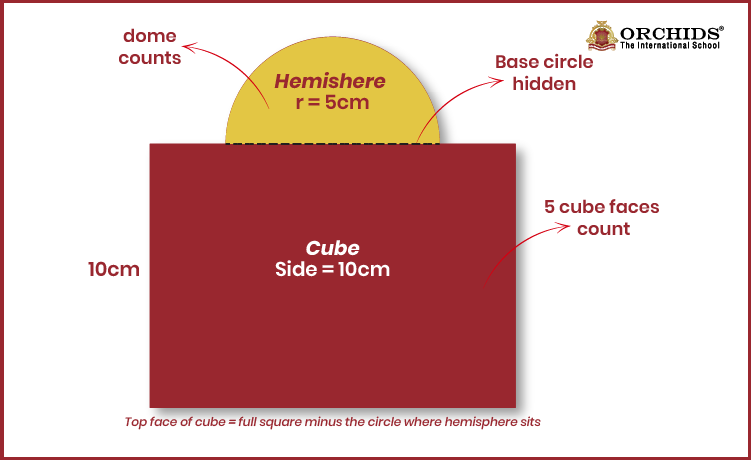
A solid hemisphere of radius five centimetres sits exactly in the centre of the top face of a cube whose side is ten centimetres. Find the total surface area of the combined solid.
Solution:
Step 1: Identify the visible surfaces
The cube has six faces. The hemisphere sits on the top face of the cube, and the circular base of the hemisphere covers a circular portion of that top face. So the top face of the cube is not a full square, it is a square with a circle removed from it. The other five faces of the cube are fully visible. The curved dome of the hemisphere is also fully visible.
Step 2: Find the five full faces of the cube
Each face of the cube is a square of side ten centimetres, which gives an area of one hundred square centimetres per face. Five full faces give a total of five hundred square centimetres.
Step 3: Find the top face of the cube (square minus circle)
The top face area = area of the square minus the area of the circle where the hemisphere sits.
Area of the square top = ten multiplied by ten = one hundred square centimetres.
Area of the circle = pi multiplied by five squared = approximately 78.54 square centimetres.
Top face area = 100 minus 78.54 = approximately 21.46 square centimetres.
Step 4: Find the curved dome of the hemisphere
The curved surface of the hemisphere uses two multiplied by pi and the radius squared. With radius five, the dome works out to approximately 157.08 square centimetres.
Step 5: Add all visible surfaces
Total surface area = five full cube faces + top face (square minus circle) + dome of hemisphere
Total surface area = 500 + 21.46 + 157.08
Total surface area ≈ 678.54 square centimetres
Numbers make sense when they're taught right. To see how Orchids The International School turns Maths from intimidating to intuitive, reach out to our admissions team.
Frequently Asked Questions on Combination of Solids: Problems and Solutions
1. What is meant by combination of solids in mathematics?
It refers to a solid formed by combining two or more basic 3D shapes like cylinders, cones, spheres, or cubes into one figure.
2. How do you solve problems on combination of solids?
Break the solid into simpler shapes, apply the correct formulas for each, and then add or subtract values based on the problem.
3. What formulas are used in combination of solids problems?
Common formulas include:
Volume of cylinder, cone, sphere, cube
Surface area formulas for each shape
These are combined depending on the structure of the solid.
4. How do you find the surface area of combined solids?
Add the surface areas of individual solids and subtract the hidden or overlapping surfaces.
5. What are common examples of combination of solids problems?
-
Cylinder with a hemisphere on top
-
Cone attached to a cylinder
-
Cube with a spherical cavity
6. Are combination of solids questions important for exams?
Yes, they are commonly asked in school exams and competitive tests.
Related Links


Admissions Open for 2026-27
What type of concept pages would you prefer?
CBSE Schools In Popular Cities
- CBSE Schools in Bangalore
- CBSE Schools in Mumbai
- CBSE Schools in Pune
- CBSE Schools in Hyderabad
- CBSE Schools in Chennai
- CBSE Schools in Gurgaon
- CBSE Schools in Kolkata
- CBSE Schools in Indore
- CBSE Schools in Sonipat
- CBSE Schools in Delhi
- CBSE Schools in Rohtak
- CBSE Schools in Bhopal
- CBSE Schools in Aurangabad
- CBSE Schools in Jabalpur
- CBSE Schools in Jaipur
- CBSE Schools in Jodhpur
- CBSE Schools in Nagpur
- CBSE Schools in Ahmednagar
- CBSE School In Tumkur











Orchids The International School is one of India's leading chains of CBSE and ICSE schools, with 130+ schools across the country.