

How to Construct a 30 Degree Angle
How to Construct a 30 Degree Angle is a simple geometry topic for students. How To Construct 30 Degree Angle helps us to draw an exact 30 degree angle using easy steps and basic tools. This topic is important because it builds a strong base in maths and improves drawing skills.
Table of Contents
- What Is a 30 Degree Angle?
- Instruments Required to Construct a 30 Degree Angle
- How to Construct a 30 Degree Angle Step by Step
- Constructing Related Angles From a 30° Angle
- Practice Questions on Construct a 30 Degree Angle
- Frequently Asked Questions on Construct a 30 Degree Angle

What Is a 30 Degree Angle?
A 30 degree angle is an acute angle that measures exactly 30°. It is exactly half of a 60° angle and one-third of a right angle (90°).
Instruments Required to Construct a 30 Degree Angle
-
A pencil
-
A ruler or straightedge (for drawing straight lines only)
-
A pair of compasses that can hold its width steady
How to Construct a 30 Degree Angle Step by Step
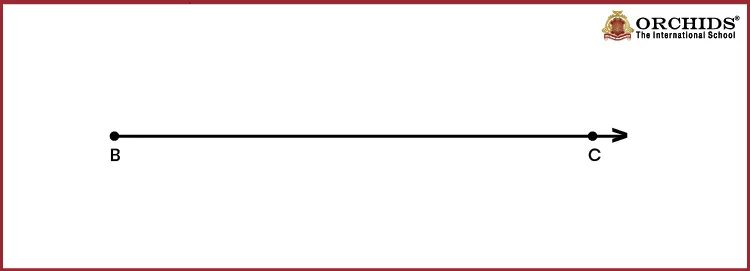
Step 1: Draw a ray BC.
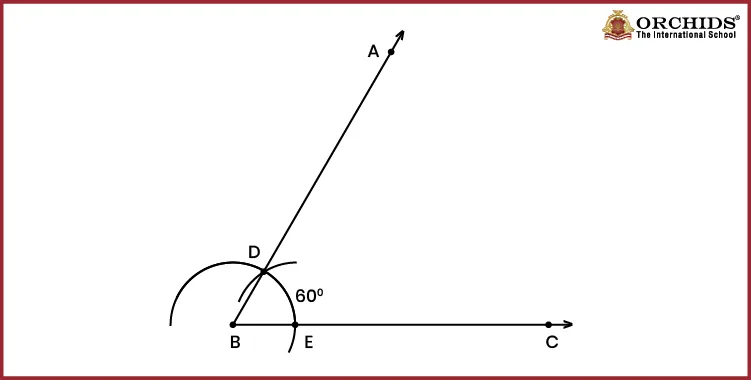
Step 2: With B as the vertex, construct ∟ABC = 60°.
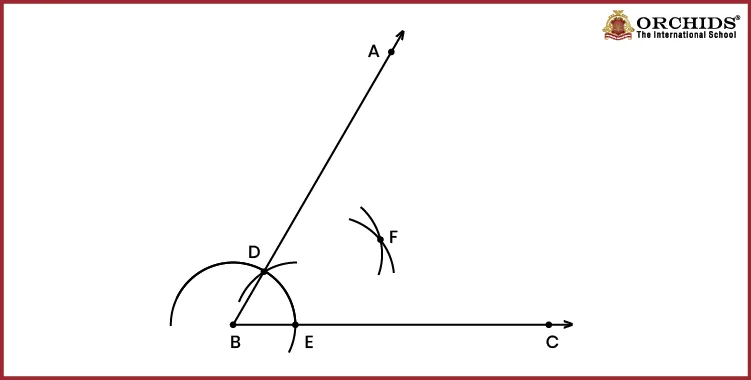
Step 3: Place the compass on point D, where the arc crosses BA, and draw an arc. Keeping the width of the compass the same, repeat for point E on the other ray BC so that the two arcs intersect at point F.
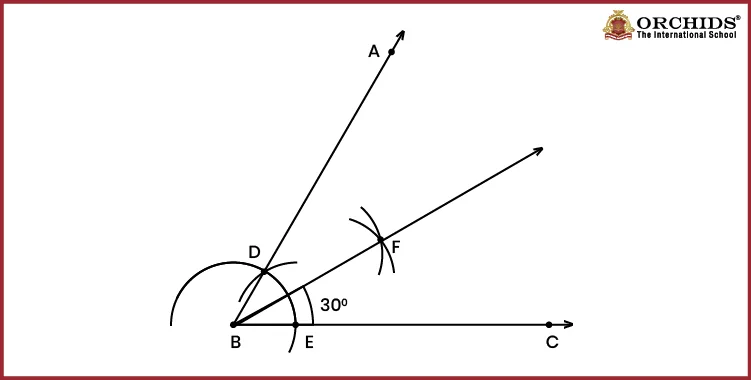
Step 4: Connect the intersection point F to vertex B to create the angle bisector. The angle FBC so obtained is of the measure 30°.
Constructing Related Angles From a 30° Angle
Once you know how to construct a 30° angle, you can use it to create several other common angles easily.
-
15°: Bisect the 30° angle. Half of 30° is 15°.
-
45°: Construct both a 30° angle and a 60° angle, then bisect the angle between them or use the standard 90°-bisector method.
-
60°: Construct a 60° angle directly using the compass before bisecting it.
-
90°: Construct a perpendicular line to form a 90° angle.
-
120°: Construct a 60° angle, then construct another 60° angle adjacent to it. Together they form 120°.
-
150°: Construct a 30° angle, then extend the base ray to form a straight line. Since a straight angle is 180°, the supplementary angle is 150° (180° − 30°).
Practice Questions on Construct a 30 Degree Angle
Q1: Which angle must be constructed FIRST
before making a 30° angle?
Answer: 60° angle.
Q2: Why do we bisect the 60° angle to get 30°?
Answer: Bisecting cuts an angle exactly in half.
Half of 60° = 30°
Q3: Is 30° an acute angle?
Answer: Yes. Acute means less than 90°.
30° < 90° → acute
Q4: What kind of triangle has angles 30°, 60°, 90°?
Answer: A 30-60-90 right triangle
Q5: Can 30° be constructed without a compass?
Answer: Only approximately (using protractor).
Exact construction requires a compass.
Q6: How many arcs are drawn in total during
the complete 30° angle construction?
Answer:
Arc 1: From A (large arc, cuts AC at P)
Arc 2: From P (same radius, meets Arc 1 at Q)
Arc 3: From P (small arc for bisection)
Arc 4: From Q (same small radius, meets Arc 3 at R)
Total = 4 arcs
Frequently Asked Questions on Construct a 30 Degree Angle
1. How do you construct a 30° angle step by step?
Draw a ray, construct a 60° angle using a compass, and then bisect the 60° angle. The bisected angle is 30°.
2. Can you construct a 30° angle without a protractor?
Yes. You can construct a 30° angle accurately using only a compass and a ruler.
3. Why do you construct a 60° angle first?
A 30° angle is half of a 60° angle, so constructing a 60° angle first makes it easy to obtain a 30° angle by bisecting it.
4. What tools are needed to construct a 30° angle?
You need a compass, ruler, and pencil.
5. How do you bisect a 60° angle to get a 30° angle?
Draw equal arcs from the two arms of the 60° angle so they intersect, then join the vertex to the intersection point. This bisects the angle into two 30° angles.
Numbers make sense when they're taught right. To see how Orchids The International School turns Maths from intimidating to intuitive, reach out to our admissions team.


Admissions Open for 2026-27
What type of concept pages would you prefer?
CBSE Schools In Popular Cities
- CBSE Schools in Bangalore
- CBSE Schools in Mumbai
- CBSE Schools in Pune
- CBSE Schools in Hyderabad
- CBSE Schools in Chennai
- CBSE Schools in Gurgaon
- CBSE Schools in Kolkata
- CBSE Schools in Indore
- CBSE Schools in Sonipat
- CBSE Schools in Delhi
- CBSE Schools in Rohtak
- CBSE Schools in Bhopal
- CBSE Schools in Aurangabad
- CBSE Schools in Jabalpur
- CBSE Schools in Jaipur
- CBSE Schools in Jodhpur
- CBSE Schools in Nagpur
- CBSE Schools in Ahmednagar
- CBSE School In Tumkur











Orchids The International School is one of India's leading chains of CBSE and ICSE schools, with 110+ schools across the country.