

DCCX Roman Numerals
DCCX Roman numerals represent the number 710. Roman numerals are an ancient number system created by the Romans, widely used in history for dates, monuments, and documents. To convert 710 into Roman numerals, we break it down into its components: 700 + 10 = 500 + 100 + 100 + 10. Using Roman symbols, this becomes D + C + C + X = DCCX. Learning to read and write numbers like 710 in Roman numerals helps students understand number patterns, addition of values, and historical number systems still used today.
Table of Contents
- How to Write DCCX Roman Numerals in Numbers?
- Numbers Related to DCCX Roman Numerals
- Solved Examples on DCCX Roman Numerals
- Practice Questions on DCCX Roman Numerals
- Conclusion
How to Write DCCX Roman Numerals in Numbers?
To understand DCCX Roman numerals in numbers, we convert each Roman symbol into its numerical value and then combine them step by step.
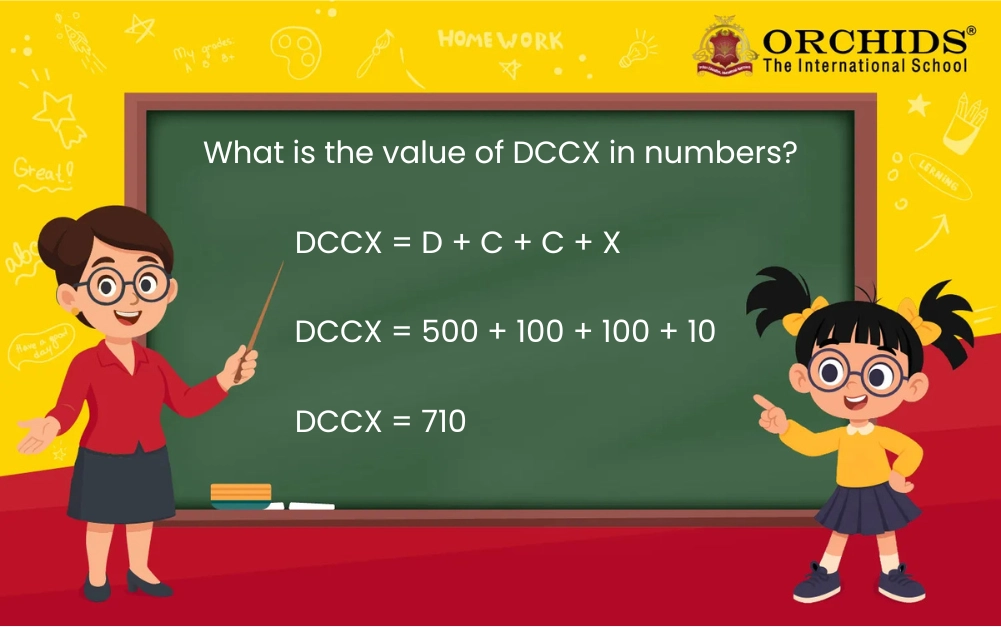
In this method, each letter in the Roman numeral DCCX is read from left to right and added together because all the values are in descending order.
-
D represents 500
-
C represents 100
-
C represents 100
-
X represents 10
Now, add all the values:
-
DCCX = 500 + 100 + 100 + 10 = 710
-
DCCX Roman numerals = 710 in numbers

Numbers Related to DCCX Roman Numerals
|
Number |
Expanded Form |
Roman Numeral Expression |
Final Roman Numeral |
|
705 |
700 + 5 |
DCC + V |
DCCV |
|
706 |
700 + 6 |
DCC + VI |
DCCVI |
|
707 |
700 + 7 |
DCC + VII |
DCCVII |
|
708 |
700 + 8 |
DCC + VIII |
DCCVIII |
|
709 |
700 + 9 |
DCC + IX |
DCCIX |
|
710 |
700 + 10 |
DCC + X |
DCCX |
|
711 |
700 + 11 |
DCC + XI |
DCCXI |
|
712 |
700 + 12 |
DCC + XII |
DCCXII |
|
713 |
700 + 13 |
DCC + XIII |
DCCXIII |
|
714 |
700 + 14 |
DCC + XIV |
DCCXIV |
|
715 |
700 + 15 |
DCC + XV |
DCCXV |
Know more about related topics:
Solved Examples on DCCX Roman Numerals
Example 1: Add 500 (D) + 210. Write the total in Roman numerals.
Solution:
-
210 = CCX
-
So, 500 + 210 = 710 = DCCX.
Example 2: If you have 1000 (M) and remove 290, what Roman numeral remains?
Solution:
-
1000 - 290 = 710 = DCCX.
Example 3: Find integers a and b such that a × b = 710 and express the product in Roman numerals (choose simple factors).
Solution:
-
71 × 10 = 710
-
71 = LXXI, 10 = X,
-
So the product is DCCX.
Example 4: A collector has 300 coins in one box and 410 coins in another. How many coins in total? Answer Roman numerals.
Solution:
-
300 + 410 = 710 = DCCX.
Example 5: Write 600 + 110 as a Roman numeral.
Solution:
-
600 = DC, 110 = CX
-
DC + CX = DCCX.
Practice Questions on DCCX Roman Numerals
1. Convert 710 into Roman numerals and explain each symbol used.
2. Write 719 in Roman numerals.
3. If DCCX = 710, what is DCCXX in numbers?
4. Add DCCX (710) and XX (20). Write the result in Roman numerals.
5. Subtract CC (200) from DCCX. What Roman numeral do you get?
Conclusion
DCCX Roman numerals represent the number 710 and are formed by combining D (500), C (100), C (100), and X (10). This numeral follows the Roman addition rule, where values are added in descending order to build larger numbers. Learning Roman numerals like DCCX helps students understand how ancient number systems worked and how numbers were recorded in history. Even today, Roman numerals are commonly used for book chapters, historical dates, monuments, and formal numbering systems.
Learn DCCX Roman numerals in a simple and student-friendly way at Orchids International School.
Numbers make sense when they're taught right. To see how Orchids The International School turns Maths from intimidating to intuitive, reach out to our admissions team.
Related Links


Admissions Open for 2026-27
What type of concept pages would you prefer?
CBSE Schools In Popular Cities
- CBSE Schools in Bangalore
- CBSE Schools in Mumbai
- CBSE Schools in Pune
- CBSE Schools in Hyderabad
- CBSE Schools in Chennai
- CBSE Schools in Gurgaon
- CBSE Schools in Kolkata
- CBSE Schools in Indore
- CBSE Schools in Sonipat
- CBSE Schools in Delhi
- CBSE Schools in Rohtak
- CBSE Schools in Bhopal
- CBSE Schools in Aurangabad
- CBSE Schools in Jabalpur
- CBSE Schools in Jaipur
- CBSE Schools in Jodhpur
- CBSE Schools in Nagpur
- CBSE Schools in Ahmednagar
- CBSE School In Tumkur











Orchids The International School is one of India's leading chains of CBSE and ICSE schools, with 110+ schools across the country.