

MCC Roman Numerals
MCC Roman numerals represent the number 1200. To convert MCC Roman numerals, we break it into components: MCC = M + CC. In Roman symbols, M equals 1000, and CC equals 200. Combining them gives MCC = M + CC = 1000 + 200 = 1200. In this article, we will explain how to convert MCC Roman numerals to Hindu-Arabic numerals that we use daily.
Table of Contents
- How to Write MCC Roman Numerals in Numbers?
- Numbers Related to MCC Roman Numerals
- Basic Rules for Writing Roman Numerals
- Solved Examples on MCC Roman Numerals
- Practice Questions on MCC Roman Numerals
- Conclusion
- Frequently Asked Questions on MCC Roman Numerals

How to Write MCC Roman Numerals in Numbers?
In this section, you will understand how to change MCC Roman numerals into their numerical value using the expansion method.
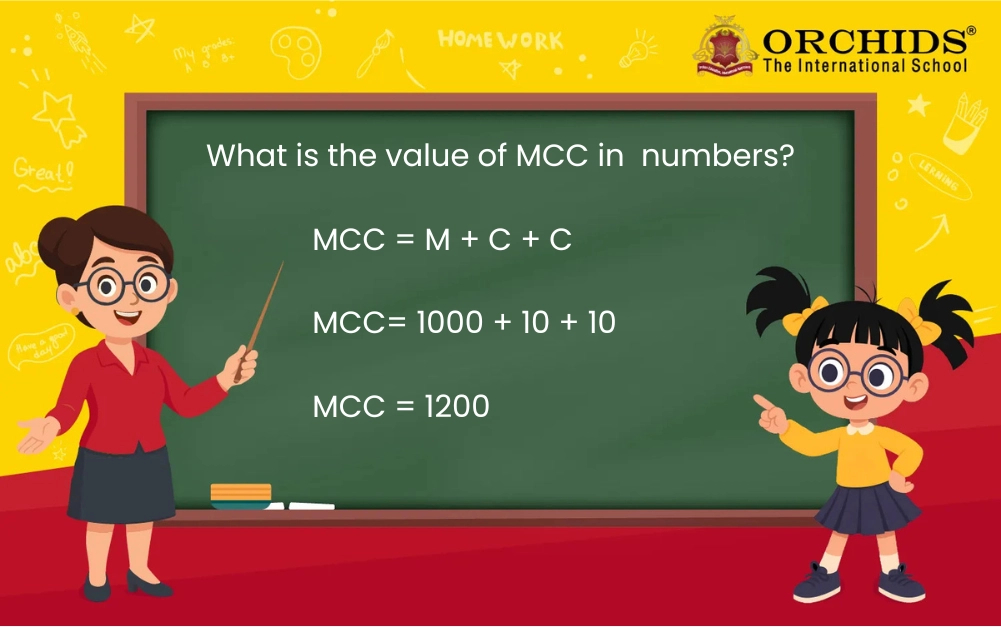
The Roman numeral MCC is formed by combining two symbols:
-
M stands for 1000
-
C stands for 100
-
MCC = M + C + C
= 1000 + 100 + 100
= 1200
So, the numerical value of the MCC Roman numerals is 1200.
Know more about related topics:
Numbers Related to MCC Roman Numerals
|
Roman Numeral |
Roman Numeral Expression |
Expanded Form |
Number |
|
MCC |
M + C + C |
1000 + 100 + 100 |
1200 |
|
MCCI |
M + C + C + I |
1000 + 100 + 100 + 1 |
1201 |
|
MCCII |
M + C + C + I + I |
1000 + 100 + 100 + 1 + 1 |
1202 |
|
MCCIII |
M + C + C + I + I + I |
1000 + 100 + 100 + 1 + 1 + 1 |
1203 |
|
MCCIV |
M + C + C + (V - I) |
1000 + 100 + 100 + (5 - 1) |
1204 |
|
MCCV |
M + C + C + V |
1000 + 100 + 100 + 5 |
1205 |
|
MCCVI |
M + C + C + V + I |
1000 + 100 + 100 + 5 + 1 |
1206 |
|
MCCVII |
M + C + C + V + I + I |
1000 + 100 + 100 + 5 + 1 + 1 |
1207 |
|
MCCVIII |
M + C + C + V + I + I + I |
1000 + 100 + 100 + 5 + 1 + 1 + 1 |
1208 |
|
MCCIX |
M + C + C + (X - I) |
1000 + 100 + 100 + (10 - 1) |
1209 |
Basic Rules for Writing Roman Numerals
-
Roman numerals use seven symbols: I, V, X, L, C, D, and M.
-
If a smaller numeral comes after a larger one, values are added (VI = 6).
-
If a smaller numeral comes before a larger one, it is subtracted (IV = 4).
-
I, X, C, and M can be repeated up to three times; V, L, and D are not repeated.
-
Roman numerals are generally written from left to right in decreasing value.
Solved Examples on MCC Roman Numerals
Example 1: Find the value of MCC Roman numerals in numbers.
Solution:
-
M = 1000, C = 100, CC = 200 (100 + 100)
-
Add them: 1000 + 200 = 1200.
MCC Roman numerals equal to 1200.
Example 2: Write 1200 in Roman numerals.
Solution:
-
Break down 1200 into 1000 + 200 = 1000 + 100 + 100
-
M = 1000, C = 100 , CC = 100 + 100 = 200
-
Combining the symbols we get 1000 + 100 + 100 = M + C + C = MCC.
The Roman numeral MCC is equal to 1200.
Example 3: Identify Roman numerals before and after MCC.
Solution: MCC Roman numerals are equal to 1200
-
Before: MCXCIX = 1199
-
After: MCCI = 1201
Example 4: What rules are used to create MCC Roman numerals?
Solution:
-
Addition rule: When symbols are written from largest to smallest, you add the values.
-
All symbols in MCC are in descending order (M > C), so addition is used throughout.
-
Repetition Rule: A numeral can be repeated up to three times in a row.
Example: CC = 100 + 100 = 200.
Example 5: Which is greater: MCC or CDXC + M?
Solution:
-
MCC = M + C + C = 1000 + 100 + 100 = 1200
-
CDXC = 400 + 90 = 490, M = 1000
-
CDXC + M = 490 + 1000 = 1490
Clearly, CDXC + M is greater than MCC
Practice Questions on MCC Roman Numerals
1. What is the value of MCC in numbers?
2. Write 1200 in Roman numerals.
3. Convert 1200 into Roman numerals using expanded form.
4. Break down MCC into thousands, hundreds, tens, and ones.
5. Write the next three Roman numerals after MCC.
6. A palace was built in the year MCC. What year is that in numbers?
Conclusion
MCC Roman numerals represent the number 1200. Roman numerals like MCC are still used in many areas today. They appear in book chapters, clock faces, movie sequels, outlines, historical events, and important ceremonies. Therefore, MCC is not just a number written differently—it represents a traditional numbering system that is still meaningful and widely used in modern society. Learning MCC and similar numerals strengthens number sense and builds a strong foundation in understanding different number systems.
Learn MCC Roman numerals in a simple and student-friendly way at Orchids International School.
Numbers make sense when they're taught right. To see how Orchids The International School turns Maths from intimidating to intuitive, reach out to our admissions team.
Frequently Asked Questions on MCC Roman Numerals
1. Why is 1200 written as Roman numeral MCC instead of other combinations?
Roman numerals are written in descending order of value unless the subtractive rule applies (e.g., 900 is CM). For 1200, you simply place two "C"s (100 each) after "M" (1000) to add them.
2. What are some common mathematical results involving MCC?
Addition: MCC + DCV = MDCCCV
Subtraction: MCC - CCLXIX = CMXXXI
Multiplication: MCC × III = MMMDC
Division: MCC ÷ IX leaves a remainder of III
3. Where is Roman numeral MCC used in modern times?
MCC (1200) is often seen in:
-
Historical dates (e.g., buildings or events around 1200 AD)
-
Numbering centuries (the 13th century starts with MCC)
-
Monuments, manuscripts, or royal records.
4. How do you write 1200 in Roman numeral using the subtractive rule?
You cannot use the subtractive rule for 1200. That rule only applies to certain pairs, such as CM (900) or CD (400). Since 1200 is made up of 1000 + 200, it must be written additively as MCC.
5. What is the square root of Roman numeral MCC ?
The Roman numeral MCC is equal to 1200. The square root of 1200 is approximately 34.64. In Roman numerals, this is roughly XXXV (35).
Related Links


Admissions Open for 2026-27
What type of concept pages would you prefer?
CBSE Schools In Popular Cities
- CBSE Schools in Bangalore
- CBSE Schools in Mumbai
- CBSE Schools in Pune
- CBSE Schools in Hyderabad
- CBSE Schools in Chennai
- CBSE Schools in Gurgaon
- CBSE Schools in Kolkata
- CBSE Schools in Indore
- CBSE Schools in Sonipat
- CBSE Schools in Delhi
- CBSE Schools in Rohtak
- CBSE Schools in Bhopal
- CBSE Schools in Aurangabad
- CBSE Schools in Jabalpur
- CBSE Schools in Jaipur
- CBSE Schools in Jodhpur
- CBSE Schools in Nagpur
- CBSE Schools in Ahmednagar
- CBSE School In Tumkur











Orchids The International School is one of India's leading chains of CBSE and ICSE schools, with 110+ schools across the country.