

MDCLXVI Roman Numerals
MDCLXVI Roman numerals represent the number 1666. Roman numerals are an ancient number system used by the Romans, where letters are used to show numerical values. In this numeral, each symbol has a specific value: M = 1000, D = 500, C = 100, L = 50, X = 10, V = 5, and I = 1. When these values are added together, we get 1666 = 1000 + 500 + 100 + 50 + 10 + 5 + 1, which forms MDCLXVI. Learning how to read and write MDCLXVI Roman numerals helps students understand how Roman symbols combine to represent numbers and improves their knowledge of historical number systems that are still seen today in clocks, book chapters, monuments, and special events.
Table of Contents
- How to Write MDCLXVI Roman Numerals in Numbers?
- Numbers Related to MDCLXVI Roman Numerals
- Basic Rules for Writing Roman Numerals
- Solved Examples on MDCLXVI Roman Numerals
- Practice Questions on MDCLXVI Roman Numerals
- Conclusion
- Frequently Asked Questions on MDCLXVI Roman Numerals

How to Write MDCLXVI Roman Numerals in Numbers?
Converting MDCLXVI into numbers can be done easily by analysing each Roman symbol and adding its value in order. This step-by-step approach makes it simple to understand how Roman numerals represent numbers.
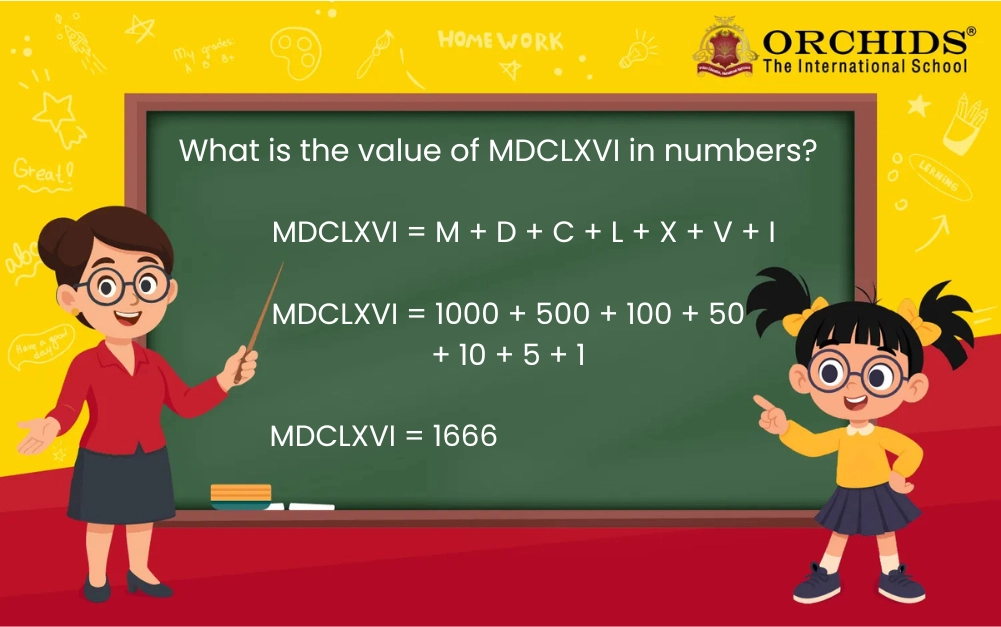
Step 1: Identify the value of each Roman numeral
-
M = 1000
-
D = 500
-
C = 100
-
L = 50
-
X = 10
-
V = 5
-
I = 1
Each symbol contributes its value to the total, and since they are arranged from largest to smallest, we will add them all.
Step 2: Combine the values
Write the numerals in addition form:
-
MDCLXVI = M + D + C + L + X + V + I
Step 3: Calculate the total
Now add all the numbers together:
-
1000 + 500 + 100 + 50 + 10 + 5 + 1 = 1666
-
MDCLXVI = 1666
Know more about related topics:
Numbers Related to MDCLXVI Roman Numerals
|
Number |
Expanded Form |
Roman Numeral Expression |
Final Roman Numeral |
|
1660 |
1000 + 500 + 100 + 50 + 10 |
M + D + C + L + X |
MDCLX |
|
1661 |
1000 + 500 + 100 + 50 + 10 + 1 |
M + D + C + L + X + I |
MDCLXI |
|
1662 |
1000 + 500 + 100 + 50 + 10 + 2 |
M + D + C + L + X + II |
MDCLXII |
|
1663 |
1000 + 500 + 100 + 50 + 10 + 3 |
M + D + C + L + X + III |
MDCLXIII |
|
1664 |
1000 + 500 + 100 + 50 + 10 + 4 |
M + D + C + L + X + IV |
MDCLXIV |
|
1665 |
1000 + 500 + 100 + 50 + 10 + 5 |
M + D + C + L + X + V |
MDCLXV |
|
1666 |
1000 + 500 + 100 + 50 + 10 + 6 |
M + D + C + L + X + VI |
MDCLXVI |
|
1667 |
1000 + 500 + 100 + 50 + 10 + 7 |
M + D + C + L + X + VII |
MDCLXVII |
|
1668 |
1000 + 500 + 100 + 50 + 10 + 8 |
M + D + C + L + X + VIII |
MDCLXVIII |
|
1669 |
1000 + 500 + 100 + 50 + 10 + 9 |
M + D + C + L + X + IX |
MDCLXIX |
|
1670 |
1000 + 500 + 100 + 50 + 10 + 10 |
M + D + C + L + X + X |
MDCLXX |
Basic Rules for Writing Roman Numerals
1. Know the Symbols: M = 1000, D = 500, C = 100, L = 50, X = 10, V = 5, I = 1
2. Largest to Smallest: Write numerals from largest to smallest. MDCLXVI = 1000 + 500 + 100 + 50 + 10 + 5 + 1
3. Subtraction Rule: Place smaller numerals before a larger one for subtraction: IV = 4, IX = 9, XL = 40, CM = 900
4. Repetition Limit: I, X, C, M can repeat up to 3 times; V, L, D cannot repeat
5. Combine Step by Step: Break the number into thousands, hundreds, tens, ones; Convert each part and combine carefully
Solved Examples on MDCLXVI Roman Numerals
Example 1: Add MDCLXVI and CMXLIV in Roman numerals.
Solution:
First, convert Roman numerals to numbers:
-
MDCLXVI = 1666
-
CMXLIV = 944
Now add the numbers:
-
1666 + 944 = 2610
Convert 2610 back to Roman numerals:
-
2610 = 2000 + 600 + 10 = MM + DC + X = MMDCLX
Answer: MDCLXVI + CMXLIV = MMDCLX
Example 2: Subtract DCCCXX from MDCLXVI
Solution:
Convert to numbers:
-
MDCLXVI = 1666
-
DCCCXX = 820
Subtract:
-
1666 − 820 = 846
Convert 846 into Roman numerals:
-
846 = 800 + 40 + 6 = DCCC + XL + VI = DCCCXLVI
Answer: MDCLXVI − DCCCXX = DCCCXLVI
Example 3: Add XXIX to MDCLXVI
Solution:
Convert Roman numerals:
-
MDCLXVI = 1666
-
XXIX = 29
Add:
-
1666 + 29 = 1695
Convert 1695 into Roman numerals:
-
1695 = 1000 + 600 + 90 + 5 = M + DC + XC + V = MDCXCV
Answer: MDCLXVI + XXIX = MDCXCV
Example 4: Find the Quotient of MDCLXVI ÷ DCLXVI
Solution:
Convert Roman numerals to numbers:
-
MDCLXVI = 1666
-
DCLXVI = 666
Divide:
-
1666 ÷ 666 = 2 (approximate quotient in whole numbers)
Convert '2' into Roman numerals:
-
2 = II
Answer: MDCLXVI ÷ DCLXVI = II
Example 5: Find the Remainder When MDCLXVI is Divided by LXX
Solution:
Convert Roman numerals to numbers:
-
MDCLXVI = 1666
-
LXX = 70
Divide 1666 by 70:
-
1666 ÷ 70 = 23 remainder 66
Convert the remainder 66 into Roman numerals:
-
66 = 50 + 10 + 5 + 1 = L + X + V + I = LXVI
Answer: The remainder when MDCLXVI is divided by LXX is LXVI
Practice Questions on MDCLXVI Roman Numerals
1. Subtract DCCLXX from MDCLXVI. Write the result in Roman numerals.
2. If you divide MDCLXVI by XXXIII, what is the quotient in Roman numerals?
3. Find the remainder when MDCLXVI is divided by LXV. Write the remainder in Roman numerals.
4. Add MDCLXVI to MDCLXVI. What is the result in Roman numerals?
5. Subtract CDXC from MDCLXVI. Express the answer in Roman numerals.
Conclusion
MDCLXVI Roman numerals represent the number 1666. By using symbols like M, D, C, L, X, V, and I, students can see how both addition and subtraction rules work in Roman numeral notation. Learning MDCLXVI helps in understanding how large numbers were written in ancient times and also allows students to read historical dates, clocks, and inscriptions with confidence.
Studying MDCLXVI Roman numerals builds maths skills and connects learners with history, making number learning engaging and practical at Orchids International School.
Numbers make sense when they're taught right. To see how Orchids The International School turns Maths from intimidating to intuitive, reach out to our admissions team.
Frequently Asked Questions on MDCLXVI Roman Numerals
1. What makes MDCLXVI unique?
MDCLXVI is special because it uses every basic Roman numeral symbol (M, D, C, L, X, V, and I) exactly once in descending order. It’s a perfect example of a “straight” sequence in Roman numerals, showing all symbols from largest to smallest without repetition.
2. How do you calculate the value of MDCLXVI?
Since the symbols are arranged from largest to smallest, we simply add their values: M (1000) + D (500) + C (100) + L (50) + X (10) + V (5) + I (1) = 1666. This is a straightforward example of the addition rule in Roman numerals.
3. What is the historical significance of the year MDCLXVI (1666)?
The year 1666 is notable in history for:
-
The Great Fire of London, which destroyed a large part of the city.
-
Isaac Newton’s “Annus Mirabilis” (Year of Wonders) was when he made groundbreaking discoveries in physics and mathematics, including gravity and calculus.
4. What is the remainder when MDCLXVI is divided by 5?
Divide 1666 by 5:
1666 ÷ 5 = 333 remainder 1
In Roman numerals, the remainder 1 is written as I.
5. What basic Roman numeral rules does MDCLXVI follow?
-
Addition Rule: Symbols are arranged from largest to smallest, so you only add values (no subtraction like IV or CM).
-
Non-repetition Rule: D, L, and V cannot be repeated, and in MDCLXVI, each symbol appears only once.
Related Links


Admissions Open for 2026-27
What type of concept pages would you prefer?
CBSE Schools In Popular Cities
- CBSE Schools in Bangalore
- CBSE Schools in Mumbai
- CBSE Schools in Pune
- CBSE Schools in Hyderabad
- CBSE Schools in Chennai
- CBSE Schools in Gurgaon
- CBSE Schools in Kolkata
- CBSE Schools in Indore
- CBSE Schools in Sonipat
- CBSE Schools in Delhi
- CBSE Schools in Rohtak
- CBSE Schools in Bhopal
- CBSE Schools in Aurangabad
- CBSE Schools in Jabalpur
- CBSE Schools in Jaipur
- CBSE Schools in Jodhpur
- CBSE Schools in Nagpur
- CBSE Schools in Ahmednagar
- CBSE School In Tumkur











Orchids The International School is one of India's leading chains of CBSE and ICSE schools, with 110+ schools across the country.