

MMXIV Roman Numerals
MMXIV Roman numerals used to represent the number 2014. In the Roman number system, numbers are written using letters such as M, D, C, L, X, V, and I. To write 2014 in Roman numerals, the number is broken into parts and then converted into its corresponding Roman numeral symbols. Here, 2000 is written as MM, 10 is written as X, and 4 is written as IV using the subtraction rule (5 − 1). When these symbols are combined, we get MMXIV. Learning how to read and write MMXIV Roman numerals helps students understand Roman numeral rules and improves their ability to recognise numbers written in this ancient system, which is still commonly seen in years, monuments, book chapters, and clocks.
Table of Contents
- How to Write MMXIV Roman Numerals in Numbers?
- Numbers Related to MMXIV Roman Numerals
- Basic Rules for Writing Roman Numerals
- Solved Examples on MMXIV Roman Numerals
- Practice Questions on MMXIV Roman Numerals
- Conclusion
- Frequently Asked Questions on MMXIV Roman Numerals

How to Write MMXIV Roman Numerals in Numbers?
To convert MMXIV Roman numerals into numbers, we follow a simple step-by-step method by identifying the value of each Roman symbol.
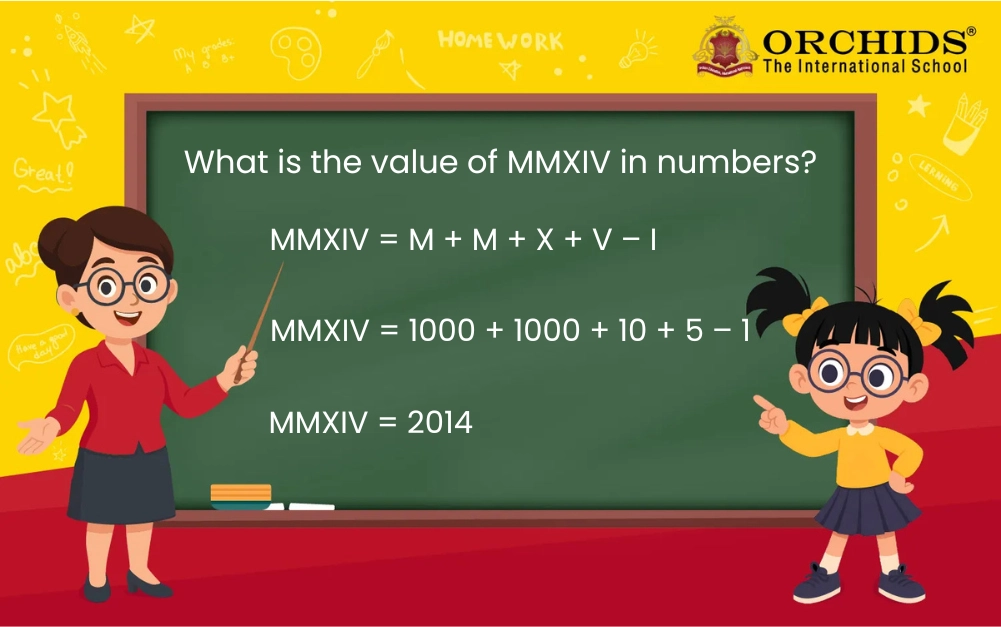
Step 1: Separate the Roman numerals into individual symbols.
MMXIV = M + M + X + V – I
Step 2: Write the numerical value for each symbol.
-
M = 1000
-
M = 1000
-
X = 10
-
IV = 4 (I before V means 5 − 1)
Step 3: Add the values together.
1000 + 1000 + 10 + 5 – 1 = 2014
Therefore, MMXIV in numbers is 2014.
Know more about related topics:
Numbers Related to MMXIV Roman Numerals
|
Roman Numerals |
Roman Numerals Expressions |
Expanded Form |
Numbers |
|
MMXI |
M + M + X + I |
1000 + 1000 + 10 + 1 |
2011 |
|
MMXII |
M + M + X + I + I |
1000 + 1000 + 10 + 1 + 1 |
2012 |
|
MMXIII |
M + M + X + I + I + I |
1000 + 1000 + 10 + 1 + 1 + 1 |
2013 |
|
MMXIV |
M + M + X + (V − I) |
1000 + 1000 + 10 + (5 − 1) |
2014 |
|
MMXV |
M + M + X + V |
1000 + 1000 + 10 + 5 |
2015 |
|
MMXVI |
M + M + X + V + I |
1000 + 1000 + 10 + 5 + 1 |
2016 |
|
MMXVII |
M + M + X + V + I + I |
1000 + 1000 + 10 + 5 + 1 + 1 |
2017 |
|
MMXVIII |
M + M + X + V + I + I + I |
1000 + 1000 + 10 + 5 + 1 + 1 + 1 |
2018 |
|
MMXIX |
M + M + X + (X − I) |
1000 + 1000 + 10 + (10 − 1) |
2019 |
|
MMXX |
M + M + X + X |
1000 + 1000 + 10 + 10 |
2020 |
Basic Rules for Writing MMXIV Roman Numerals
1. Roman numerals use fixed symbols
The main symbols are I = 1, V = 5, X = 10, L = 50, C = 100, D = 500, and M = 1000.
2. Numbers are usually added from left to right
When a smaller or equal symbol follows a larger one, the values are added. Example: MMX = 1000 + 1000 + 10 = 2010.
3. The subtraction rule is sometimes used
If a smaller numeral appears before a larger one, it is subtracted. Example: IV = 5 − 1 = 4. In MMXIV, IV represents 4.
4. Symbols cannot repeat more than three times in Roman numerals.
For example, III correctly represents 3, but IIII is not used.
5. Larger values come before smaller values
Roman numerals are usually arranged from highest to lowest value. Example: MMXIV = 1000 + 1000 + 10 + 4 = 2014.
Solved Examples on MMXIV Roman Numerals
Example 1: During a large festival, MMXIV visitors attended on the first day. On the second day, LXXXVI more visitors joined. What is the total number of visitors?
Solution:
First, convert the Roman numerals into numbers.
- MMXIV = 2014
- LXXXVI = 86
Now add the values:
- 2014 + 86 = 2100
Convert 2100 back into Roman numerals:
2100 = 2000 + 100
= MM + C
= MMC
Therefore, the total number of visitors is MMC in Roman numerals.
Example 2: A library initially had MMXIV books. Later, CXL books were removed for repair. How many books remain in the library?
Solution:
Convert the Roman numerals into numbers.
- MMXIV = 2014
- CXL = 140
Now subtract:
- 2014 − 140 = 1874
Convert 1874 into Roman numerals:
1874 = 1000 + 800 + 70 + 4
= M + DCCC + LXX + IV
= MDCCCLXXIV
Hence, the library now has MDCCCLXXIV books.
Example 3: In a school competition, Team A scored CMXL points, and Team B scored MMXIV points. What is the total score of both teams?
Solution:
Convert each Roman numeral into numbers.
- CMXL = 900 + 40 = 940
- MMXIV = 2014
Add the values:
- 940 + 2014 = 2954
Convert 2954 into Roman numerals:
2954 = 2000 + 900 + 50 + 4
= MM + CM + L + IV
= MMCMLIV
Therefore, the total score is MMCMLIV.
Example 4: In a plantation drive, volunteers planted MMXIV trees in total. Out of these, DCCL trees were planted in one park. How many trees were planted in the remaining areas?
Solution:
Convert the Roman numerals into numbers.
- MMXIV = 2014
- DCCL = 750
Now subtract:
- 2014 − 750 = 1264
Convert 1264 into Roman numerals:
1264 = 1000 + 200 + 60 + 4
= M + CC + LX + IV
= MCCLXIV
So, MCCLXIV trees were planted in the remaining areas.
Example 5: A competition had MMXIV participants. Prizes are given in groups of XX participants. After distributing prizes equally, how many participants are left without a prize group?
Solution:
First, convert the Roman numerals to numbers.
- MMXIV = 2014
- XX = 20
Now divide:
2014 ÷ 20 = 100 remainder 14
Convert 14 into Roman numerals:
14 = 10 + 4
= X + IV
= XIV
Therefore, XIV participants remain without a complete prize group.
Practice Questions on MMXIV Roman Numerals
1. Break MMXIV into its expanded numerical form.
2. Add MMXIV and X. Write the final answer in Roman numerals.
3. Subtract XIV from MMXIV and express the result in Roman numerals.
4. Which Roman symbols are used to form MMXIV?
5. Write 2019 in Roman numerals and compare it with MMXIV.
Conclusion
MMXIV Roman numerals represent the number 2014. It is formed by grouping and expanding the values as M + M + X + IV = 1000 + 1000 + 10 + 4, where IV follows the subtraction rule (5 − 1). This example shows how the Roman numeral system uses both addition and subtraction to represent numbers clearly. Learning numerals like MMXIV helps students understand number structure, recognise Roman numeral patterns, and convert numbers easily between Roman and standard forms. Roman numerals are still commonly seen in places like clocks, book chapters, movie titles, and historical dates, making them useful to learn.
Learn and understand the MMXIV Roman numerals in a simple and engaging way with step by step guidance at Orchids International School.
Numbers make sense when they're taught right. To see how Orchids The International School turns Maths from intimidating to intuitive, reach out to our admissions team.
Frequently Asked Questions on MMXIV Roman Numerals
1. What is the value of MMXIV in Roman numerals?
The Roman numeral MMXIV represents the number 2014. It is formed by combining M (1000), M (1000), X (10), and IV (4).
2. What does MMXIV mean in numbers?
To understand MMXIV Roman numerals, we expand the symbols: MMXIV = MM + X + IV = 2000 + 10 + 4 = 2014. So, the numerical value of MMXIV is 2014.
3. How do you convert MMXIV Roman numerals into numbers?
To convert MMXIV into an Arabic number, break it into parts:
M = 1000, M = 1000, X = 10, and IV = 4.
Adding them together gives 1000 + 1000 + 10 + 4 = 2014.
4. Why is 2014 written as MMXIV in Roman numerals?
In Roman numerals, 2000 is written as MM, 10 as X, and 4 as IV. When these symbols are placed together in order, they form MMXIV, which represents the number 2014.
5. Where are Roman numerals like MMXIV used today?
Roman numerals such as MMXIV are still used in many places today, including clocks, book chapters, movie titles, and important historical dates. They help represent numbers in a traditional and symbolic way.
Related Links


Admissions Open for 2026-27
What type of concept pages would you prefer?
CBSE Schools In Popular Cities
- CBSE Schools in Bangalore
- CBSE Schools in Mumbai
- CBSE Schools in Pune
- CBSE Schools in Hyderabad
- CBSE Schools in Chennai
- CBSE Schools in Gurgaon
- CBSE Schools in Kolkata
- CBSE Schools in Indore
- CBSE Schools in Sonipat
- CBSE Schools in Delhi
- CBSE Schools in Rohtak
- CBSE Schools in Bhopal
- CBSE Schools in Aurangabad
- CBSE Schools in Jabalpur
- CBSE Schools in Jaipur
- CBSE Schools in Jodhpur
- CBSE Schools in Nagpur
- CBSE Schools in Ahmednagar
- CBSE School In Tumkur











Orchids The International School is one of India's leading chains of CBSE and ICSE schools, with 110+ schools across the country.