

What are Mutually Exclusive Events in Probability: Definition and Solved Examples
Mutually exclusive events are a fundamental concept in probability that describes situations where two or more events cannot occur at the same time. In simple terms, if the occurrence of one event prevents the occurrence of another, then those events are called mutually exclusive. For example, when rolling a die, getting an even number and an odd number in a single roll are mutually exclusive events because both outcomes cannot happen together. In this guide, you will learn the definition of mutually exclusive events, how to identify them, and how to solve probability problems using clear examples. This concept is widely used in probability theory to calculate the likelihood of different outcomes and to solve real-world problems involving uncertainty.
Table of Contents
- What Are Mutually Exclusive Events?
- Mutually Exclusive Events Formula
- Venn Diagram Representation
- How to Identify and Work With Mutually Exclusive Events
- Do Mutually Exclusive Events Add up to 1?
- Mutually Exclusive vs Independent Events
- Solved Examples on Mutually Exclusive Events
- Real-Life Examples of Mutually Exclusive Events
- Frequently Asked Questions of Mutually Exclusive Events

What Are Mutually Exclusive Events?
Two events are called 'mutually exclusive' (sometimes also called 'disjoint events') when they cannot both happen at the same time. If one of them occurs, it completely rules out the possibility of the other occurring in the same trial or experiment.
Definition: Two events, A and B, are said to be mutually exclusive if their intersection is empty; that is, the events share no common outcomes. Mathematically: A ∩ B = ∅, which means P(A ∩ B) = 0.
Think about flipping a coin. You get either heads or tails, never both simultaneously. The moment heads lands, tails is impossible, and vice versa. That is mutually exclusive in its simplest form.
Know more about related topics:
Mutually Exclusive Events Formula
Let A and B be mutually exclusive events.
The probability of both A and B occurring simultaneously is zero (impossible).
P(A ∩ B) = 0
The probability of A or B occurring equals the sum of their individual probabilities.
P(A ∪ B) = P(A) + P(B)
The general addition rule is: P(A ∪ B) = P(A) + P(B) − P(A ∩ B). For mutually exclusive events, P(A ∩ B) = 0, so the last term vanishes and the formula simplifies to P(A) + P(B).
For example, In a coin toss, the probability of getting a head is P(H) and the probability of getting a tail is P(T) and both getting a head and getting a tail are mutually exclusive events.
Then,
P(H) = 0.50
P(T) = 0.50
P(H∩T) = 0
P(HUT) = P(H) + P(T) = 0.50 + 0.50 = 1
Venn Diagram Representation
The easiest way to understand mutually exclusive events is through a Venn diagram. In these events, there is no overlap between the circles because both events cannot happen at the same time.
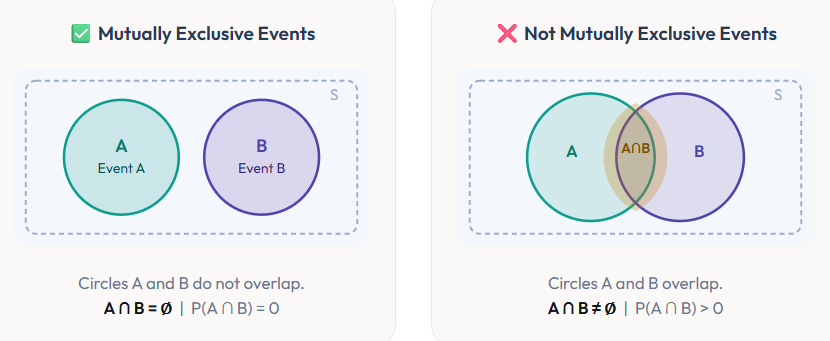
The left diagram is what mutually exclusive events always look like. Two completely separate circles inside the sample space, touching nowhere. The right diagram is what non-mutually exclusive events look like, with a shared overlap region (like Hearts and Kings in a deck of cards).
How to Identify and Work With Mutually Exclusive Events
Step-by-step approach for any problem:
Step 1: List the outcomes of each event. Write out what A contains and what B contains.
Step 2: Check for common outcomes (the intersection A ∩ B). If the intersection is empty, the events are mutually exclusive. If it has any elements, they are not.
Step 3: Choose the right formula. Mutually exclusive: P(A ∪ B) = P(A) + P(B). Not mutually exclusive: P(A ∪ B) = P(A) + P(B) − P(A ∩ B).
Step 4: Verify if your answer makes sense. P(A ∪ B) should always be between 0 and 1, and it should always be ≥ P(A) and ≥ P(B).
When to use the complementary rule: If asked for P(neither A nor B) or P(not A and not B), calculate 1 − P(A ∪ B).
Do Mutually Exclusive Events Add up to 1?
We know that mutually exclusive events cannot occur at the same time. The sum of the probabilities of mutually exclusive events can never be greater than 1. It is usually less than 1 unless the given events are also exhaustive (meaning at least one of the events must occur). In that case, the sum of their probabilities becomes exactly 1.
Mathematically, for mutually exclusive events A and B: P(A∪B)=P(A)+P(B)
If the events are both mutually exclusive and exhaustive, then:
P(A)+P(B)=1
Mutually Exclusive vs Independent Events
Mutually exclusive events with non-zero probability are actually dependent, not independent. Knowing that one occurred gives you perfect information about the other. That is the opposite of independence.
Can events be both mutually exclusive and independent?
Only in a trivial case when at least one of them has a probability of 0 (an impossible event). If P(A) > 0 and P(B) > 0, the events cannot be both mutually exclusive and independent at the same time. For mutual exclusivity: P(A ∩ B) = 0. For independence: P(A ∩ B) = P(A)·P(B) > 0. These two conditions contradict each other.
Solved Examples on Mutually Exclusive Events
Example 1: A fair six-sided die is rolled once. Event A = getting an odd number. Event B = getting an even number. Are A and B mutually exclusive? Find P(A ∪ B).
Solution: List the outcomes: Sample space S = {1, 2, 3, 4, 5, 6}
Event A = {1, 3, 5} and Event B = {2, 4, 6}
Check for overlap: A ∩ B = { } = ∅; as no number is both odd and even.
So A and B are mutually exclusive.
Calculate individual probabilities:
P(A) = 3/6 = 1/2 P(B) = 3/6 = 1/2
Apply the mutually exclusive addition rule:
P(A ∪ B) = P(A) + P(B) = 1/2 + 1/2 = 1
Yes, A and B are mutually exclusive. P(A ∪ B) = 1
Example 2: A die is rolled. Event A = getting a multiple of 2. Event B = getting a multiple of 3. Determine whether A and B are mutually exclusive.
Solution: A = multiples of 2 from {1 to 6} = {2, 4, 6}
⇒ P(A) = 3/6 = 1/2
B = multiples of 3 from {1 to 6} = {3, 6}
⇒ P(B) = 2/6 = 1/3
A ∩ B = {6}; the number 6 is in both A and B.
A and B are NOT mutually exclusive (they share outcome 6).
Example 3: A card is drawn at random from a standard deck of 52 cards. Find the probability of drawing a King or a Queen.
Solution: A card cannot be a king and a queen simultaneously.
⇒ mutually exclusive events.
P(King) = 4/52 = 1/13. P(Queen) = 4/52 = 1/13
P(King or Queen) = 1/13 + 1/13 = 2/13
P(King or Queen) = 2/13 ≈ 0.154 (about 15.4% chance)
Example 4: Events A and B are mutually exclusive. P(A) = 0.35, P(B) = 0.25. Find: (a) P(A ∪ B) (b) P(neither A nor B) (c) P(A ∩ B)
Solution: (c) By definition of mutually exclusive
P(A ∩ B) = 0
(a) P(A ∪ B) = P(A) + P(B) [mutually exclusive rule]:
= 0.35 + 0.25 = 0.60
(b) P(neither A nor B) = 1 − P(A ∪ B):
= 1 − 0.60 = 0.40
Real-Life Examples of Mutually Exclusive Events
Here are a few examples of mutually exclusive events across different contexts:
-
Flipping a Coin: A coin lands on heads or tails. It cannot be both in the same flip. P(H ∩ T) = 0.
-
Rolling a Die: Getting a 3 and getting a 5 on the same roll are mutually exclusive. A die shows exactly one face.
-
Drawing a Card: Drawing a King and drawing an Ace in a single draw are mutually exclusive.
-
Traffic Lights: A traffic light cannot show red and green simultaneously. Each colour is mutually exclusive of the others.
-
Cricket Match Result: A team either wins, loses, or draws. No two of these outcomes can happen simultaneously in the same match.
-
Turning Direction: You cannot turn left and turn right at the same moment. These are mutually exclusive actions.
-
Even & Odd Numbers: A positive integer cannot be both even and odd. The sets {2,4,6,...} and {1,3,5,...} share no elements.
Numbers make sense when they're taught right. To see how Orchids The International School turns Maths from intimidating to intuitive, reach out to our admissions team.
Frequently Asked Questions of Mutually Exclusive Events
1. What are mutually exclusive events?
Two events are mutually exclusive if they cannot both occur in the same trial or experiment. In other words, they have no outcomes in common; their intersection is empty.
2. When events A and B are mutually exclusive, then?
If events A and B are mutually exclusive, it means they cannot happen at the same time.
3. Which is an example of a mutually exclusive event?
Flipping heads and flipping tails on the same coin toss is the classic example of mutually exclusive events. You get either heads or tails, never both simultaneously.
4. How to find if two events are mutually exclusive?
Find the common outcomes of the two events.
If there are no common outcomes, they are mutually exclusive.
If there is at least one common outcome, they are not mutually exclusive.
5. What formula is used for the probability of mutually exclusive events?
For mutually exclusive events A and B: P(A ∪ B) = P(A) + P(B).
Related Links


Admissions Open for 2026-27
What type of concept pages would you prefer?
CBSE Schools In Popular Cities
- CBSE Schools in Bangalore
- CBSE Schools in Mumbai
- CBSE Schools in Pune
- CBSE Schools in Hyderabad
- CBSE Schools in Chennai
- CBSE Schools in Gurgaon
- CBSE Schools in Kolkata
- CBSE Schools in Indore
- CBSE Schools in Sonipat
- CBSE Schools in Delhi
- CBSE Schools in Rohtak
- CBSE Schools in Bhopal
- CBSE Schools in Aurangabad
- CBSE Schools in Jabalpur
- CBSE Schools in Jaipur
- CBSE Schools in Jodhpur
- CBSE Schools in Nagpur
- CBSE Schools in Ahmednagar
- CBSE School In Tumkur











Orchids The International School is one of India's leading chains of CBSE and ICSE schools, with 130+ schools across the country.