

Understanding Negative Exponents
A negative exponent indicates that we take the reciprocal of the base and then make the exponent positive. In other words, for any nonzero number a, . They are commonly used in algebra and for scientific calculations. Understanding negative exponents makes it easier to simplify expressions and solve problems involving negative powers. In this guide, you will learn the definition of negative exponents, their rules, and step-by-step methods to solve problems with clear examples.
Table of Contents
- What are Negative Exponents
- Solved Examples on Negative Exponents
- Practice Questions on Negative Exponent
- Frequently Asked Questions on Negative Exponents

What are Negative Exponents
Study the following chart:
We know the meaning of exponents with non-negative integral powers.
But what does 7−1 or 7−4 mean? That is, when the value of the power is a negative number.
We can find the values of 7−1 and 7−4 by extending the above chart.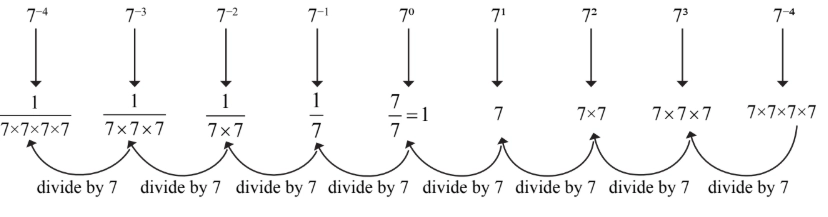
Hence, 7−1 = and 7−4 =
We can write the denominators of these numbers in exponential form as:
7−1 = and 7−4 =
Similarly, 7−2 = and 7−3 =
In general, for any non-zero number x, x−m = 1/xm also, x−m × xm = 1
Important Note: When the base is a rational number a/b, (a/b)−n = (b/a)n
Know more about related topics:
Solved Examples on Negative Exponents
Example 1: Find the multiplicative inverse of 117 .
Solution: xm and x−m are the multiplicative inverses of each other.
The multiplicative inverse of 117 is 11−7.
Example 2: Find the multiplicative inverse of 2−5 .
Solution: xm and x−m are the multiplicative inverses of each other.
The multiplicative inverse of 2⁻⁵ is 25.
Example 3: Find the multiplicative inverse of 27⁻¹⁴.
Solution: xm and x−m are the multiplicative inverses of each other.
The multiplicative inverse of 27-14 is 2714.
Practice Questions on Negative Exponent
1. Find the multiplicative inverse of
2. Find the multiplicative inverse of
3. Find the multiplicative inverse of
Numbers make sense when they're taught right. To see how Orchids The International School turns Maths from intimidating to intuitive, reach out to our admissions team.
Frequently Asked Questions on Negative Exponents
1. Does a negative exponent mean the answer is negative?
No. Negative exponents don't mean the number is negative. A negative exponent means the reciprocal (1 over) of the base raised to the positive exponent.
2. Can zero have a negative exponent?
No. Expressions like is undefined, because division by zero is not defined.
3. What is a negative exponent?
A negative exponent indicates that we take the reciprocal of the base and then make the exponent positive. In other words, for any nonzero number a,
4. What is the difference between positive and negative exponents?
A positive exponent means repeated multiplication, and negative exponents mean repeated division.
Related Links


Admissions Open for 2026-27
What type of concept pages would you prefer?
CBSE Schools In Popular Cities
- CBSE Schools in Bangalore
- CBSE Schools in Mumbai
- CBSE Schools in Pune
- CBSE Schools in Hyderabad
- CBSE Schools in Chennai
- CBSE Schools in Gurgaon
- CBSE Schools in Kolkata
- CBSE Schools in Indore
- CBSE Schools in Sonipat
- CBSE Schools in Delhi
- CBSE Schools in Rohtak
- CBSE Schools in Bhopal
- CBSE Schools in Aurangabad
- CBSE Schools in Jabalpur
- CBSE Schools in Jaipur
- CBSE Schools in Jodhpur
- CBSE Schools in Nagpur
- CBSE Schools in Ahmednagar
- CBSE School In Tumkur











Orchids The International School is one of India's leading chains of CBSE and ICSE schools, with 110+ schools across the country.