

Power of a Power Rule: Formula, Examples and Exponent Simplification
The power of a power rule is a fundamental exponent law that simplifies expressions by describing how to combine nested exponents efficiently. When an exponential expression is raised to another exponent, you multiply the exponents. It can be represented as . Understanding this rule strengthens problem-solving skills in algebraic simplification, exponential growth and decay, and computational mathematics. Power to the power rule lays a clear foundation for advanced topics such as logarithms, differential equations, and exponentiation in complex systems. In this guide, you'll learn the formal statement of the rule, step-by-step examples, and practical applications across math and science.
Table of Contents
- What is Power of a Power Rule?
- Power To the Power Rule Formula
- Why Does the Power of a Power Rule Work?
- Power Of a Power Rule With Negative Exponents
- Power Of a Power Rule With Fractional Exponents
- Solved Examples of Power of a Power Rule
- Practice Questions on Power of a Power Rule
- Related Exponents Rule
- Frequently Asked Questions of Power of a Power Rule

What is Power of a Power Rule?
The Power of a Power Rule is one of the fundamental laws of exponents used to simplify expressions involving powers raised to another power.
For example:
Here, the base x already has an exponent of 2, and the entire expression is raised to the power of 3.
Power of a Power Rule Formula: .
This means when a power is raised to another power, we multiply the exponents and keep the base unchanged.
So,
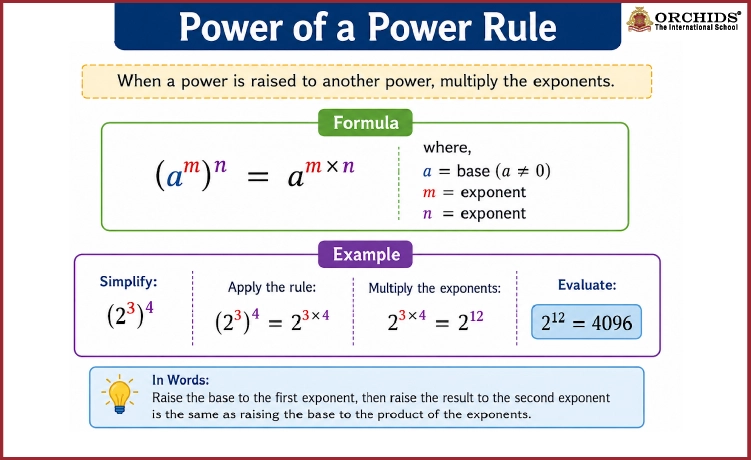
Power To the Power Rule Formula
The formula for the Power of a power rule is
Where:
-
a = base
-
m = the inner exponent, the one directly attached to the base.
-
n = the outer exponent, the one applied to the entire bracket.
Why Does the Power of a Power Rule Work?
Let's take (a²)³ and expand it step by step, using just the basic meaning of an exponent:
-
Write what the outer exponent means: (a²)³ = (a²) × (a²) × (a²)
-
Now expand each bracket: = (a × a) × (a × a) × (a × a)
-
Count all the a's being multiplied together: there are 6 of them.
-
So the result is a⁶ =
In general, (aᵐ)ⁿ means write aᵐ exactly n times and multiply. Each aᵐ contributes m copies of a, and you do that n times, giving you m × n copies of a in total. Hence, aᵐⁿ.
Let us understand it with an example. Consider
Step 1: Expand the expression
Step 2: Apply outer exponent (4 times multiplication)
Step 3: Multiply total number of 2’s
There are 3 × 4 = 12 twos i.e.,
So,
Learn more: Laws of Exponents
Power Of a Power Rule With Negative Exponents
The formula (aᵐ)ⁿ = aᵐⁿ works for all integers, positive, negative, or zero.
Negative Exponent Variants
-
(a⁻ᵐ)⁻ⁿ = aᵐⁿ
-
(a⁻ᵐ)ⁿ = a⁻ᵐⁿ
-
(aᵐ)⁻ⁿ = a⁻ᵐⁿ
For example, (x⁻³)⁴ = x⁻¹². This can also be written as 1/x¹² using the negative exponent rule.
Power Of a Power Rule With Fractional Exponents
Power of a Power Rule works the same way for fractional exponents as it does for whole-number exponents.
Multiply the numerators together, and the denominators together
For example,
Learn more: Scientific Notation
Solved Examples of Power of a Power
Example 1: Simplify (5³)⁴.
Solution: Base = 5, inner exponent = 3, outer exponent = 4.
(5³)⁴ = 53×4 = 5¹²
⇒ 5¹² = 244,140,625
Example 2: Simplify: [(x + y)³]⁴
Solution: Base = (x + y), inner exponent = 3, outer exponent = 4.
[(x + y)³]⁴ = = (x + y)¹²
Example 3: Simplify: [(x²y³)⁴]
Solution: Distribute the outer power 4 to each factor: (x²y³)⁴ =
[(x²y³)⁴] = x⁸y¹²
Example 4: Evaluate: (10⁻³)⁻⁷
Solution: −3 × (−7) = 21
(10⁻³)⁻⁷ = 10²¹
Example 5: Evaluate
Solution: Multiply the exponents: (3/2) × (2/3) = 6/6 = 1
= 4¹ = 4
Example 6: Simplify:
Solution: =
Practice Questions on Power of a Power Rule
1. Simplify: (y⁶)³
2. Evaluate: (3²)⁴
3. Simplify: (p⁻⁴)²
4. Evaluate: (2⁻³)⁻²
5. Simplify: (a^(2/5))⁵
6. Simplify: [(2x³)²]³
7. Evaluate: ((-1)²) ⁷
8. Simplify: (x²y⁴)³
9. Simplify: [(x + y)^(1/2)]⁴
10. Evaluate: (2²)³
Related Exponents Rule
| Exponent Rule | Formula | When to Use |
|---|---|---|
| Product Rule | Multiply powers with the same base. | |
| Quotient Rule | Divide powers with the same base. | |
| Power of a Power Rule | Raise one power to another power. | |
| Power of a Product Rule | Raise an entire product to a power. | |
| Power of a Quotient Rule | Raise a fraction to a power. | |
| Zero Exponent Rule | Any non-zero number raised to 0. | |
| Negative Exponent Rule | Rewrite negative exponents as reciprocals. |
The power of a power rule simplifies exponential expressions by multiplying exponents. Mastering this rule helps in solving algebra, scientific notation, and higher mathematics problems.
Frequently Asked Questions of Power of a Power Rule
1. What is the power of a power rule?
When a base raised to a power is then raised to another power, you simply multiply the two exponents and keep the base the same. For example, (x³)⁴ = x¹²
2. What is the formula for power of power?
The formula is (aᵐ)ⁿ = aᵐⁿ, where a is the base and m, n are the exponents.
3. Does the power of a power rule work for negative exponents?
Yes. Simply multiply the exponents, respecting the sign. So (a⁻³)⁴ = a⁻¹² and (a⁻²)⁻⁵ = a¹⁰.
4. What happens when the outer exponent is 0?
Any non-zero base raised to the power 0 equals 1. So (a⁵)⁰ = a⁰ = 1
5. Is the power of a power rule in NCERT Maths?
Yes. Laws of exponents, including the power of a power rule, are introduced in NCERT Class 7 Maths (Chapter: Exponents and Powers) and revisited in Class 8.
6. Can we add exponents in power of power rule?
No, exponents are multiplied.
7. Is power of power rule used in CBSE Class 8?
Yes, the power of a power rule is taught in CBSE Class 8. Students learn it as part of the chapter on exponents and powers.
The rule is:
Numbers make sense when they're taught right. To see how Orchids The International School turns Maths from intimidating to intuitive, reach out to our admissions team.


Admissions Open for 2026-27
What type of concept pages would you prefer?
CBSE Schools In Popular Cities
- CBSE Schools in Bangalore
- CBSE Schools in Mumbai
- CBSE Schools in Pune
- CBSE Schools in Hyderabad
- CBSE Schools in Chennai
- CBSE Schools in Gurgaon
- CBSE Schools in Kolkata
- CBSE Schools in Indore
- CBSE Schools in Sonipat
- CBSE Schools in Delhi
- CBSE Schools in Rohtak
- CBSE Schools in Bhopal
- CBSE Schools in Aurangabad
- CBSE Schools in Jabalpur
- CBSE Schools in Jaipur
- CBSE Schools in Jodhpur
- CBSE Schools in Nagpur
- CBSE Schools in Ahmednagar
- CBSE School In Tumkur











Orchids The International School is one of India's leading chains of CBSE and ICSE schools, with 130+ schools across the country.