

Table of 471
Table of 471 helps students learn how to multiply 471 by different numbers in a clear way. Practicing the Table of 471 makes solving large multiplication problems easier. Students can also download a free printable PDF of the Table of 471 for regular practice.
Table of 471 Chart
The Table of 471 chart displays all multiplication results of 471 in a clear format, helping students read, practise, and revise the table easily.
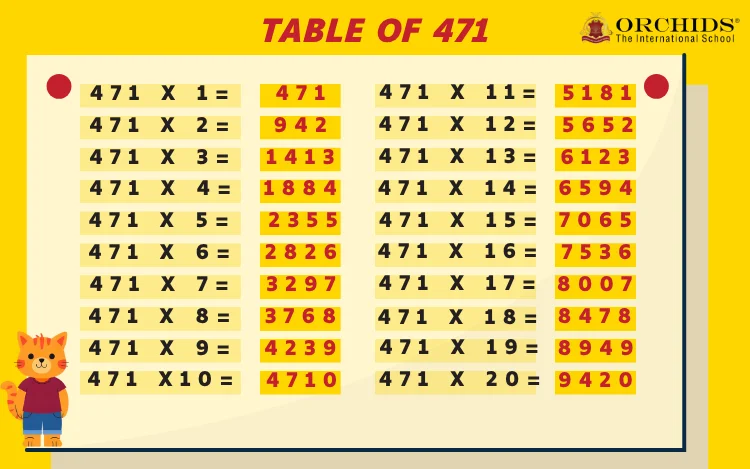

Multiplication Table of 471
The multiplication table of 471 increases by 471 with each step. Learning this table helps students understand multiplication with larger numbers and recognize number patterns. Practicing the Table of 471 improves speed and confidence when solving problems in class or exams.
| Multiplicand | Operation | Multiplier | Result | |
| 471 | x | 1 | = | 471 |
| 471 | x | 2 | = | 942 |
| 471 | x | 3 | = | 1413 |
| 471 | x | 4 | = | 1884 |
| 471 | x | 5 | = | 2355 |
| 471 | x | 6 | = | 2826 |
| 471 | x | 7 | = | 3297 |
| 471 | x | 8 | = | 3768 |
| 471 | x | 9 | = | 4239 |
| 471 | x | 10 | = | 4710 |
| 471 | x | 11 | = | 5181 |
| 471 | x | 12 | = | 5652 |
| 471 | x | 13 | = | 6123 |
| 471 | x | 14 | = | 6594 |
| 471 | x | 15 | = | 7065 |
| 471 | x | 16 | = | 7536 |
| 471 | x | 17 | = | 8007 |
| 471 | x | 18 | = | 8478 |
| 471 | x | 19 | = | 8949 |
| 471 | x | 20 | = | 9420 |
You can also download the Table of 471 as a free PDF to practice multiplication facts clearly and revise the table anytime using the link given below.
Know more about related topics:
Download PDF - Table of 471
How to read the multiplication table of 471?
To read the table of 471, begin from 471 × 1 and continue step by step up to 471 × 20. Each multiplication shows how the value increases in order. This method helps learners clearly understand the full multiplication table of 471.
471 times 1 is 471
471 times 2 is 942
471 times 3 is 1413
471 times 4 is 1884
471 times 5 is 2355
471 times 6 is 2826
471 times 7 is 3297
471 times 8 is 3768
471 times 9 is 4239
471 times 10 is 4710
471 times 11 is 5181
471 times 12 is 5652
471 times 13 is 6123
471 times 14 is 6594
471 times 15 is 7065
471 times 16 is 7536
471 times 17 is 8007
471 times 18 is 8478
471 times 19 is 8949
471 times 20 is 9420
Table of 471 in Words
The Table of 471 in words explains each multiplication result in simple sentences, helping students read and understand the table clearly.
Four hundred seventy-one times one is four hundred seventy-one
Four hundred seventy-one times two is nine hundred forty-two
Four hundred seventy-one times three is one thousand four hundred thirteen
Four hundred seventy-one times four is one thousand eight hundred eighty-four
Four hundred seventy-one times five is two thousand three hundred fifty-five
Four hundred seventy-one times six is two thousand eight hundred twenty-six
Four hundred seventy-one times seven is three thousand two hundred ninety-seven
Four hundred seventy-one times eight is three thousand seven hundred sixty-eight
Four hundred seventy-one times nine is four thousand two hundred thirty-nine
Four hundred seventy-one times ten is four thousand seven hundred ten
Four hundred seventy-one times eleven is five thousand one hundred eighty-one
Four hundred seventy-one times twelve is five thousand six hundred fifty-two
Four hundred seventy-one times thirteen is six thousand one hundred twenty-three
Four hundred seventy-one times fourteen is six thousand five hundred ninety-four
Four hundred seventy-one times fifteen is seven thousand sixty-five
Four hundred seventy-one times sixteen is seven thousand five hundred thirty-six
Four hundred seventy-one times seventeen is eight thousand seven
Four hundred seventy-one times eighteen is eight thousand four hundred seventy-eight
Four hundred seventy-one times nineteen is eight thousand nine hundred forty-nine
Four hundred seventy-one times twenty is nine thousand four hundred twenty
Table of 471 Using The Repeated Addition Method
The Table of 471 using the repeated addition method explains multiplication as adding 471 again and again. This helps students understand how the table of 471 is formed step by step.
|
Multiplication |
Repeated Addition |
Answer |
|
471 × 1 |
471 |
471 |
|
471 × 2 |
471 + 471 |
942 |
|
471 × 3 |
471 + 471 + 471 |
1413 |
|
471 × 4 |
471 + 471 + 471 + 471 |
1884 |
|
471 × 5 |
471 + 471 + 471 + 471 + 471 |
2355 |
|
471 × 6 |
471 + 471 + 471 + 471 + 471 + 471 |
2826 |
|
471 × 7 |
471 + 471 + 471 + 471 + 471 + 471 + 471 |
3297 |
|
471 × 8 |
471 + 471 + 471 + 471 + 471 + 471 + 471 + 471 |
3768 |
|
471 × 9 |
471 + 471 + 471 + 471 + 471 + 471 + 471 + 471 + 471 |
4239 |
|
471 × 10 |
471 + 471 + 471 + 471 + 471 + 471 + 471 + 471 + 471 + 471 |
4710 |
Solved Examples on the Table of 471
Example 1: A factory produces 6 machines every day. How many machines will be produced in 471 days?
Solution:
Number of machines produced in one day = 6
Total machines produced in 471 days
= 471 × 6
= 2826
Answer: The factory will produce 2826 machines in 471 days.
Example 2: A school distributes 471 notebooks to each class. If there are 8 classes, how many notebooks are distributed in total?
Solution:
Notebooks per class = 471
Total notebooks distributed
= 471 × 8
= 3768
Answer: A total of 3768 notebooks are distributed.
Example 3: A train travels 471 km in one trip. How far will it travel in 5 such trips?
Solution:
Distance covered in one trip = 471 km
Total distance covered
= 471 × 5
= 2355 km
Answer: The train will travel 2355 km in 5 trips.
Example 4: A warehouse stores 471 boxes in each section. If there are 7 sections and 200 boxes are later removed, how many boxes remain?
Solution:
Step 1: Total boxes stored
= 471 × 7
= 3297
Step 2: Boxes remaining
= 3297 − 200
= 3097
Answer: 3097 boxes remain in the warehouse.
Example 5: A shop packs items in bundles. Each bundle has 3 packets, and each packet contains 471 items. How many items are there in 4 such bundles?
Solution:
Step 1: Items in one bundle
= 3 × 471
= 1413
Step 2: Items in 4 bundles
= 1413 × 4
= 5652
Answer: There are 5652 items in total.
Learn More Multiplication Tables
Numbers make sense when they're taught right. To see how Orchids The International School turns Maths from intimidating to intuitive, reach out to our admissions team.
Frequently Asked Questions on the Table of 471
1. Why should students learn the table of 471?
Learning the table of 471 improves multiplication skills and makes it easier to work with large numbers in calculations.
2. What is 471 multiplied by 5?
From the table of 471, multiplying 471 by 5 gives 2355. That is, 471 × 5 = 2355.
3. How can the table of 471 help in quick calculations?
The table of 471 allows students to find answers faster without repeated counting, especially when solving long multiplication problems.
4. How does the table of 471 grow as numbers increase?
Each next value in the table of 471 is formed by adding 471 to the previous result, creating a consistent number pattern.
5. What is the use of the table of 471 in daily life?
The table of 471 can be useful when counting large quantities, calculating totals, or estimating values in real-life situations.
Related Links


Admissions Open for 2026-27
What type of concept pages would you prefer?
CBSE Schools In Popular Cities
- CBSE Schools in Bangalore
- CBSE Schools in Mumbai
- CBSE Schools in Pune
- CBSE Schools in Hyderabad
- CBSE Schools in Chennai
- CBSE Schools in Gurgaon
- CBSE Schools in Kolkata
- CBSE Schools in Indore
- CBSE Schools in Sonipat
- CBSE Schools in Delhi
- CBSE Schools in Rohtak
- CBSE Schools in Bhopal
- CBSE Schools in Aurangabad
- CBSE Schools in Jabalpur
- CBSE Schools in Jaipur
- CBSE Schools in Jodhpur
- CBSE Schools in Nagpur
- CBSE Schools in Ahmednagar
- CBSE School In Tumkur











Orchids The International School is one of India's leading chains of CBSE and ICSE schools, with 110+ schools across the country.