

Table of 48
Table of 48 shows how the value increases by forty-eight each time, giving students a clear idea of repeated multiplication. This table is handy for improving speed and accuracy in large-number calculations. A neatly designed Table of 48 PDF is also available for quick revision and regular practice.
Table of 48 Chart
The Table of 48 chart neatly lines up all the multiples of 48 in one place, helping students recognise the steady rise in numbers. Its clean design supports visual learning and makes memorisation simpler. Students can use this chart for fast checks while solving worksheets or practising mental maths.
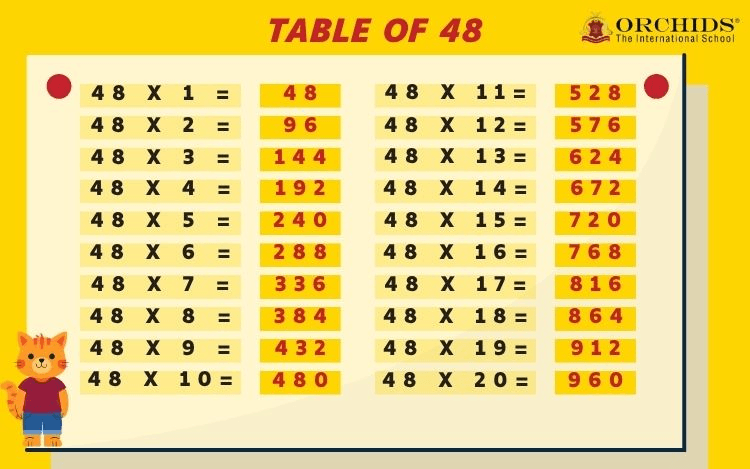

Multiplication Table of 48
The table of 48 lists all products from 48 × 1 to 48 × 20 clearly. Students can connect each multiplication with its result and notice interesting number patterns while practising. It also strengthens confidence in handling bigger numbers.
| Multiplicand | Operation | Multiplier | Result | |
| 48 | x | 1 | = | 48 |
| 48 | x | 2 | = | 96 |
| 48 | x | 3 | = | 144 |
| 48 | x | 4 | = | 192 |
| 48 | x | 5 | = | 240 |
| 48 | x | 6 | = | 288 |
| 48 | x | 7 | = | 336 |
| 48 | x | 8 | = | 384 |
| 48 | x | 9 | = | 432 |
| 48 | x | 10 | = | 480 |
| 48 | x | 11 | = | 528 |
| 48 | x | 12 | = | 576 |
| 48 | x | 13 | = | 624 |
| 48 | x | 14 | = | 672 |
| 48 | x | 15 | = | 720 |
| 48 | x | 16 | = | 768 |
| 48 | x | 17 | = | 816 |
| 48 | x | 18 | = | 864 |
| 48 | x | 19 | = | 912 |
| 48 | x | 20 | = | 960 |
Access the Table of 48 PDF to master multiplication quickly. Having this resource handy lets students practise regularly and strengthen their numerical skills effortlessly.
Know more about related topics:
Download PDF - Table of 48
How do you read the multiplication table of 48?
Begin with 48 × 1 and continue step by step to 48 × 20. With every step, the number grows by 48, forming an easy-to-follow pattern. Practising this table repeatedly helps students recall multiples faster.
48 times 1 equals 48
48 times 2 equals 96
48 times 3 equals 144
48 times 4 equals 192
48 times 5 equals 240
48 times 6 equals 288
48 times 7 equals 336
48 times 8 equals 384
48 times 9 equals 432
48 times 10 equals 480
48 times 11 equals 528
48 times 12 equals 576
48 times 13 equals 624
48 times 14 equals 672
48 times 15 equals 720
48 times 16 equals 768
48 times 17 equals 816
48 times 18 equals 864
48 times 19 equals 912
48 times 20 equals 960
Table of 48 in words
The table of 48 in words shows the product of each multiplication in full, easy-to-read words. This method makes it easier for students to visualise the sequence and internalise the growth of numbers through repeated addition.
Forty-eight times one equals forty-eight
Forty-eight times two equals ninety-six
Forty-eight times three equals one hundred forty-four
Forty-eight times four equals one hundred ninety-two
Forty-eight times five equals two hundred forty
Forty-eight times six equals two hundred eighty-eight
Forty-eight times seven equals three hundred thirty-six
Forty-eight times eight equals three hundred eighty-four
Forty-eight times nine equals four hundred thirty-two
Forty-eight times ten equals four hundred eighty
Forty-eight times eleven equals five hundred twenty-eight
Forty-eight times twelve equals five hundred seventy-six
Forty-eight times thirteen equals six hundred twenty-four
Forty-eight times fourteen equals six hundred seventy-two
Forty-eight times fifteen equals seven hundred twenty
Forty-eight times sixteen equals seven hundred sixty-eight
Forty-eight times seventeen equals eight hundred sixteen
Forty-eight times eighteen equals eight hundred sixty-four
Forty-eight times nineteen equals nine hundred twelve
Forty-eight times twenty equals nine hundred sixty
Table of 48 Using Repeated Addition
Picture 48 as a set of coins. Every time you add another set, your total increases: 48, 96, 144… Counting in this way helps learners visualise the growth of numbers and understand multiplication as repeated addition.
|
Multiplication |
Repeated Addition |
Result |
|
48 × 1 |
48 |
48 |
|
48 × 2 |
48 + 48 |
96 |
|
48 × 3 |
48 + 48 + 48 |
144 |
|
48 × 4 |
48 + 48 + 48 + 48 |
192 |
|
48 × 5 |
48 + 48 + 48 + 48 + 48 |
240 |
|
48 × 6 |
48 + 48 + 48 + 48 + 48 + 48 |
288 |
|
48 × 7 |
48 + 48 + 48 + 48 + 48 + 48 + 48 |
336 |
|
48 × 8 |
48 + 48 + 48 + 48 + 48 + 48 + 48 + 48 |
384 |
|
48 × 9 |
48 + 48 + 48 + 48 + 48 + 48 + 48 + 48 + 48 |
432 |
|
48 × 10 |
48 + 48 + 48 + 48 + 48 + 48 + 48 + 48 + 48 + 48 |
480 |
Solved Examples on Table of 48
1. A box contains 48 crayons. If a school buys 6 boxes, how many crayons do they have?
Answer: 48×6=288 crayons
2. A train travels 48 miles per hour. How far will it travel in 9 hours?
Answer: 48×9=432 miles
3. A baker prepares 48 pastries every morning. How many pastries will she prepare in 11 mornings?
Answer: 48×11=528 pastries
4. A carpenter uses 48 screws for one piece of furniture. If he makes 14 pieces of furniture, how many screws does he use?
Answer: 48×14=672 screws
5. A factory produces 48 electronic gadgets per hour. How many gadgets will they produce in 20 hours?
Answer: 48×20=960 gadgets
Learn More Multiplication Tables
Numbers make sense when they're taught right. To see how Orchids The International School turns Maths from intimidating to intuitive, reach out to our admissions team.
Frequently Asked Questions on Table of 48
1. What is the Table of 48?
The table of 48 shows all the multiples of 48 when multiplied by numbers from 1 to 20. It helps students understand how 48 grows in equal steps through multiplication.
2. What are the first ten multiples of 48?
The first ten multiples of 48 are: 48, 96, 144, 192, 240, 288, 336, 384, 432, and 480.
3. Are there any tricks to learn the table of 48 easily?
You can learn the table of 48 by using repeated addition: 48 + 48 + 48… or by noticing patterns in the last digit and tens digit. Practising the table aloud and writing it repeatedly also helps memorisation.
4. How is the table of 48 used in real life?
The table of 48 is useful in daily tasks like calculating totals, arranging items in groups of 48, or budgeting. It helps students apply multiplication in practical situations.
5. Why is the table of 48 important for learning multiplication?
The table of 48 helps students understand multiplication as repeated addition, recognise number patterns, and improve speed in mental calculations. It builds a strong foundation for more advanced math concepts.
Related Links


Admissions Open for 2026-27
What type of concept pages would you prefer?
CBSE Schools In Popular Cities
- CBSE Schools in Bangalore
- CBSE Schools in Mumbai
- CBSE Schools in Pune
- CBSE Schools in Hyderabad
- CBSE Schools in Chennai
- CBSE Schools in Gurgaon
- CBSE Schools in Kolkata
- CBSE Schools in Indore
- CBSE Schools in Sonipat
- CBSE Schools in Delhi
- CBSE Schools in Rohtak
- CBSE Schools in Bhopal
- CBSE Schools in Aurangabad
- CBSE Schools in Jabalpur
- CBSE Schools in Jaipur
- CBSE Schools in Jodhpur
- CBSE Schools in Nagpur
- CBSE Schools in Ahmednagar
- CBSE School In Tumkur











Orchids The International School is one of India's leading chains of CBSE and ICSE schools, with 110+ schools across the country.