

Table of 736
The table of 736 explains how the number 736 increases when multiplied step by step. It supports a better understanding of multiplication sequences and faster problem-solving. Learners can download the Table of 736 PDF to practise the table anytime.
Table of 736 Chart
The Table of 736 chart arranges all multiples of 736 in a simple, structured way. It allows learners to track the progression of results, understand number patterns, and practice calculations efficiently. Using this chart regularly improves speed and accuracy.
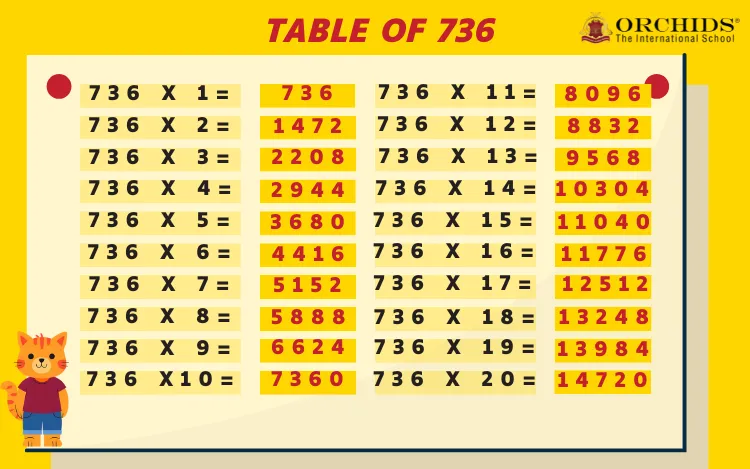

Multiplication Table of 736
The multiplication table of 736 presents the multiples of 736 in a clear, structured way. By following this table, learners can easily track the progression of numbers, develop accuracy in calculations, and apply the table in practical problem-solving.
| Multiplicand | Operation | Multiplier | Result | |
| 736 | x | 1 | = | 736 |
| 736 | x | 2 | = | 1472 |
| 736 | x | 3 | = | 2208 |
| 736 | x | 4 | = | 2944 |
| 736 | x | 5 | = | 3680 |
| 736 | x | 6 | = | 4416 |
| 736 | x | 7 | = | 5152 |
| 736 | x | 8 | = | 5888 |
| 736 | x | 9 | = | 6624 |
| 736 | x | 10 | = | 7360 |
| 736 | x | 11 | = | 8096 |
| 736 | x | 12 | = | 8832 |
| 736 | x | 13 | = | 9568 |
| 736 | x | 14 | = | 10304 |
| 736 | x | 15 | = | 11040 |
| 736 | x | 16 | = | 11776 |
| 736 | x | 17 | = | 12512 |
| 736 | x | 18 | = | 13248 |
| 736 | x | 19 | = | 13984 |
| 736 | x | 20 | = | 14720 |
Download the Table of 736 in a free PDF to practise all the multiples and improve your speed and accuracy in multiplication.
Know more about related topics:
Download the Table of 736
How Do You Read the Multiplication Table of 736?
The Table of 736 can be read by observing each multiple. By noticing how the number 736 increases consistently with each step, learners can understand the pattern and solve multiplication problems more confidently.
736 times 1 is 736
736 times 2 is 1472
736 times 3 is 2208
736 times 4 is 2944
736 times 5 is 3680
736 times 6 is 4416
736 times 7 is 5152
736 times 8 is 5888
736 times 9 is 6624
736 times 10 is 7360
736 times 11 is 8096
736 times 12 is 8832
736 times 13 is 9568
736 times 14 is 10,304
736 times 15 is 11,040
736 times 16 is 11,776
736 times 17 is 12,512
736 times 18 is 13,248
736 times 19 is 13,984
736 times 20 is 14,720
Table of 736 in Words
The Table of 736 in Words presents all multiples written out in full. This method helps learners visualise larger numbers, read them correctly, and remember the multiplication sequence more easily.
Seven hundred thirty-six times one is seven hundred thirty-six
Seven hundred thirty-six times two is one thousand four hundred seventy-two
Seven hundred thirty-six times three is two thousand two hundred eight
Seven hundred thirty-six times four is two thousand nine hundred forty-four
Seven hundred thirty-six times five is three thousand six hundred eighty
Seven hundred thirty-six times six is four thousand four hundred sixteen
Seven hundred thirty-six times seven is five thousand one hundred fifty-two
Seven hundred thirty-six times eight is five thousand eight hundred eighty-eight
Seven hundred thirty-six times nine is six thousand six hundred twenty-four
Seven hundred thirty-six times ten is seven thousand three hundred sixty
Seven hundred thirty-six times eleven is eight thousand ninety-six
Seven hundred thirty-six times twelve is eight thousand eight hundred thirty-two
Seven hundred thirty-six times thirteen is nine thousand five hundred sixty-eight
Seven hundred thirty-six times fourteen is ten thousand three hundred four
Seven hundred thirty-six times fifteen is eleven thousand forty
Seven hundred thirty-six times sixteen is eleven thousand seven hundred seventy-six
Seven hundred thirty-six times seventeen is twelve thousand five hundred twelve
Seven hundred thirty-six times eighteen is thirteen thousand two hundred forty-eight
Seven hundred thirty-six times nineteen is thirteen thousand nine hundred eighty-four
Seven hundred thirty-six times twenty is fourteen thousand seven hundred twenty
Table of 736 Using Repeated Addition
The Table of 736 can be understood clearly by seeing each multiple as 736 added repeatedly. This approach makes multiplication more concrete and helps learners remember the sequence with ease.
|
Multiplication |
Repeated Addition |
Result |
|
736 × 1 |
736 |
736 |
|
736 × 2 |
736 + 736 |
1472 |
|
736 × 3 |
736 + 736 + 736 |
2208 |
|
736 × 4 |
736 + 736 + 736 + 736 |
2944 |
|
736 × 5 |
736 + 736 + 736 + 736 + 736 |
3680 |
|
736 × 6 |
736 + 736 + 736 + 736 + 736 + 736 |
4416 |
|
736 × 7 |
736 + 736 + 736 + 736 + 736 + 736 + 736 |
5152 |
|
736 × 8 |
736 + 736 + 736 + 736 + 736 + 736 + 736 + 736 |
5888 |
|
736 × 9 |
736 + 736 + 736 + 736 + 736 + 736 + 736 + 736 + 736 |
6624 |
|
736 × 10 |
736 + 736 + 736 + 736 + 736 + 736 + 736 + 736 + 736 + 736 |
7360 |
Solved Examples on Table of 736
1. A theatre has 736 seats. How many seats are there in 4 theatres?
Solution: One theatre has 736 seats. To find the total in 4 theatres, multiply 736 × 4 = 2944. So, all 4 theatres together have 2944 seats.
2. A factory produces 736 toys per day. How many toys are made in 7 days?
Solution: Each day, 736 toys are produced. Multiply 736 × 7 = 5152 to get the total number of toys in 7 days. Therefore, 5152 toys are made.
3. A water tank holds 736 liters. How much water do 3 tanks hold?
Solution: One tank holds 736 liters. Multiply 736 × 3 = 2208 to get the total water in 3 tanks. So, the tanks hold 2208 liters of water.
4. A bookstore sells 736 books per week. How many books are sold in 5 weeks?
Solution: One week has 736 books sold. Multiply 736 × 5 = 3680 to find the total for 5 weeks. Therefore, 3680 books are sold.
5. A farmer plants 736 trees in one row. How many trees are planted in 8 rows?
Solution: Each row has 736 trees. Multiply 736 × 8 = 5888 to get the total for 8 rows. Hence, 5888 trees are planted in total.
Learn More Multiplication Tables
Numbers make sense when they're taught right. To see how Orchids The International School turns Maths from intimidating to intuitive, reach out to our admissions team.
Frequently Asked Questions on Table of 736
1. Why is the Table of 736 important?
The Table of 736 helps learners practice multiplication with larger numbers, improving both speed and accuracy. It is also useful in real-life situations such as counting seats, items, or objects in bulk.
2. How can I check my answers quickly for the Table of 736?
You can split 736 into 700 + 36 and multiply each part separately. For example, 736 × 4 = (700 × 4) + (36 × 4) = 2800 + 144 = 2944, which makes calculations easier to verify.
3. Can I use repeated addition to learn the Table of 736?
Yes, repeated addition is an effective way to understand multiplication. Adding 736 repeatedly for the required number of times gives the same result as multiplying, reinforcing the concept clearly.
4. How do I memorise the Table of 736 easily?
Observe the pattern in the results as you multiply 736 by 1, 2, 3, and so on. Practising in small steps and grouping numbers into hundreds and tens helps in easier memorisation.
5. Where can the Table of 736 be applied in daily life?
It is useful for calculating totals in multiple rows, boxes, or containers. It also helps in budgeting, distributing resources, and planning events involving large numbers.
Related Links


Admissions Open for 2026-27
What type of concept pages would you prefer?
CBSE Schools In Popular Cities
- CBSE Schools in Bangalore
- CBSE Schools in Mumbai
- CBSE Schools in Pune
- CBSE Schools in Hyderabad
- CBSE Schools in Chennai
- CBSE Schools in Gurgaon
- CBSE Schools in Kolkata
- CBSE Schools in Indore
- CBSE Schools in Sonipat
- CBSE Schools in Delhi
- CBSE Schools in Rohtak
- CBSE Schools in Bhopal
- CBSE Schools in Aurangabad
- CBSE Schools in Jabalpur
- CBSE Schools in Jaipur
- CBSE Schools in Jodhpur
- CBSE Schools in Nagpur
- CBSE Schools in Ahmednagar
- CBSE School In Tumkur











Orchids The International School is one of India's leading chains of CBSE and ICSE schools, with 110+ schools across the country.