

Vertically Opposite Angles
When two lines intersect each other at a point, four angles are formed. The angles that are opposite to each other are called 'vertically opposite angles'. Understanding the concept of vertically opposite angles helps in solving questions related to angles, intersecting lines, parallel lines cut by a transversal, and other geometrical concepts. In this guide, we will learn the definition of vertically opposite angles, their properties, and related examples to build a strong understanding of the concept.
Table of Contents
- What are Vertically Opposite Angles
- Vertically Opposite Angles Theorem
- Solved Examples on Vertically Opposite Angles
- Frequently Asked Questions on Vertically Opposite Angles

What are Vertically Opposite Angles
Vertically opposite angles are pairs of angles formed opposite to each other when two straight lines intersect at a point. They share a common vertex and are always equal in measure.
Vertically opposite angles are always equal.
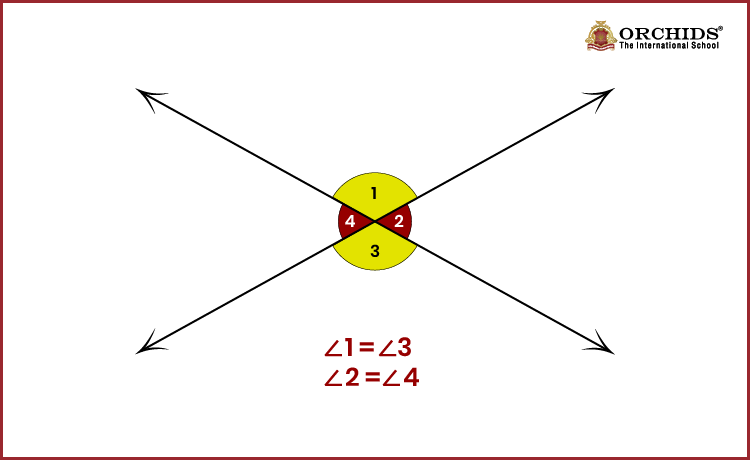
In the above figure the two lines intersecting each other have formed four angles, ∠1, ∠2, ∠3 and ∠4.
-
∠1 and ∠3 are vertically opposite angles.
-
∠2 and ∠4 are vertically opposite angles.
-
∠1 = ∠3
-
∠2 = ∠4
-
∠ 1 + ∠ 2 = 180 (linear pair)
-
∠3 + ∠4 = 180 (linear pair)
-
∠1 + ∠2 + ∠3 + ∠4 = 360
Know more about related topics:
Vertically Opposite Angles Theorem
Theorem: When two lines intersect each other, then the vertically opposite angles are congruent (equal).
Proof:
∠1 + ∠2 = 180° (∵ linear pair of angles adds up to 180°) --------- (1)
∠1 + ∠4 = 180° (∵ linear pair of angles adds up to 180°) --------- ( 2)
From equations (1) and (2), ∠1 + ∠2 = 180° = ∠1 +∠4.
∴ 180° = ∠1 + ∠2 = ∠1 +∠4
∠1 + ∠2 = ∠1 +∠4. --------(3)
By eliminating ∠1 on both sides of the equation (3), we get ∠2 = ∠4.
Similarly. We can prove that ∠1 = ∠3.
∴ We conclude that vertically opposite angles are equal when two straight lines intersect.
Solved Examples on Vertically Opposite Angles.
Example 1: Two lines intersect at a point. One of the angles formed is 95°. Find the vertically opposite angle.
Solution: Vertically opposite angles are equal in measure.
∴ The measure of the vertically opposite angle = 95°.
Example 2: Two lines intersect each other at point O. If one angle is 120°. Find the value of all four angles.
Solution: The measure of one angle is 120°.
∴ The angle vertically opposite to the given angle is also 120°.
The remaining two angles will be 60° each since they form a linear pair with the 120° angles.
Example 3: Two lines intersect, forming angles (3x + 10)° and (5x - 30)°, which are vertically opposite. Find the value of x.
Solution: Vertically opposite angles are always equal.
∴ (3x + 10) ° = (5x - 30) °
10 + 30 = 5x - 3x
40 = 2x
X = 20.
Numbers make sense when they're taught right. To see how Orchids The International School turns Maths from intimidating to intuitive, reach out to our admissions team.
Frequently Asked Questions on Vertically Opposite Angles
1. Are vertically opposite angles always equal?
Yes. Vertically opposite angles are always equal.
2. Do vertically opposite angles add up to 180°?
No. The sum of vertically opposite angles need not always be 180°. This happens only when the measure of the pair of vertical angles is 90°.
3. Are all opposite angles vertical angles?
No, all opposite angles are not vertically opposite. Vertically opposite angles are formed when two straight lines intersect each other.
4. Can vertically opposite angles be complementary?
Yes. Vertically opposite angles can be complementary when the measure of each angle is 45°.
Related Links


Admissions Open for 2026-27
What type of concept pages would you prefer?
CBSE Schools In Popular Cities
- CBSE Schools in Bangalore
- CBSE Schools in Mumbai
- CBSE Schools in Pune
- CBSE Schools in Hyderabad
- CBSE Schools in Chennai
- CBSE Schools in Gurgaon
- CBSE Schools in Kolkata
- CBSE Schools in Indore
- CBSE Schools in Sonipat
- CBSE Schools in Delhi
- CBSE Schools in Rohtak
- CBSE Schools in Bhopal
- CBSE Schools in Aurangabad
- CBSE Schools in Jabalpur
- CBSE Schools in Jaipur
- CBSE Schools in Jodhpur
- CBSE Schools in Nagpur
- CBSE Schools in Ahmednagar
- CBSE School In Tumkur











Orchids The International School is one of India's leading chains of CBSE and ICSE schools, with 110+ schools across the country.