

I Wandered Lonely as a Cloud: Full Poem, Summary and Poetic Devices for Students
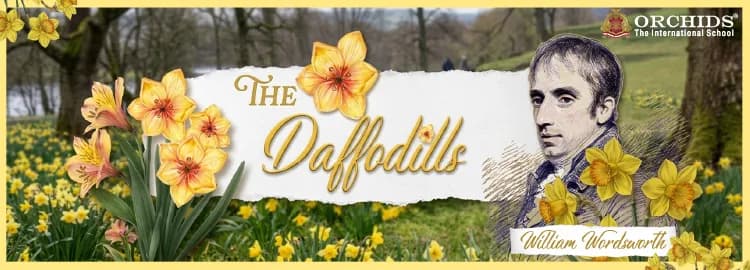
In April 1802, on a windy afternoon beside Ullswater in England’s Lake District, William Wordsworth and his sister Dorothy turned a corner on their walk and found themselves looking at a shoreline thick with daffodils, thousands of them, tossing and glittering in the wind off the lake. Dorothy wrote about it in her journal that evening. Two years later, her brother turned the same memory into I Wandered Lonely as a Cloud, a poem so widely read and so often recited that few pieces of English verse have travelled as far beyond the classroom.
What makes the poem endure is not its plot, since almost nothing happens in it. A man walks, sees flowers and walks on. Its power lies instead in what the moment becomes afterwards, once the walker is home, alone, and finds that the memory of the daffodils has stayed with him and continues to lift his spirits long after the flowers themselves have faded. This page sets out the complete poem, the story behind it, a clear I Wandered Lonely as a Cloud summary, its central poetic devices and the deeper ideas Wordsworth was reaching for, along with FAQs.
Table of Contents
- I Wandered Lonely as a Cloud: The Full Poem
- Synopsis of I Wandered Lonely as a Cloud
- Poetic Devices at Work in the Poem
- Themes and the Idea at the Heart of the Poem
- Frequently Asked Questions about 'I Wandered Lonely as a Cloud' Poem
I Wandered Lonely as a Cloud: The Full Poem
by William Wordsworth
I wandered lonely as a cloud
That floats on high o'er vales and hills,
When all at once I saw a crowd,
A host, of golden daffodils;
Beside the lake, beneath the trees,
Fluttering and dancing in the breeze.
Continuous as the stars that shine
And twinkle on the milky way,
They stretched in never-ending line
Along the margin of a bay:
Ten thousand saw I at a glance,
Tossing their heads in sprightly dance.
The waves beside them danced; but they
Out-did the sparkling waves in glee:
A poet could not but be gay,
In such a jocund company:
I gazed - and gazed - but little thought
What wealth the show to me had brought:

For oft, when on my couch I lie
In vacant or in pensive mood,
They flash upon that inward eye
Which is the bliss of solitude;
And then my heart with pleasure fills,
And dances with the daffodils.
Who Wrote I Wandered Lonely as a Cloud
The question of who wrote I Wandered Lonely as a Cloud has a clear answer, but the more interesting story is how it came to be written. William Wordsworth composed the poem in 1804, drawing on a walk he had taken with his sister Dorothy two years earlier near Glencoyne Bay on the shore of Ullswater. It first appeared in print in 1807, in his collection Poems, in Two Volumes, and Wordsworth later reworked it slightly for the final version most readers know today, published in 1815.
Synopsis of I Wandered Lonely as a Cloud
A short synopsis of I Wandered Lonely as a Cloud runs as follows. A man walking alone, likened in the very first line to a drifting cloud, comes upon a great stretch of daffodils growing beside a lake. The flowers seem almost alive, nodding and dancing in numbers too vast to count easily, stretching further than the eye can comfortably follow along the shoreline. The man watches, pleased by the sight, though at the time he barely registers how much this particular memory is worth to him.
It is only afterwards, lying at home in an idle or a low mood, that the full value of the moment reveals itself. The daffodils return to his mind uninvited, and the memory alone is enough to lift him out of whatever flat or heavy mood he was in. This is the heart of any honest I Wandered Lonely as a Cloud summary: a poem about a flower field on the surface, and underneath that, a poem about how the mind keeps gifts that the moment itself could not fully appreciate.
Why the Poem is also Known as Daffodils
Though the poem has no title beyond its opening line, it is also known as 'Daffodils' in almost every anthology and classroom where it is taught, and the alternative name has stuck for good reason. The daffodils are not decoration in this poem; they are its entire subject, its source of energy and the image the speaker returns to in the final stanza. Calling it the Daffodils poem simply names what the poem is actually about, in a way the original first line does not.
A Daffodils poem summary, therefore, tells the same story as the synopsis above. It begins with a lonely walker, moves through an almost overwhelming field of golden flowers beside a lake and ends with the realisation that this single sighting has become a private store of joy the speaker can draw on whenever solitude turns heavy rather than peaceful. Students searching under either title, I Wandered Lonely as a Cloud or Daffodils, will find themselves reading the very same poem.
Stanza-by-Stanza Summary
Stanza 1: A Chance Encounter
The speaker opens by comparing his solitary wandering to a cloud drifting over valleys and hills, a comparison that sets the tone of quiet, aimless movement. Without warning, he comes across a great crowd of golden daffodils beside a lake, fluttering and dancing beneath the trees in the wind.
Stanza 2: A Field without Wind
The daffodils are likened to the stars of the Milky Way, continuous and countless, stretching in what feels like an unbroken line along the edge of the bay. The speaker guesses there were ten thousand flowers in view at once, all tossing their heads in a lively, almost playful dance.
Stanza 3: Outshining the Lake itself
Even the waves of the lake seem to dance nearby, yet the daffodils outdo them in sheer liveliness and joy. The speaker, describing himself directly as a poet, admits he could not help feeling cheerful in such company, though he watches the scene without yet understanding how precious this particular memory will turn out to be.
Stanza 4: The Gift Revealed Later
The final stanza shifts forward in time to a quieter moment at home, where the speaker lies on his couch in an empty or a thoughtful mood. The daffodils flash back into his mind unbidden, and that flicker of memory alone is enough to fill his heart with pleasure so that it dances along with the daffodils all over again.
Poetic Devices at Work in the Poem
- Simile: The poem opens on a simile, comparing the speaker himself to a cloud drifting across the sky, which establishes the gentle, unhurried mood that carries through the rest of the poem.
- Personification: The daffodils are treated almost as living company throughout: they flutter, dance, toss their heads and form what the speaker calls a jocund company, giving the flowers a human sense of joy and movement.
- Imagery: Wordsworth builds the poem on strong visual imagery, particularly the gold of the daffodils against the dark water and trees and the comparison of the flowers to stars scattered along the Milky Way.
- Hyperbole: The claim of seeing ten thousand daffodils at a single glance is a deliberate exaggeration, used to suggest just how overwhelming and seemingly endless the field of flowers appeared to the speaker.
- Alliteration: Soft repeated sounds run through phrases such as fluttering and dancing, giving certain lines a musical quality that echoes the swaying movement they describe.
- Rhyme Scheme and Metre: The poem is built from four sestets, each following an ABABCC rhyme scheme, and is written largely in iambic tetrameter, a steady rising and falling rhythm that mirrors the gentle swaying of the flowers themselves.
Themes and the Idea at the Heart of the Poem
At its core, the poem is about the way nature can quietly restore a person’s spirits long after the original moment has passed. A brief, almost accidental encounter with beauty becomes something the mind can return to and draw strength from, an idea closely tied to what Wordsworth elsewhere called spots of time, moments from the past that retain the power to comfort and renew us.
The poem also reshapes how we usually think about solitude. It opens with loneliness, framed through the image of a single drifting cloud, yet by its final stanza solitude has become something the speaker calls blissful, since it is precisely in being alone that the memory of the daffodils returns most vividly. Running underneath both ideas is a quiet meditation on memory and imagination, on how the mind does not simply store a moment but can relive its pleasure, sometimes more fully the second time, through nothing more than the act of remembering.
Frequently Asked Questions about ‘I Wandered Lonely as a Cloud’ Poem
1. Who wrote I Wandered Lonely as a Cloud?
William Wordsworth wrote the poem, first publishing it in 1807 and later revising it for his 1815 collection.
2. What is the rhyme scheme of the poem ‘I Wandered Lonely as a Cloud’?
The poem follows an ABABCC rhyme scheme across four six-line stanzas, written mostly in iambic tetrameter.
3. What type of poem is I Wandered Lonely as a Cloud?
It is a Romantic lyric poem celebrating nature’s quiet power to restore the mind, built around a single remembered scene rather than a developing story.
Admissions Open for 2026-27
More Poems
We hope this was useful for your child's learning journey. To explore more about what Orchids The International School has to offer, get in touch with our admissions team.
Popular Searches
- NCERT Solutions for Class 1 subjects
- NCERT Solutions for Class 2 subjects
- NCERT Solutions for Class 3 subjects
- NCERT Solutions for Class 4 subjects
- NCERT Solutions for Class 5 subjects
- CBSE School In Aurangabad
- CBSE Schools In Bangalore
- CBSE School In Bhopal
- CBSE Schools In Chennai
- CBSE Schools In Delhi
- Best CBSE Schools In Gurgaon
- CBSE School In Hyderabad
- CBSE School In Indore
- CBSE School In Jabalpur
- CBSE Schools In Jaipur
- CBSE Schools In Kolkata
- CBSE Schools In Mumbai
- CBSE Schools In Nagpur
- CBSE Schools In Pune
- Top CBSE School In Rohtak
- Best CBSE Schools In Sonipat











Orchids The International School is one of India's leading chains of CBSE and ICSE schools, with 110+ schools across the country.