

Our Casuarina Tree: Full Poem, Summary and Poetic Devices of Toru Dutt’s Autobiographical Verses
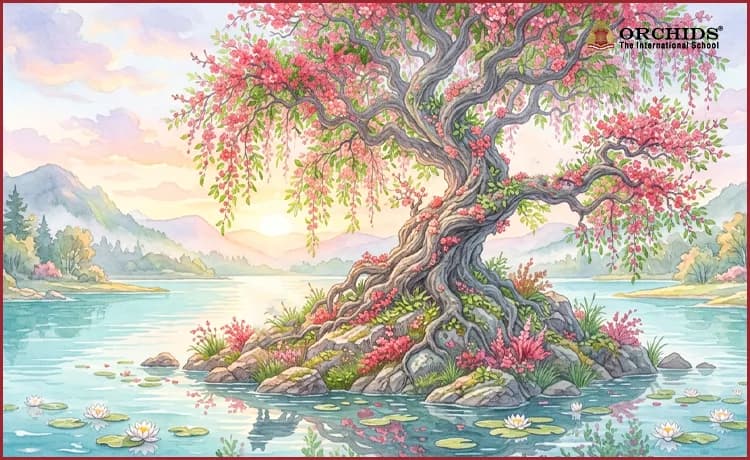
In the garden of a family home in Baugmaree, near Calcutta, stood a tall casuarina tree wrapped in a giant creeper; its branches hung with crimson flowers and were crowded with birds. For Toru Dutt, the tree was not simply a striking feature of the family garden but a living link to a childhood she shared with siblings who did not live to grow old alongside her. Our Casuarina Tree is her tribute to that single tree, written with such tenderness that the poem has become one of the most studied pieces of Indian English poetry of the nineteenth century.
What begins as a detailed, almost painterly description of a tree quietly turns into something far more personal. By the second half of the poem, the tree itself becomes a mourner, its sound compared to a lament carried across distant shores, and Dutt asks that it be remembered forever as a kind of living monument to those she has lost. This page sets out the complete poem, a stanza wise and line by line explanation, its tone, the kind of poem it is, its central poetic devices and the deeper themes running beneath its surface, along with FAQs.
Table of Contents
- Our Casuarina Tree: The Full Poem
- Our Casuarina Tree Summary
- Poetic Devices Used in the Poem Our Casuarina Tree
- Our Casuarina Tree: Themes and the Idea
- Frequently Asked Questions about Our Casuarina Tree
Our Casuarina Tree: The Full Poem
by Toru Dutt
Like a huge Python, winding round and round
The rugged trunk, indented deep with scars,
Up to its very summit near the stars,
A creeper climbs, in whose embraces bound
No other tree could live. But gallantly
The giant wears the scarf, and flowers are hung
In crimson clusters all the boughs among,
Whereon all day are gathered bird and bee;
And oft at nights the garden overflows
With one sweet song that seems to have no close,
Sung darkling from our tree, while men repose.
When first my casement is wide open thrown
At dawn, my eyes delighted on it rest;
Sometimes, and most in winter, on its crest
A gray baboon sits statue-like alone
Watching the sunrise; while on lower boughs
His puny offspring leap about and play;
And far and near kokilas hail the day;
And to their pastures wend our sleepy cows;
And in the shadow, on the broad tank cast
By that hoar tree, so beautiful and vast,
The water-lilies spring, like snow enmassed.
But not because of its magnificence
Dear is the Casuarina to my soul:
Beneath it we have played; though years may roll,
O sweet companions, loved with love intense,
For your sakes, shall the tree be ever dear.
Blent with your images, it shall arise
In memory, till the hot tears blind mine eyes!
What is that dirge-like murmur that I hear
Like the sea breaking on a shingle-beach?
It is the tree's lament, an eerie speech,
That haply to the unknown land may reach.
Unknown, yet well-known to the eye of faith!
Ah, I have heard that wail far, far away
In distant lands, by many a sheltered bay,
When slumbered in his cave the water-wraith
And the waves gently kissed the classic shore
Of France or Italy, beneath the moon,
When earth lay trancèd in a dreamless swoon:
And every time the music rose, before
Mine inner vision rose a form sublime,
Thy form, O Tree, as in my happy prime
I saw thee, in my own loved native clime.
Therefore I fain would consecrate a lay
Unto thy honor, Tree, beloved of those
Who now in blessed sleep for aye repose,
Dearer than life to me, alas, were they!
Mayst thou be numbered when my days are done
With deathless trees, like those in Borrowdale,
Under whose awful branches lingered pale
"Fear, trembling Hope, and Death, the skeleton,
And Time the shadow"; and though weak the verse
That would thy beauty fain, oh, fain rehearse,
May Love defend thee from Oblivion's curse.

Who Wrote Our Casuarina Tree
Our Casuarina Tree by Toru Dutt summary discussions usually begin with the poet herself, since the poem cannot really be separated from her short and remarkable life. Toru Dutt was born in 1856 into a Bengali Christian family in Calcutta and died at the age of just twenty-one, yet in that brief span she became one of the earliest Indian poets to write in English and one of the first Indian women to publish poetry in French as well. The casuarina tree of the poem stood in the garden of Baugmaree, her family’s ancestral home, and was a real and much-loved feature of her childhood.
The poem was published posthumously in 1882 in her collection Ancient Ballads and Legends of Hindustan, after Dutt had already lost two siblings, her sister Aru and her brother Abju, to illness while still young. That loss sits quietly beneath nearly every stanza of the poem, even as it opens with what looks like a simple, admiring description of a tree.
What Kind of Poem is Our Casuarina Tree
Readers often ask what kind of poem is Our Casuarina Tree, and the most accurate answer is that it is an ode, a poem of sustained praise and reflection addressed to a single subject, in this case a tree that has come to stand for childhood, companionship and loss. It belongs to the elegiac tradition as well, since much of its emotional weight comes from mourning people who have died rather than simply describing nature for its own sake.
The poem is written in five stanzas of eleven lines each, mostly in iambic pentameter, and shows clear influence from English Romantic poets such as Wordsworth, whose poem on the yew trees of Borrowdale is directly quoted near the end. At the same time, the poem is rooted firmly in an Indian setting, with its casuarina tree, kokilas and tank of water lilies, making it an early and important example of Indian poetry written in English that blends a colonial literary form with deeply personal, local subject matter.
What is the Tone of the Poem Our Casuarina Tree
The question of what is the tone of the poem Our Casuarina Tree is best answered by tracking how the mood shifts across its five stanzas. The opening two stanzas are warm and admiring, almost celebratory, as the speaker lingers happily over the tree’s appearance and the busy life of birds and animals around it. From the third stanza onwards, the tone turns gradually more sombre, shaped by grief for lost companions, until it becomes openly mournful and elegiac in the final two stanzas.
By the close of the poem, the tone has settled into something between sorrow and quiet hope, as the speaker moves from personal grief towards a wish for the tree’s lasting remembrance. This blend of nostalgic affection, deep grief and a final note of hope for permanence is what gives the poem its distinctive emotional register, setting it apart from poems that are either purely descriptive or purely mournful.
Our Casuarina Tree Summary
A clear Our Casuarina Tree summary in English can be given in a few sentences, though the poem rewards a slower reading. The poem opens by describing a tall casuarina tree wound about by a giant creeper, its branches filled with crimson flowers, birdsong and a great grey baboon watching the sunrise from its crest. Beneath the tree lies a broad tank where water lilies grow in the tree's shadow, completing a picture of natural abundance and quiet beauty.
The poem then turns away from description towards memory. The speaker explains that the tree is not dear to her because of its grandeur but because of the companions with whom she once played beneath it, companions now dead, whose images remain bound up with the tree forever. A mournful sound from the tree, compared to waves breaking on a shore, becomes a lament that the speaker says she has heard echoed in distant lands across the sea. The poem closes with a wish that the tree itself be remembered and protected from being forgotten, much as ancient yew trees in England's Borrowdale have been kept alive in verse and memory long after the people who once stood beneath them are gone.
Our Casuarina Tree Summary Stanza Wise
Stanza 1: The Tree and Its Creeper
The poem opens with a vivid simile comparing the creeper wound around the tree to a huge python coiling round a scarred trunk. The tree is described as wearing this creeper almost like a decorative scarf, its boughs hung with crimson flowers that draw birds and bees throughout the day, while at night a single unbroken birdsong rises from its branches as the household sleeps.
Stanza 2: A Morning View from the Window
The speaker describes opening her window at dawn to find the tree the first thing her eyes rest on with pleasure. In winter especially, a grey baboon sits alone and statue-like on the topmost branch, watching the sunrise, while its young play on the lower boughs. Birds called kokilas greet the morning, cows head out to pasture, and water lilies bloom like fallen snow in the tank shaded by the great tree.
Stanza 3: Beyond Beauty, Towards Memory
The speaker shifts away from admiring the tree's appearance to explain its true value to her. It is dear not for its size or splendour but because she once played beneath it with companions she loved deeply, companions whose memory remains tied to the tree even as years pass. She then notices a low, mournful sound coming from the tree, like waves breaking on a shingled shore, and wonders whether this sound is the tree's own lament reaching towards some unknown world.
Stanza 4: A Sound Heard Far from Home
The speaker reveals that she has heard this same mournful sound before, far away from her own country, beside quiet, sheltered bays in France or Italy, under a moon shining on calm water. Each time that sound rose, an inner vision of the tree appeared before her, exactly as she remembered it from happier days in her own native land.
Stanza 5: A Wish for the Tree's Immortality
In the closing stanza the speaker wishes to dedicate her poem as a tribute to the tree, beloved because it is linked to those who are now at eternal rest and who were dearer to her than life itself. She hopes the tree will be remembered among the world's great and lasting trees, comparing it to the ancient yews of Borrowdale celebrated in earlier English poetry, and asks that love, rather than the limited power of her own verse, protect the tree from being forgotten.
Our Casuarina Tree Poem Line by Line Explanation
The opening lines compare the creeper climbing the tree to a huge python winding round and round a scarred trunk, immediately giving the tree an air of age and quiet survival despite the creeper's tight grip. The tree is said to wear this creeper gallantly, like a scarf, and its boughs are crowded with crimson flowers that attract birds and bees throughout the day, while at night an unbroken song rises from somewhere within its branches.
In the second stanza, the speaker describes her own daily ritual of looking out at the tree first thing each morning, finding particular pleasure in winter when a grey baboon sits motionless on its highest point watching the sunrise, its young playing carelessly below. The wider garden scene fills in around the tree, with kokilas calling out the day, cows heading to pasture and water lilies opening in the shaded tank beneath it, like patches of fallen snow.
The third stanza marks the poem's turning point, as the speaker insists that the tree's beauty is not the real reason it matters to her. What matters is the memory of playing beneath it with loved ones who are no longer alive, memories so closely tied to the tree that thinking of one brings tears for the other. The dirge-like murmur she hears from the tree, likened to waves on a shore, raises the unsettling thought that the tree itself may be grieving, its sound perhaps reaching towards some unknown afterlife.
The fourth stanza extends this idea outward, as the speaker recalls hearing the very same mournful sound while travelling far from home, beside calm bays in France or Italy under moonlight. Each time, the memory of the tree rose up vividly in her mind exactly as it had looked during her happiest years, showing how deeply the tree and her sense of home have become intertwined.
The final stanza turns into a direct address to the tree, as the speaker dedicates her poem to it out of love for those connected to its memory who have since died. She hopes the tree will be counted among the great, enduring trees of literature, drawing a direct comparison to the ancient yews of Borrowdale remembered in earlier English verse, and closes by asking that love, more than her own modest poetic skill, keep the tree from ever being forgotten.
Poetic Devices Used in the Poem Our Casuarina Tree
- Simile: The poem opens with an extended simile comparing the creeper to a huge python winding round the tree's trunk and later compares the mournful sound from the tree to waves breaking on a shingle beach.
- Personification: The tree is treated as though it can feel and express grief, lamenting like a mourner and producing a dirge-like murmur, which allows the tree to share in the speaker's own sense of loss.
- Imagery: Dutt uses rich visual and auditory imagery throughout, from the crimson flower clusters and the grey baboon watching the sunrise to the unbroken birdsong heard at night and the wave-like sound carried from the tree.
- Alliteration: Phrases such as ‘far and near’ and the repeated soft consonant sounds across several lines give the verse a flowing, musical quality suited to its reflective tone.
- Allusion: The closing stanza directly alludes to Wordsworth's poem on the yew trees of Borrowdale, placing the casuarina tree within a wider literary tradition of trees remembered as witnesses to human emotion and mortality.
- Rhyme scheme and metre: The poem is composed of five stanzas of eleven lines each, written largely in iambic pentameter, with a rhyme scheme that varies slightly between stanzas but consistently binds the lines together into a tight, formal structure suited to its ode-like character.
Our Casuarina Tree: Themes and the Idea
At its centre, the poem is about how a single ordinary object, a tree in a family garden, can come to hold an entire history of love and loss. The casuarina tree becomes inseparable from the memory of the speaker's childhood companions so that one cannot be recalled without the other, turning a poem that begins as a nature description into a meditation on grief and remembrance.
The poem is equally concerned with the idea of permanence achieved through art. Just as Wordsworth's yew trees were kept alive in literary memory long after the people who once stood beneath them had died, Dutt hopes her own poem will protect the casuarina tree, and through it the memory of her lost siblings, from being forgotten. There is also a quieter theme of distance and homesickness running through the poem, since the speaker recalls hearing the tree's mournful sound even while far from home in Europe, suggesting that some memories of home travel with a person no matter how far they go.
Frequently Asked Questions about Our Casuarina Tree
1. Who wrote Our Casuarina Tree?
The poem was written by Toru Dutt and published posthumously in 1882 in her collection Ancient Ballads and Legends of Hindustan.
2. What does the casuarina tree symbolise in the poem?
The tree symbolises childhood, companionship and memory, becoming inseparable in the speaker's mind from the siblings she lost.
3. Why does the poem refer to Borrowdale?
The reference to Borrowdale alludes to Wordsworth's poem about ancient yew trees, and Dutt uses it to express her hope that her own tree will be remembered through poetry just as those yews were.
Admissions Open for 2026-27
More Poems
We hope this was useful for your child's learning journey. To explore more about what Orchids The International School has to offer, get in touch with our admissions team.
Popular Searches
- NCERT Solutions for Class 1 subjects
- NCERT Solutions for Class 2 subjects
- NCERT Solutions for Class 3 subjects
- NCERT Solutions for Class 4 subjects
- NCERT Solutions for Class 5 subjects
- CBSE School In Aurangabad
- CBSE Schools In Bangalore
- CBSE School In Bhopal
- CBSE Schools In Chennai
- CBSE Schools In Delhi
- Best CBSE Schools In Gurgaon
- CBSE School In Hyderabad
- CBSE School In Indore
- CBSE School In Jabalpur
- CBSE Schools In Jaipur
- CBSE Schools In Kolkata
- CBSE Schools In Mumbai
- CBSE Schools In Nagpur
- CBSE Schools In Pune
- Top CBSE School In Rohtak
- Best CBSE Schools In Sonipat











Orchids The International School is one of India's leading chains of CBSE and ICSE schools, with 110+ schools across the country.