

The Bangle Sellers by Sarojini Naidu: Summary, Themes, Analysis, Symbols and Poetic Devices
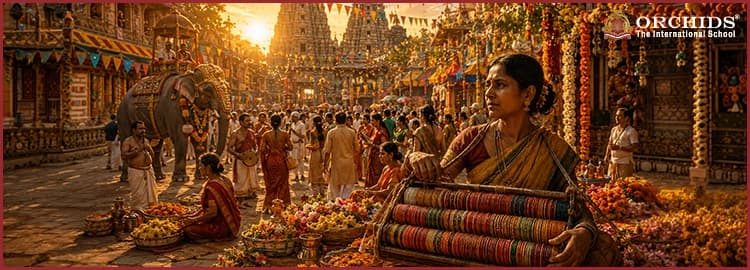
The Bangle Sellers by Sarojini Naidu is one of the most widely studied poems in Indian English literature. At first glance, the poem appears to be little more than a group of travelling sellers praising their colourful bangles. However, beneath this simple surface lies a rich exploration of womanhood, tradition, and the different stages of life in early twentieth-century India. Through vivid imagery and musical language, Naidu presents bangles as more than decorative ornaments. They become symbols of dreams, love, marriage, maturity, and fulfilment. Published in The Bird of Time (1912), the poem reflects the poet's deep appreciation for Indian traditions and everyday life. In this guide, you will learn the poem, summary, stanza-by-stanza analysis, literary devices, symbols, and themes.
Table of contents
- About the Author
- Introduction to the Poem
- The Bangle Sellers Summary
- Stanza-by-Stanza Explanation and Analysis of The Bangle Sellers
- Themes in The Bangle Sellers
- Symbols in The Bangle Sellers
- Poetic Devices and Figurative Language in The Bangle Sellers
- Form, Metre and Rhyme Scheme of The Bangle Sellers
- Literary and Historical Context of The Bangle Sellers
- Frequently Asked Questions about The Bangle Sellers
About the author
Sarojini Naidu (1879 to 1949) was an Indian poet, freedom fighter and politician, often remembered as the ‘Nightingale of India’ because of the lyrical quality of her verse.
She later worked closely with Mahatma Gandhi during India's struggle for independence and was also a strong voice for women's rights at a time when this was not a common cause to champion publicly.
Although she wrote her poetry in English, having been influenced by poets such as W. B. Yeats, her subject matter stayed rooted firmly in Indian life, its festivals, its landscapes and its social customs. Naidu published five collections of poetry across her career, and The Bangle Sellers appears in her second collection, The Bird of Time, which came out in 1912. Later in her life, she went on to become the Governor of the United Provinces (now Uttar Pradesh), making her the first woman to hold such a post in the country.
Introduction to the poem
The Bangle Sellers is a short lyric poem told from the point of view of a group of travelling sellers who carry bangles to sell at a temple fair. On the face of it, the poem reads like a market chant, the kind of sing-song call a trader might use to draw in customers. But as the poem progresses, it becomes clear that the bangles are not just ordinary jewellery. Each colour and shade represents a stage in a woman's life, from girlhood through marriage and then to motherhood.
Written in flowing, musical language and simple rhyming couplets, the poem has a gentle, almost hypnotic rhythm that mirrors the steady, cyclical way the poet imagines a woman's life unfolding, much like the changing of the seasons.
The Bangle Sellers Summary
The poem opens with the bangle sellers announcing who they are and what they carry, describing their bright, rainbow-coloured bangles as gifts fit for happy daughters and wives. They ask, almost as a sales pitch, who among the crowd at the temple fair would like to buy these glowing ‘circles of light’.

In the second stanza, the sellers turn to the bangles suited to a young unmarried girl. These are pale, cool shades, silvery blue like a misty hillside, soft pink like a flower bud, and pale green like a freshly opened leaf. The colours suggest youth, innocence and the hopeful anticipation of what lies ahead.
The third stanza shifts to a bride on her wedding morning. Here the bangles turn golden, like a field of ripened corn, or fiery red and orange, echoing the sacred fire lit during a Hindu wedding ceremony. The sellers describe these bangles as carrying both the joy and the nervous tears of a bride on her big day.
In the final stanza, the sellers describe bangles for a woman who is now a mother and has ‘journeyed midway through life’. These bangles are in deeper, quieter tones, purple mixed with flecks of grey and gold, and represent a woman who has raised her children, run her household, and remained devoted to her faith alongside her husband.
Taken together, the four stanzas trace an entire life cycle, from girlhood to bridehood and motherhood, using nothing more than the changing colours of a few bangles.
Stanza-by-stanza explanation and analysis of The Bangle Sellers
Stanza One: The Sellers and Their Colourful Wares
The poem opens with the sellers speaking as one voice, telling us who they are and where they are headed, a temple fair, carrying what they call their "shining loads" of bangles. Straight away, Naidu makes it clear these are not just any bangles being hawked at a market stall. They are described as delicate, rainbow tinted and glowing, almost as if each one has a light of its own. By the end of the stanza, the sellers have already hinted at what is really going on, these bangles are "tokens" of a happy life, meant for daughters and wives. So even in these opening six lines, the poem is doing two things at once, working as a cheerful market cry to pull in customers, and quietly setting up the idea that a bangle can stand for something far bigger than jewellery.
Stanza Two: Bangles for Young Maidens
Once the introductions are out of the way, the sellers get down to business and start describing their stock. First up are the bangles meant for a young, unmarried girl, and the colours chosen for her say a lot. Think mountain mist, a flower bud still half asleep, a fresh green leaf just unfurling. Nothing here is bold or showy, it is all soft, cool and a little dreamy, which fits perfectly with the idea of a girl on the edge of growing up, full of quiet hope but not quite there yet.
Stanza Three: Bangles for Brides
The mood changes noticeably in this stanza, and so does the colour palette. The bangles now belong to a bride on her wedding day, and everything about them feels warmer, brighter, more urgent, golden cornfields, the flames of the wedding fire, colours that seem to burn rather than glow. What makes this stanza feel especially honest is that the sellers do not pretend a wedding day is only about joy. They mention the bride's laughter in the same breath as her tears, a small but telling reminder that big life changes usually come with both excitement and nerves.
Stanza Four: Bangles for Mature Women
By the final stanza, the pace of the poem has slowed right down, and so has its colour scheme. The bangles here suit a woman who has already lived through the earlier stages, girlhood and marriage, and is now raising a family of her own. Purple, grey, flecks of gold, nothing flashy, just a quiet, settled richness. The language shifts too, away from youthful excitement and towards words like duty, devotion and pride, and the poem ends on that note, treating a mature woman's life as something to be respected rather than something that has simply lost its shine.
Themes in The Bangle Sellers
The cycle of a woman's life: The poem presents a woman's life as following a natural rhythm, not unlike the turning of the seasons. Naidu presents girlhood, marriage and motherhood as three connected, equally valuable phases, each with its own kind of beauty.
Tradition and Indian womanhood: The poem is firmly rooted in the customs of early twentieth-century India. References to the temple fair, the wedding fire and worshipping "the gods at her husband's side" all point to a traditional Hindu way of life, and the poem reflects the traditional expectations surrounding a woman's journey during that period.
Beauty and joy in everyday life: Even though the poem touches on serious cultural expectations, its overall tone stays celebratory. The sellers describe every stage of a woman's life with warmth and delight, treating each phase as something worth honouring rather than something to be endured.
Colour, nature and symbolism: Nature imagery, including mist, buds, leaves, cornfields, and fire, is used throughout to link human life stages with the natural world, reinforcing the idea that a woman's growth is as organic and inevitable as the changing of a season.
Symbols in The Bangle Sellers
Bangles: The bangles are, without question, the poem's biggest symbol, and everything else really orbits around them. On the surface they are just pretty things being sold at a fair, but Naidu uses them to carry a woman's entire life story, her age, her emotional state, even her place within the culture she belongs to. A single bangle, in this poem, is never just a bangle.
Colours: Colour does a lot of quiet work throughout the poem. The paler, softer shades point to innocence and a kind of untested hopefulness, the sort of thing you would associate with a young girl who has not yet stepped into adult life. Once the colours turn brighter and warmer, gold, flame, red, we are clearly in celebration territory, the excitement of a wedding day. And by the time the shades deepen into purple and grey, the poem has moved into a calmer, more settled kind of maturity, less about excitement and more about quiet dignity.
The temple fair: It would be easy to skip past the temple fair as just a bit of scene setting, but it is doing more than that. It is where the whole community comes together, so it stands in for shared traditions and a collective way of life rather than anything private or individual. The fact that the sellers choose this exact spot to sell their bangles is not incidental, it ties each woman's personal journey back to the wider culture she is part of.
Nature: Finally, nature imagery runs right through the poem, mist, buds, leaves, cornfields, and it is there to remind us that a woman's life, in Naidu's eyes, unfolds just as naturally as the seasons do. Growth, renewal, beauty, the slow passing of time, all of it gets folded into these small, everyday images from the natural world.
Poetic devices and figurative language in The Bangle Sellers
Imagery: This is really where the poem does most of its heavy lifting. Naidu leans so heavily on visual detail that you can almost picture the tray of bangles in front of you, along with the misty hillsides, budding flowers and sunlit cornfields she keeps drawing on for comparison.
Simile: You will notice Naidu reaching for 'like' and 'as' again and again, bangles compared to mist, to buds, to fields of corn. These little comparisons are not just decorative, they are doing the job of linking each bangle back to a particular feeling or stage of life, which is what gives the symbolism its weight.
Metaphor: Beyond the individual similes, the bangles work as one big extended metaphor running across the whole poem. Each one effectively stands in for a chapter of a woman's life, so read together, they trace out something like a full life story in miniature.
Alliteration: Naidu also has a good ear for sound, and repeated consonants pop up throughout the poem, giving certain lines a musical, almost sing song quality. It suits the idea of the bangle sellers chanting out to attract buyers.
Symbolism: If there is one device holding the whole poem together, it is symbolism. Almost nothing in this poem is only what it appears to be on the surface, the bangles, the colours, the fair itself, all of it points to something bigger about womanhood and tradition, which is really the heart of what makes this poem worth studying closely.
Form, metre and rhyme scheme of The Bangle Sellers
Structurally, the poem is quite tidy, four stanzas of six lines each, and this neat arrangement works nicely alongside the poem's content, since each stanza maps onto a distinct stage of a woman's life. Nothing feels cluttered or out of place.
The rhyme scheme sticks to a simple AABBCC pattern in every stanza, and this regularity gives the poem a song-like, almost chant-like quality, not unlike the call of a street vendor trying to draw a crowd, which fits the subject matter rather well.
As for metre, Naidu does not lock herself into one rigid pattern. The rhythm stays fairly loose but never loses its flow, which keeps the poem sounding natural rather than forced. It is worth remembering that Naidu was known in her time as a genuinely musical poet, and this poem is a good example of why that reputation stuck.
Literary and historical context of The Bangle Sellers
The Bangle Sellers was published in The Bird of Time in 1912, a period when India was still under British colonial rule and decades away from independence. Although the poem itself does not touch on politics directly, it is worth remembering that Naidu was, at the same time, deeply involved in the Indian nationalist movement, working alongside figures such as Mahatma Gandhi.
The poem reflects the social expectations placed on women in India during this era, where a woman's life was largely understood in terms of her relationships, as a daughter, then a wife, then a mother, rather than primarily through an independent public identity. Reading the poem today, many students and critics note that while it celebrates these stages with real warmth, it also gives us a window into how narrowly a woman's role could be defined at the time.
Frequently asked questions about The Bangle Sellers
What is the theme of the poem The Bangle Sellers?
Answer: The main theme is the cycle of a woman's life, moving from girlhood to marriage and then to motherhood, presented as a natural and beautiful progression similar to the changing of the seasons. The poem also touches on traditional Indian customs and the idea of an ideal, devoted womanhood.
Where are the bangle sellers going?
Answer: The bangle sellers are travelling to a temple fair, where they hope to sell their bangles to women of different ages who have gathered there.
Who is the speaker in the poem The Bangle Sellers?
Answer: The poem is spoken by a group, a chorus of bangle sellers, rather than a single narrator. They speak collectively throughout, describing their wares and calling out to potential buyers.
Why do bangle sellers come to the fair?
Answer: They come to the temple fair because it is a gathering place where many women, young and old, would be present, making it an ideal spot to sell bangles suited to every stage of a woman's life.
How does the bangle seller describe her wares?
Answer: The bangle sellers describe their bangles as delicate, glowing and rainbow-tinted, calling them lustrous tokens of a radiant life. They go on to describe individual bangles using comparisons to mist, buds, leaves, cornfields and fire, matching each set of colours to a different life stage.
Admissions Open for 2026-27
More Poems
We hope this was useful for your child's learning journey. To explore more about what Orchids The International School has to offer, get in touch with our admissions team.
Popular Searches
- NCERT Solutions for Class 1 subjects
- NCERT Solutions for Class 2 subjects
- NCERT Solutions for Class 3 subjects
- NCERT Solutions for Class 4 subjects
- NCERT Solutions for Class 5 subjects
- CBSE School In Aurangabad
- CBSE Schools In Bangalore
- CBSE School In Bhopal
- CBSE Schools In Chennai
- CBSE Schools In Delhi
- Best CBSE Schools In Gurgaon
- CBSE School In Hyderabad
- CBSE School In Indore
- CBSE School In Jabalpur
- CBSE Schools In Jaipur
- CBSE Schools In Kolkata
- CBSE Schools In Mumbai
- CBSE Schools In Nagpur
- CBSE Schools In Pune
- Top CBSE School In Rohtak
- Best CBSE Schools In Sonipat











Orchids The International School is one of India's leading chains of CBSE and ICSE schools, with 130+ schools across the country.