

The Lamb by William Blake: Summary, Analysis and Themes
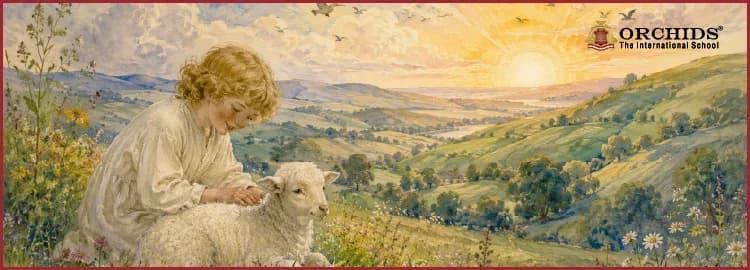
The Lamb is one of the most loved poems in English literature, and it is also one of the simplest-looking. Written by William Blake, it appears in his collection Songs of Innocence, published in 1789. On the surface it reads like a nursery rhyme a child could recite. Underneath, it carries a full argument about faith, creation, and the nature of God. The poem is often studied alongside Blake's famous poem The Tyger. While The Lamb focuses on gentleness and purity, The Tyger presents power, mystery, and fear. Together, the two poems help readers understand Blake's view of the world and human experience.
This article walks through the poem line by line, covers its themes, symbols, and structure, and gives you clear answers to the kind of questions that show up in exams and assignments.
Table of Contents
- About the Author: William Blake
- The Lamb by William Blake Overview
- The Lamb Poem: Full Poem
- The Lamb Summary
- Significance of the Title: The Lamb
- The Lamb Themes
- Line-by-Line Explanation and Analysis
- Symbols in The Lamb
- Poetic Devices and Figurative Language in The Lamb
- Structure, Form, Meter and Rhyme Scheme of The Lamb
- The Speaker and Narrator: The Lamb
- Literary and Historical Context of The Lamb
- The Lamb and The Tyger Comparison
- Frequently Asked Questions about The Lamb
About the Author: William Blake
William Blake (1757 to 1827) was an English poet and painter of the Romantic Age. He was not famous or financially successful during his lifetime, and much of his work was seen as strange or even mad by his contemporaries. Today he is regarded as one of the most original voices of the Romantic period.
Blake trained as an engraver and illustrated his poems by hand, so his books were as much visual art as they were literature. His two best known collections are Songs of Innocence (1789) and Songs of Experience (1794), later published together as Songs of Innocence and of Experience, Shewing the Two Contrary States of the Human Soul. That subtitle matters a lot for understanding ‘The Lamb’, because it tells you exactly what Blake was trying to do across his work: show two different ways of looking at the same world.
The Lamb by William Blake Overview

The Lamb Poem: Full Poem
By William Blake
Little Lamb who made thee
Dost thou know who made thee
Gave thee life & bid thee feed.
By the stream & o'er the mead;
Gave thee clothing of delight,
Softest clothing wooly bright;
Gave thee such a tender voice,
Making all the vales rejoice!
Little Lamb who made thee
Dost thou know who made thee
Little Lamb I'll tell thee,
Little Lamb I'll tell thee!
He is called by thy name,
For he calls himself a Lamb:
He is meek & he is mild,
He became a little child:
I a child & thou a lamb,
We are called by his name.
Little Lamb God bless thee.
Little Lamb God bless thee.
The Lamb Summary
The poem is of two stanzas, and it is built as a question and an answer. In the first stanza, a speaker turns to a young lamb and asks who made it. The speaker wonders who gave the lamb life, who lets it feed by the stream and over the meadow, who gave it its soft wool, and who gave it that gentle bleating voice that seems to make the whole valley happy.
In the second stanza, the same speaker answers the question. The maker, the speaker says, is one who is himself called a lamb, meek and mild, and who became a little child. This is a clear reference to Jesus Christ, who is described in the Bible as the Lamb of God and who, in Christian belief, was born as a human child. The speaker then connects everyone; the lamb, the speaker, and the maker share the same name as part of the same gentle, innocent family. The poem ends with a simple blessing repeated twice: "Little Lamb God bless thee."
One-line summary: A child asks a lamb who created it, then answers that the creator is Christ, the Lamb of God, and links the child, the lamb, and God together through gentleness and innocence.
Significance of the Title: The Lamb
The title 'The Lamb’ works on more than one level, which is very typical of Blake. On the first level, ‘The Lamb’ simply names the animal being spoken to in the poem. On a deeper level, it points to Jesus Christ, who is called the "Lamb of God" in Christian scripture because of his innocence and his role as a sacrifice.
By naming the poem after the animal rather than after God or Christ directly, Blake keeps the poem sitting comfortably inside a child's world, a farm, a meadow, a soft-voiced animal, while quietly building a religious meaning underneath. The title invites two readings at once, the literal and the symbolic, and that double meaning is really the whole point of the poem.
The Lamb Themes
-
Innocence: This is the central theme of the whole Songs of Innocence collection. The poem shows a world where a child and an animal exist without fear, without questioning suffering, and without doubt. Everything in the poem is soft, safe, and content.
-
Creation: The poem is structured around the basic question every child eventually asks: Where do living things come from? Blake answers it in a way that a child can accept without difficulty: a caring, gentle God made everything with love.
-
Christian faith and divine presence: Blake brings in the idea of Christ as both a lamb and a child, which lets him argue that God is not a distant, frightening figure but someone close to ordinary, humble life. God is present in nature and in the innocence of children and animals alike.
-
Unity between creator and creation: The poem does not treat God as separate from what he made. Instead, the lamb, the child, and Christ are described as sharing the same name and the same gentle nature. This blurs the line between maker and made, suggesting that creation carries the qualities of its creator.
Line-by-Line Explanation and Analysis
Lines 1 – 4
The poem opens with the same question asked twice. This repetition sounds like the way a small child talks, and it also builds a kind of gentle, sing-song rhythm right from the start. Here the speaker starts listing what the maker gave the lamb, first life itself, then permission and ability to graze near a stream and across a meadow. The setting is calm, open, and safe.
Lines 5–8
The speaker describes the lamb's soft wool and gentle voice. Calling it ‘clothing of delight’ turns a plain physical detail into something that sounds like a gift given with care and joy. These qualities highlight innocence and comfort. The surrounding landscape seems happier because of the lamb's presence. The lamb's bleat is described as tender, and its effect on the valleys around it is pure joy. Nature itself seems to respond happily to the lamb's presence.
Lines 9–10
The opening question returns, closing the first stanza the way it began. This creates a neat, circular structure and also builds anticipation for the answer that is about to come.
Lines 11–14
The second stanza begins with the speaker announcing that an answer is coming, again repeated twice, keeping that childlike, patient tone. The creator is called by the same name as the lamb, pointing to Christ. This is the key theological line. The maker shares the lamb's name because he refers to himself as a lamb, a direct pointer to Christ being called the Lamb of God.
Lines 15–18
Christ is described using the same gentle qualities as the lamb, and then the speaker adds that this maker also became a child, connecting him to human innocence as well as animal innocence. The speaker now includes themselves directly. Child, lamb, and Christ are all linked under one shared identity built on gentleness and innocence.
Lines 19–20
The poem closes with a blessing, repeated once more, ending on a note of comfort and warmth rather than any unresolved tension.
Symbols in The Lamb
-
The Lamb: The most obvious symbol in the poem, standing for innocence, gentleness, and, through the biblical reference, Jesus Christ himself.
-
The Child: The speaker, who is likely a young child, symbolizes purity and the unclouded, trusting faith that Blake associates with early life, before experience and doubt creep in.
-
The Meadow and the Stream: These natural settings symbolise a peaceful, untroubled world, an Eden-like space where nothing threatens the lamb or the speaker.
-
Wool ('clothing of delight'): The lamb's soft wool symbolises comfort and protection, gifts generously given by a caring creator.
Poetic Devices and Figurative Language in The Lamb
-
Repetition: Lines like ‘Little Lamb who made thee’ and ‘Little Lamb God bless thee’ repeat within the poem, giving it a musical, chant-like quality similar to a lullaby or a hymn.
-
Rhetorical question: The opening question is not really asked to get new information, since the speaker answers it themselves in the next stanza. It is used to draw the reader in and set up the poem's structure.
-
Alliteration: Phrases such as "softest clothing, woolly, bright" use repeated consonant sounds to add rhythm and a pleasant, musical feel.
-
Symbolism: As covered above, the lamb, the child, and the natural setting all carry meaning beyond their literal sense.
-
Apostrophe: The speaker directly addresses the lamb throughout, a device where someone speaks to an object, animal, or absent figure as though it can respond.
-
Biblical allusion: The reference to Christ as a lamb and as a child draws directly from Christian scripture without ever naming Jesus outright.
Structure, Form, Meter and Rhyme Scheme of The Lamb
The poem is a lyric poem with strong hymn-like qualities. It is written in two balanced stanzas. The poem is made up of two stanzas of ten lines each, giving it a neat, balanced shape. It is written mostly in trochaic and iambic meter, which means the stress pattern shifts a little through the poem, but the overall effect is a light, bouncy rhythm that feels close to a nursery rhyme or a hymn meant to be sung.
Structure:
-
Two stanzas
-
Ten lines in each stanza
-
The first stanza asks questions
-
Second stanza provides answers
Form:
The poem resembles a song or prayer. Its simple style reflects childhood innocence. This is considered a lyric poem, and more specifically it fits into the pastoral tradition because of its rural, natural setting, and into the category of religious or devotional verse because of its Christian themes.
Meter:
The rhythm is regular and musical, making it easy to read aloud. Blake intentionally uses a song-like pattern because many poems in Songs of Innocence were designed to feel musical.
Rhyme Scheme:
The rhyme scheme in each stanza generally follows a pattern of rhyming couplets, AABBCCDDEE, with the opening and closing lines of each stanza repeating exactly. This repetition at the start and end of each stanza gives the poem a circular, song-like feel, fitting for a poem meant to represent childlike simplicity.
The Speaker and Narrator: The Lamb
The speaker is widely understood to be a young child, most likely a shepherd child given the setting. This matters a great deal for how the poem works. A child asking a lamb who made it and then confidently answering their own question reflects the kind of simple, secure faith Blake associates with innocence, faith that has not yet been tested by doubt, suffering, or hard experience. Some readers see the speaker as representing childhood generally rather than one specific character, standing in for anyone who still sees the world through trusting, unquestioning eyes.
Literary and Historical Context of The Lamb
Blake wrote ‘The Lamb’ in 1789, at a time when Britain was going through major social and religious change. The Industrial Revolution was reshaping cities and work, and traditional religious ideas were being challenged by new scientific and philosophical thinking. Blake, a deeply spiritual but unconventional thinker, used poetry to explore his own views on faith, nature, and society, often pushing back against rigid institutional religion while still holding on to a personal, mystical Christianity.
‘Songs of Innocence’ was written before ‘Songs of Experience’, and Blake later combined both into a single volume with the subtitle ‘Shewing the Two Contrary States of the Human Soul’. This tells you that Blake never intended ‘The Lamb’ to be read as a complete, final statement on faith or creation. It represents only one side, the innocent, trusting side, and it is meant to be placed against its counterpart from Songs of Experience.
The Lamb and The Tyger Comparison
‘The Tyger’, published five years later in ‘Songs of Experience’, asks a very similar opening question, 'Who made you?', but directed at a fierce, dangerous tiger instead of a gentle lamb. Where ‘The Lamb’ answers its own question calmly and with full confidence, ‘The Tyger’ ends without a clear answer, full of unease and wonder instead of comfort.
Read side by side, the two poems form one of the best-known contrasts in English poetry: innocence against experience, comfort against fear, and certainty against doubt. Both poems ask whether the same God could really have made two such different creatures, and Blake never gives a single, tidy answer across the pair. Instead, he leaves the reader to sit with both possibilities at once.
Frequently Asked Questions about The Lamb
What type of poem is 'The Lamb' by William Blake?
Answer: It is a short lyric poem, written in a pastoral and devotional style. It also functions as a companion piece within the larger collection Songs of Innocence, and it is often studied as part of Blake's broader project on innocence and experience.
Who is the narrator of 'The Lamb' by William Blake?
Answer: The narrator is generally understood to be a young child, likely a shepherd child, speaking directly to a lamb. The child asks who created the lamb and then answers the question themselves, reflecting simple, trusting religious faith.
What is 'The Lamb' by William Blake about, in short?
Answer: It is about a child asking a lamb who made it, then explaining that the maker is Christ, described in the Bible as the Lamb of God, and connecting the child, the lamb, and God together through shared innocence and gentleness.
What is the main theme of 'The Lamb'?
Answer: Innocence is the main theme, shown through trust in a loving creator, a peaceful natural setting, and the gentle bond between a child, an animal, and God.
How does 'The Lamb' connect to 'The Tyger'?
Answer: Both poems open with the same kind of question, 'Who made you?', but 'The Lamb' is set in Songs of Innocence and gives a calm, confident answer, while 'The Tyger' is set in Songs of Experience and ends in uncertainty. Together they represent two different, contrasting ways of understanding the same act of creation.
Why does Blake compare the lamb to Christ?
Answer: In Christian scripture, Christ is referred to as the Lamb of God because of his gentleness, innocence, and role as a sacrifice. Blake uses this existing image so that the poem can talk about a real farm animal and about Christ at the same time, without ever separating the two meanings.
What is the rhyme scheme of The Lamb?
Answer: The poem largely follows a pattern of rhyming couplets in each stanza, with the opening and closing lines of each stanza repeating word for word, giving the poem a circular, song-like structure.
Admissions Open for 2026-27
More Poems
We hope this was useful for your child's learning journey. To explore more about what Orchids The International School has to offer, get in touch with our admissions team.
Popular Searches
- NCERT Solutions for Class 1 subjects
- NCERT Solutions for Class 2 subjects
- NCERT Solutions for Class 3 subjects
- NCERT Solutions for Class 4 subjects
- NCERT Solutions for Class 5 subjects
- CBSE School In Aurangabad
- CBSE Schools In Bangalore
- CBSE School In Bhopal
- CBSE Schools In Chennai
- CBSE Schools In Delhi
- Best CBSE Schools In Gurgaon
- CBSE School In Hyderabad
- CBSE School In Indore
- CBSE School In Jabalpur
- CBSE Schools In Jaipur
- CBSE Schools In Kolkata
- CBSE Schools In Mumbai
- CBSE Schools In Nagpur
- CBSE Schools In Pune
- Top CBSE School In Rohtak
- Best CBSE Schools In Sonipat











Orchids The International School is one of India's leading chains of CBSE and ICSE schools, with 110+ schools across the country.