

The Road Not Taken by Robert Frost: Full Poem, Summary and Poetic Devices for Students
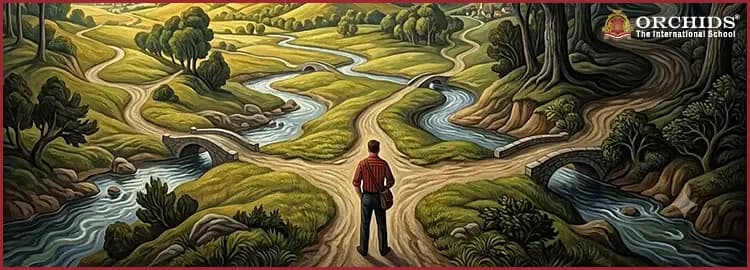
Two roads diverge in a yellow autumn wood. A walker stops, looks down each one as far as he can see, chooses one and walks on. That is the whole event of The Road Not Taken, and it takes four stanzas to describe. Yet the poem has been quoted at graduations, printed on posters, used in speeches and cited as an inspiration for individual thinking for more than a century, almost always with the same reading: the speaker chose the less travelled road, and that brave, independent choice made all the difference.
This page sets out the complete poem, a full summary of the poem The Road Not Taken, a stanza by stanza and line by line analysis, the poetic devices at work in it and the deeper ideas Frost was exploring, along with FAQs.
Table of Contents
- The Road Not Taken: The Full Poem
- The Road Not Taken about the Poet
- Summary of the Poem The Road Not Taken
- The Road Not Taken Analysis Stanza by Stanza
- The Road Not Taken Analysis Line by Line
- The Road Not Taken Analysis: Tone, Themes and the Bigger Picture
- Poetic Devices Used in the Poem The Road Not Taken
- Frequently Asked Questions about The Road Not Taken
The Road Not Taken: The Full Poem
by Robert Frost
Two roads diverged in a yellow wood,
And sorry I could not travel both
And be one traveler, long I stood
And looked down one as far as I could
To where it bent in the undergrowth;
Then took the other, as just as fair,
And having perhaps the better claim,
Because it was grassy and wanted wear;
Though as for that the passing there
Had worn them really about the same,
And both that morning equally lay
In leaves no step had trodden black.
Oh, I kept the first for another day!
Yet knowing how way leads on to way,
I doubted if I should ever come back.
I shall be telling this with a sigh
Somewhere ages and ages hence:
Two roads diverged in a wood, and I,
I took the one less traveled by,
And that has made all the difference.
Who Wrote The Road Not Taken
For students asking who wrote The Road Not Taken, the answer is Robert Frost, one of the most widely read American poets of the twentieth century. Frost was born in San Francisco in 1874 and spent much of his adult life in rural New England, whose landscapes, seasons and ordinary human encounters provide the setting for most of his poetry. He won the Pulitzer Prize for Poetry four times and remains one of the few poets to have achieved both popular affection and serious critical recognition simultaneously.
The Road Not Taken was written in 1915 and published in 1916 in Frost’s collection Mountain Interval. It was the opening poem of that collection, a position that signals its importance to Frost even as its meaning has been debated ever since. The poem was first published in a letter Frost sent to his friend Edward Thomas, and it grew directly from observations Frost had made of Thomas’s habit during their walks in the English countryside, a detail that changes how the poem reads considerably once a student is aware of it.
The Road Not Taken about the Poet
Any section on The Road Not Taken about the poet benefits from understanding where Frost was in his life and friendship when he wrote it. Between 1912 and 1915, Frost lived in England, where he formed a close friendship with the Welsh port and nature writer Edward Thomas. The two men walked the English countryside together regularly, and Thomas had a particular habit that Frost found both endearing and gently comic: he would often express regret about whichever path they had not taken, wondering what birds or flowers or views they had missed by going one way rather than the other.
Frost wrote the poem with Thomas in mind, affectionately teasing his friend’s tendency towards retrospective regret. He sent it to Thomas before publication, expecting Thomas to recognise himself in the speaker. Thomas did not and took the poem as a straightforward celebration of independence instead, which tells its own story about how easily this particular poem can be misread. Edward Thomas was killed in action in France in 1917, just a year after the poem was published, and Frost later said that the poem had always been ‘about’ Thomas in a personal sense that he never fully explained publicly.

Summary of the Poem The Road Not Taken
A clear summary of the poem The Road Not Taken begins with the setting: an autumn morning in a wood where a path splits into two. The speaker stops at the fork and looks as far down each road as he can. He eventually takes one, telling himself it is the slightly less worn of the two and therefore perhaps the more interesting choice. He then immediately qualifies this: the two roads have actually been worn about the same, and both lie equally covered in undisturbed fallen leaves that morning.
The speaker tells himself he will return one day and take the other road, then immediately admits he almost certainly will not, since paths lead to further paths and life rarely doubles back. The poem closes by jumping forward to an imagined future moment in which the speaker pictures himself sighing and telling someone that he took the road less travelled by, and that this made all the difference. The irony, established carefully in the first three stanzas, is that the speaker knows as he says this that it is a slight distortion of what actually happened: the roads were not meaningfully different, the choice was not heroic and the story he will tell about it will be neater and more meaningful than the reality it describes.
The Road Not Taken Analysis Stanza by Stanza
Stanza 1: The Fork in the Road
The poem opens on a specific, sensory scene: an autumn wood, yellow with turning leaves, where a path divides. The speaker stands for a long time at the fork, looking down one road as far as he can, which is not very far at all since it bends into the undergrowth and disappears. The mood is one of genuine difficulty; he is ‘sorry’ he cannot take both roads, and the act of standing and looking is presented as a serious, sustained attempt to make a wise choice. The limitation of his sight, the road bending away before he can really see it, is quietly important: he cannot know what either road holds, no matter how long he looks.
Stanza 2: The Choice That is Not Quite a Choice
The speaker takes the second road, and the reasons he gives for doing so unravel almost as quickly as he gives them. He says it had ‘perhaps the better claim’ because it was grassy and appeared less worn. Then he immediately corrects himself: the two roads had actually been worn about the same. This self-correction is the hinge of the poem. The speaker chose one road over the other, but not for any clear or compelling reason; the distinction he thought he saw dissolved on closer inspection. The honesty of this acknowledgement is what separates a careful reading of the poem from the popular version of it.
Stanza 3: The Road Not Taken
Both roads that morning lay equally covered in leaves that no one had yet walked through and darkened. The speaker tells himself he is keeping the first road for another day but in the very next breath admits he knows this is almost certainly not true. ‘Way leads on to way’: life moves forward, paths multiply and the idea that a person can retrace their steps and take the road they passed over is comforting but rarely true. The speaker knows this even as he says otherwise.
Stanza 4: The Story Told in the Future
The final stanza moves forward to an imagined future moment, ‘ages and ages hence’, when the speaker pictures himself sighing and telling someone the story of this fork in the road. The story he will tell is that he took the road less travelled by and that this made all the difference. The gap between this future story and what the poem has already shown to be true is the poem’s central irony: the speaker will construct a meaningful narrative out of a moment that was, in reality, an essentially arbitrary choice between two nearly identical paths. He knows he will do this. He perhaps cannot help it.
The Road Not Taken Analysis Line by Line
Stanza 1
- ‘Two roads diverged in in a yellow wood’ opens with a straightforward image that immediately carries symbolic weight: a fork is a decision, and autumn wood suggests a world of things passing, changing, coming to an end.
- ‘And sorry I could not travel both / And be one traveler’ establishes the speaker’s dilemma honestly: the limitation is not a failure of courage but a fact of being a single person in a single moment.
- ‘Long I stood / And looked down one as far as I could / To where it bent in the undergrowth’ shows how seriously the speaker takes the decision, and quietly shows its limits: no amount of looking can reveal what lies around the bend.
Stanza 2
- ‘Then took the other, as just and fair’ is the line that undoes the popular reading of the poem at a stroke. The road taken is ‘just as fair’ as the other one, not braver, not more interesting, not less travelled, simply equally fine.
- ‘And having perhaps the better claim, / Because it was grassy and wanted wear’ begins a rationalisation: the word ‘perhaps’ is doing real work here, signalling that this is not a confident assessment.
- ‘Though as for that the passing there / Had worn them really about the same’ immediately withdraws the rationalisation. The speaker thought one road was less worn; on reflection, both had been used equally.
Stanza 3
- ‘And both that morning equally lay / In leaves no step had trodden black’ confirms what stanza two suggested: there is no meaningful difference between the two roads. The leaves on both are fresh and undisturbed.
- ‘Oh, I kept the first for another day!’ is the exclamation of someone trying to reassure himself that this choice is not final.
- ‘Yet knowing how way leads on to way, / I doubted if I should ever come back’ is the speaker’s own quiet, honest admission that this reassurance is almost certainly false. The sigh of realism in ‘I doubted’ is one of the most important moments in the poem.
Stanza 4
- ‘I shall be telling this with a sigh / Somewhere ages and ages hence’ places the speaker outside his own present moment, imagining how this small event will eventually be narrated. The sigh is ambiguous: it could be nostalgia, satisfaction or the mild self-awareness of someone who knows they are about to simplify.
- ‘Two roads diverged in a wood, and I, / I’ contains a pause, a slight dramatic hesitation, before the speaker delivers the famous version of the story.
- ‘I took the one less traveled by, / And that has made all the difference’ is the tidier, more satisfying story: a heroic individual choice with consequences that justified it. The poem’s preceding stanzas have already shown the reader that this story, while emotionally compelling, is not quite accurate.
The Road Not Taken Analysis: Tone, Themes and the Bigger Picture
Tone
The tone of the poem is quietly reflective and gently ironic rather than triumphant. The speaker is not celebrating his boldness; he is observing, with some honesty and some self-awareness, the way human beings make choices and then construct stories about those choices that are more meaningful than the original moment warranted. The final stanza’s tone is complicated: the speaker is not lying, exactly, but he knows he will be simplifying, and the poem holds both his awareness of this and his inevitability of doing it without judging him for it.
The Gap between Experience and Narrative
The deepest theme of the poem is the human tendency to impose meaning on events after the fact. At the moment of choice, the speaker saw two nearly identical roads and made an essentially arbitrary decision. Years later, he will have turned this into a story about independence and distinction. Frost is not mocking this tendency; it is perhaps simply what human beings do with their lives. But he draws the gap between the reality of the moment and the story told about it with great precision.
Choice and Irreversibility
The poem is also about the fact that choices, once made, cannot be unmade, not because the road not taken was necessarily worse but simply because life moves forward and does not allow for comparison. The speaker will never know what the other road held. That not knowing is not presented as tragedy, but the poem takes it seriously as a condition of being alive and having to act without complete information.
The Irony of the Title
It is worth noting that the poem is not called ‘The Road Less Travelled’ or ‘The Road I Chose’. It is called The Road Not Taken, which points not to the road the speaker walked but to the one he did not. The poem is, in a quiet way, about the road left behind and the thoughts that attach themselves to it, not about the triumphant walk down the road chosen.
Poetic Devices Used in the Poem The Road Not Taken
- Symbolism: The fork in the road is one of the most widely recognised symbols in English poetry, representing a moment of decision or a turning point in life. The autumn wood, yellow with falling leaves, adds a quiet sense of time passing and of things coming to an end.
- Irony: The poem’s central and defining device is irony. The speaker carefully establishes that the two roads were essentially the same, then closes the poem with a future claim that he took the one less travelled by. The gap between these two positions is the poem’s real subject.
- Imagery: Frost builds the poem on clear, precise visual imagery: the yellow wood, the roads bending into undergrowth, the leaves lying undisturbed on both paths that morning. The images are simple and rural, but each one carries weight in the poem’s argument.
- Enjambment: Several lines run on into the next without a full stop, particularly in the first stanza, which gives the speaker’s thinking a flowing, ruminative quality, as though he is working something out as he speaks rather than delivering a prepared speech.
- Tone shift: The shift between the quiet, honest self-examination of the first three stanzas and the slightly elevated, story-telling tone of the fourth stanza is itself a poetic device, showing the speaker moving from the raw experience to the constructed narrative he will eventually tell about it.
- Rhyme scheme and metre: The poem is composed of four five-line stanzas following an ABAAB rhyme scheme. The metre is roughly iambic tetrameter, though Frost handles it with the easy flexibility he was known for, allowing natural speech rhythms to take precedence over strict metrical regularity. The result is a poem that sounds like a person thinking aloud rather than reciting verse.
Frequently Asked Questions about The Road Not Taken
1. Who wrote The Road Not Taken?
The Road Not Taken was written by Robert Frost and published in 1916 in his collection Mountain Interval.
2. What is the real meaning of The Road Not Taken?
The poem is widely read as a celebration of individuality and bold choice, but Frost intended it as a gentle, ironic reflection on the human habit of constructing meaningful stories about choices that were, in the original moment, largely arbitrary. The two roads were essentially identical; the speaker simply needs to believe his choice was meaningful.
3. What is the tone of The Road Not Taken?
The tone is quietly reflective and gently ironic, moving from honest self-examination in the first three stanzas to a knowing, slightly self-aware storytelling mode in the final stanza.
4. What does the road symbolise in the poem The Road Not Taken?
The road symbolises a life choice or a turning point, and the fork represents the moment of decision. The autumn wood adds a sense of time passing and of irreversibility to the setting.
5. Why is The Road Not Taken so often misread?
Most readers focus on the final stanza and take its claim about the road less travelled at face value. Reading the first three stanzas carefully reveals that the speaker himself established the two roads were essentially the same, making the final claim an example of retrospective story-making rather than a factual account.
6. What are the main poetic devices in the poem The Road Not Taken?
The poem uses symbolism, irony, imagery, enjambment and an ABAAB rhyme scheme across four five-line stanzas written in flexible iambic tetrameter.
Admissions Open for 2026-27
More Poems
We hope this was useful for your child's learning journey. To explore more about what Orchids The International School has to offer, get in touch with our admissions team.
Popular Searches
- NCERT Solutions for Class 1 subjects
- NCERT Solutions for Class 2 subjects
- NCERT Solutions for Class 3 subjects
- NCERT Solutions for Class 4 subjects
- NCERT Solutions for Class 5 subjects
- CBSE School In Aurangabad
- CBSE Schools In Bangalore
- CBSE School In Bhopal
- CBSE Schools In Chennai
- CBSE Schools In Delhi
- Best CBSE Schools In Gurgaon
- CBSE School In Hyderabad
- CBSE School In Indore
- CBSE School In Jabalpur
- CBSE Schools In Jaipur
- CBSE Schools In Kolkata
- CBSE Schools In Mumbai
- CBSE Schools In Nagpur
- CBSE Schools In Pune
- Top CBSE School In Rohtak
- Best CBSE Schools In Sonipat











Orchids The International School is one of India's leading chains of CBSE and ICSE schools, with 110+ schools across the country.