

The Snake and the Mirror: Summary, Central Idea, Themes, Character Sketch and Literary Devices
The Snake and the Mirror is one of those stories that stays with a reader long after the last line. It looks like a simple tale about a doctor and a snake, but underneath that surface lies a gentle lesson about pride, fear and self-awareness. Written by Vaikom Muhammad Basheer, the story uses humour to talk about something quite serious: how easily human beings get carried away by vanity and how quickly that vanity can vanish the moment real danger appears.
This article walks through the story of The Snake and the Mirror in detail, covering the author's background, the central idea, a full summary broken into its key moments, a character study of the doctor, the major themes and the literary devices used.
Table of Contents
- About the Author: Vaikom Muhammad Basheer
- The Snake and the Mirror: Central Idea
- The Snake and the Mirror: Summary
- Character Sketch of the Doctor
- Themes in The Snake and the Mirror
- Literary Devices Used in The Snake and the Mirror
- Frequently Asked Questions on The Snake and the Mirror
About the Author: Vaikom Muhammad Basheer
The Snake and the Mirror was written by Vaikom Muhammad Basheer, a well-known Malayalam writer whose stories are famous for their simplicity and warmth. Basheer wrote about ordinary people and everyday struggles, often mixing humour with a strong sense of compassion for all living beings. Basheer preferred using simple, conversational language rather than complex literary expressions. This made his stories accessible to readers of all ages while allowing them to connect emotionally with the characters.
Born on 21 January 1908 in Vaikom, Kerala, Basheer developed a passion for literature at a young age. Before becoming a full-time writer, he travelled extensively across India and worked in various professions. His own life was full of adventure and hardship, and this experience shows up in the honest, unpolished way he tells his stories. He never tried to sound overly literary; instead, he wrote the way people actually spoke. Which is why his work still feels fresh and relatable today.
Basheer received national recognition for his contribution to literature and social life, and many of his short stories continue to be studied because they combine entertainment with quiet moral depth. The Snake and the Mirror is a fine example of this style: a light, almost conversational narrative that ends up saying something important about human nature.
The Snake and the Mirror is based on one of Basheer's own experiences. Although he presents the incident with humour and dramatic storytelling, the story also reflects his ability to find meaningful lessons in everyday life. His engaging narration transforms an ordinary event into a memorable tale about fear, pride, and self-realisation.
The Snake and the Mirror: Central Idea
The central idea of The Snake and the Mirror is that pride and self-importance can disappear in an instant when life presents an unexpected challenge. Through the experience of a young doctor, the story shows how quickly confidence can turn into fear and how such moments often lead to self-realisation.

At the beginning of the story, the doctor is completely absorbed in admiring his appearance and dreaming about his future. He believes that his good looks and personality will help him lead a happy and successful life. However, the sudden arrival of the snake changes everything. Faced with real danger, he no longer thinks about his appearance, wealth, or future plans. His only concern becomes staying alive.
The story also highlights the unpredictable nature of life. Even an ordinary evening can suddenly become life-changing. The doctor learns that people cannot always control what happens around them, no matter how confident they may feel.
Another important idea is the value of humility. The frightening encounter reminds the narrator that human beings are not as powerful as they often imagine. Nature has the ability to humble even the most confident person within moments.
Through humour, suspense, and realistic storytelling, The Snake and the Mirror encourages readers to remain modest, appreciate life, and understand that courage often means staying calm during difficult situations rather than acting fearlessly.
What Makes the Story Humorous?
Readers often ask what makes The Snake and the Mirror funny despite its frightening subject matter. The humour comes largely from contrast and self-deprecation. The doctor's grand, almost theatrical plans; shaving daily, growing a moustache, and marrying a wealthy and sturdy wife are described in a mock-serious tone, as if they were matters of national importance. When these plans collapse the instant a snake appears, the sudden shift from grandeur to sheer panic is genuinely comic.
Basheer also adds humour through small, honest details, such as the thief who steals everything except one particularly grubby piece of clothing, treating even that as beneath him. These touches of self-mockery, combined with the doctor's willingness to admit his own foolishness, are what give the story its light, good-natured tone even while describing a genuinely dangerous moment.
The Snake and the Mirror: Summary
The story is told as a story within a story. A group of people are talking about snakes when one of them, a doctor, offers to share a personal experience from his younger days. What follows is his own account of a night he can never forget.
Human Vanity
The doctor explains that, in his early days of practice, he was not doing particularly well financially. He lived alone in a modest rented room that he shared, quite literally, with a family of rats scurrying along the roof beams. Despite his thin income, he was deeply concerned with his appearance and his future prospects.
One warm evening, after eating out at a small restaurant, he returned to his room, lit his lamp, and sat down at his table with a medical book in front of him. Instead of reading, though, his attention drifted to the mirror kept on the table. Looking at his own reflection, he began imagining a far more glamorous version of himself: clean shaven and charming, someone who smiled easily and always looked his best. His thoughts soon wandered further, picturing a future wife who was financially comfortable, ran a thriving clinic, and was heavier built than him, since he joked to himself that such a wife would never be able to chase him down whenever he made a mistake.
Caught up in this daydream, the doctor barely noticed that the usual scratching of rats overhead had gone quiet. That silence, as it turns out, was the first hint that something else had entered the room.
Encounter with a Snake
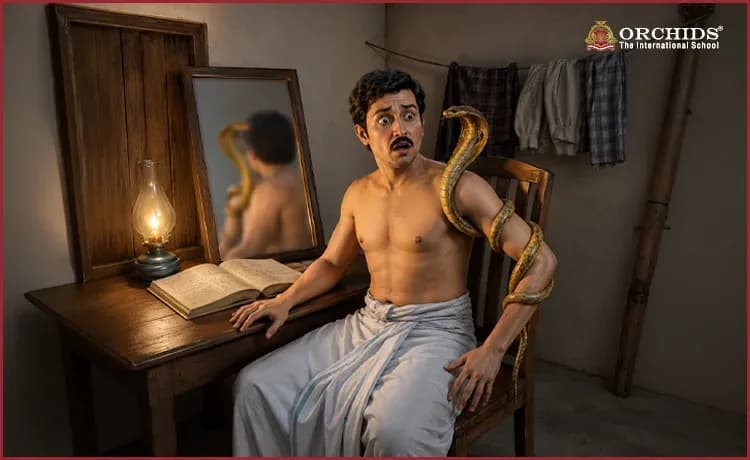
Just as the doctor was deep in his fantasy of future comfort, something heavy dropped onto the back of his chair with a dull thump. Before he could react, it had slid across his shoulder and settled there, only inches from his face. It was a fully grown cobra, its hood raised, coiling itself around his upper arm.
Terrified and unable to move a muscle, the doctor sat frozen, all his earlier dreams of good looks and a comfortable future replaced instantly by a single, urgent thought: survival. He mentally ran through the medicines in his cabinet, wondering if any of them would help if the snake struck. In that instant of raw fear, all his pride disappeared, and he silently turned to prayer, hoping to be spared.
Fortunately for him, the cobra's attention shifted. It noticed its own image in the mirror on the table and, seemingly fascinated by what it saw, slowly uncoiled itself from the doctor's arm and moved toward the reflection instead. The doctor seized the opportunity, slipping quietly out of the room and running straight to a friend's house, where he spent the rest of the night recovering from the shock. When he returned the next morning to collect his belongings, he discovered that a thief had cleaned out the room overnight, taking everything of value and leaving behind only an old, dirty vest, apparently not even worth stealing.
Character Sketch of the Doctor
The doctor who narrates ‘The Snake and the Mirror ’ is a wonderfully human character, full of small contradictions that make him easy to relate to. A few defining traits stand out:
-
Ambitious and Hopeful: At the beginning of the story, the doctor is at the start of his career. Although he has limited income and lives in a modest room, he remains optimistic about his future. He dreams of becoming successful and leading a comfortable life. His hopeful attitude reflects the confidence and enthusiasm often found in young professionals.
-
Vain but self-aware in hindsight: He openly admits, while narrating the story later, that he was overly proud of his appearance and prospects at the time, which shows a good deal of honesty and self-reflection.
-
Financially modest: His practice was still new and not particularly profitable, yet this did not stop him from dreaming big about marriage and comfort.
-
Calm under extreme pressure: Even though he was paralysed with fear, he did not scream, panic, or make sudden movements, instinctively understanding that stillness was his safest option.
-
Practical and quick thinking: His mind immediately turned to medical solutions, showing that his professional training stayed with him even in a crisis.
-
Humble by the end: The experience leaves him grateful simply to be alive, a sharp contrast to the self-important young man at the start of the account.
Themes in The Snake and the Mirror
The Snake and the Mirror explores several meaningful themes through a simple yet engaging narrative. These themes help readers understand the deeper message behind the story.
-
Vanity versus humility: The doctor's obsession with his looks and future comfort is undone almost instantly by real danger, showing how shallow such pride can be.
-
The unpredictability of life: A quiet, ordinary evening turns into a life threatening situation without any warning, reminding readers that circumstances can change in a heartbeat.
-
Fear and faith: Facing possible death, the doctor turns inward and toward prayer, illustrating how crises often push people toward something greater than themselves.
-
Irony and coincidence: The very mirror that fed the doctor's vanity ends up saving his life by distracting the snake, a twist that ties the title's two symbols neatly together.
-
Respect for other living creatures: The snake is never treated as purely evil or monstrous; it is simply behaving like any creature would, and it leaves the doctor unharmed once it is no longer curious about him
Literary Devices Used in The Snake and the Mirror
The Snake and the Mirror uses a mix of narrative techniques that make it more than a simple anecdote:
-
Frame narrative: The story is told within another story, since the doctor is recounting the tale to a group of listeners, which adds a conversational, believable tone.
-
First-person narration: Because the doctor tells his own story, readers experience his fear and relief directly, making the account feel personal and immediate.
-
Irony: The mirror, a symbol of the doctor's self-admiration, becomes the very thing that saves him, which is a clear example of situational irony.
-
Humour through contrast: The gap between the doctor's grand daydreams and his sudden, undignified terror creates much of the story's comic effect.
-
Symbolism: The mirror represents vanity and self-image, while the snake represents sudden, uncontrollable danger; together they frame the story's central conflict.
Frequently Asked Questions on The Snake and the Mirror
Who wrote The Snake and the Mirror?
Answer: The story was written by Vaikom Muhammad Basheer.
What is the story of The Snake and the Mirror about?
Answer: It is about a young doctor who, while daydreaming about his looks and future, is suddenly confronted by a cobra. He survives only because the snake becomes distracted by its own reflection in a mirror.
What is the central idea of The Snake and the Mirror?
Answer: The story shows how a moment of real danger can instantly humble a person who has been overly focused on vanity and self-image.
What is the main message of The Snake and the Mirror?
Answer: The main message is that life is unpredictable, and true wisdom comes from remaining humble, staying calm during difficult situations, and learning from every experience.
Admissions Open for 2026-27
More Stories
We hope this was useful for your child's learning journey. To explore more about what Orchids The International School has to offer, get in touch with our admissions team.
Popular Searches
- NCERT Solutions for Class 1 subjects
- NCERT Solutions for Class 2 subjects
- NCERT Solutions for Class 3 subjects
- NCERT Solutions for Class 4 subjects
- NCERT Solutions for Class 5 subjects
- CBSE School In Aurangabad
- CBSE Schools In Bangalore
- CBSE School In Bhopal
- CBSE Schools In Chennai
- CBSE Schools In Delhi
- Best CBSE Schools In Gurgaon
- CBSE School In Hyderabad
- CBSE School In Indore
- CBSE School In Jabalpur
- CBSE Schools In Jaipur
- CBSE Schools In Kolkata
- CBSE Schools In Mumbai
- CBSE Schools In Nagpur
- CBSE Schools In Pune
- Top CBSE School In Rohtak
- Best CBSE Schools In Sonipat











Orchids The International School is one of India's leading chains of CBSE and ICSE schools, with 130+ schools across the country.