

What is a Gerund: Meaning, Definition, Usage and Examples
Learning English effectively requires understanding the various forms that verbs can take. One important form is the gerund, which plays a unique role in the language. A gerund is a verb that ends in -ing and functions as a noun in a sentence. By mastering gerunds, learners can enhance their writing and speaking skills, making their English more fluent and expressive. In this guide, you will explore the definition of gerunds, their grammatical usage, and provide practical examples.
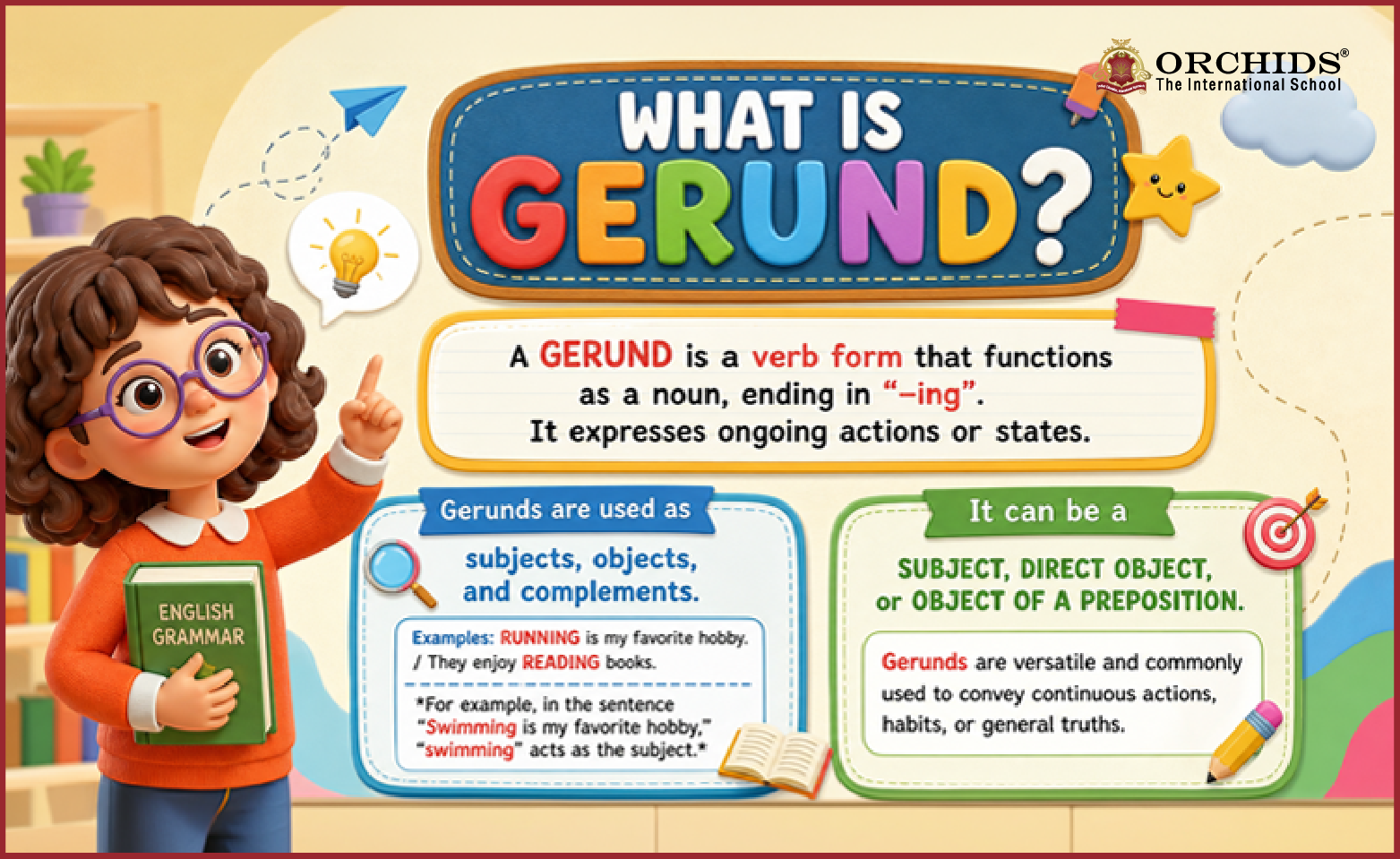
Table of Contents
- What Is a Gerund? – Meaning and Definition
- How to Identify a Gerund?
- Forms and Functions of Gerunds
- What are the Difference Between Gerunds and Present Participles?
- Usage of Gerunds in Everyday English
- Common Examples of Gerunds
- Frequently Asked Questions on Gerund

What Is a Gerund? – Meaning and Definition
A gerund is a verb form that functions as a noun by adding “-ing” to the base form of the verb. In English, gerunds are important because they allow us to convert actions into ideas, subjects, and objects within a sentence. When used correctly, gerunds helps you to understand how words can shift rolesdepending on grammatical context. Because they often look like present participles, sometimes confuse the two, but their functions are different. Understanding gerunds gives learners stronger control over sentence structure, clarity, and expression.
A gerund behaves exactly like a noun inside a sentence. It can act as the subject, the object, the complement, or even the object of a preposition. Since gerunds are built from verbs, they carry a sense of action; yet because they function as nouns, they also fit where people, things, ideas, or activities would normally appear. This dual nature is what makes gerunds so unique and essential for mastering English grammar.
How to Identify a Gerund?
Before exploring deeper uses of gerunds, it is important to understand how they can be identified. You may confuse gerunds with present participles because both end in “-ing.” However, while participles function as adjectives, gerunds function as nouns. Identifying this difference requires careful attention to how the word is placed in a sentence and what role it performs. Regular reading and practice make it easier to recognize gerunds instantly.
Gerunds can be identified by asking whether the “-ing” word is acting as a thing in the sentence. If the “-ing” word names an activity, idea, or abstract concept, it is almost certainly a gerund. Unlike participles, gerunds do not describe nouns; instead, they are the nouns. Understanding this distinction builds strong grammatical intuition and helps students avoid mistakes in advanced writing.
Forms and Functions of Gerunds
Gerunds show great flexibility in sentence construction. Because they function like nouns, they can take on almost every position that nouns normally occupy. This means that they can be the subject of a sentence, the direct object, the complement of a verb, or the object of a preposition. Recognizing these functions gives students the confidence to use gerunds to form complex and fluent sentences. Furthermore, knowing how gerunds work prepares learners for advanced topics such as gerund phrases and sophisticated sentence transitions.
Each function of a gerund plays a specific role in expressing ideas. Subjects built with gerunds make sentences more elegant and concise. Objects made of gerunds allow students to express preferences, dislikes, intentions, and habits. Gerunds used after prepositions help form natural and idiomatic English expressions. You’ll explore these structures, they gain stronger control over the rhythm and clarity of their writing.
Gerunds as the Subject of a Sentence
When a gerund becomes the subject, it introduces the main action or idea of the sentence. This is common in English because it makes statements clearer and more direct. Instead of writing long explanations, a gerund places the main activity at the front of the sentence, giving the statement focus and simplicity. You will notice that many general statements about habits, hobbies, and universal truths use gerunds as subjects.
Because actions can become topics through gerunds, subject-gerund constructions help express opinions, rules, observations, and advice. In academic writing, this structure is often used to express abstract ideas in a concise way. When you become comfortable with this pattern, you can write sentences that flow more naturally and sound more formal and polished.
Gerunds as Objects in a Sentence
Gerunds also appear as objects of verbs. Many English verbs require an object that expresses an activity rather than a physical thing. In such cases, gerunds serve this purpose perfectly. They help represent preferences, intentions, and criticisms. This is why students encounter gerunds after common verbs like enjoy, avoid, consider, suggest, and imagine. The more students familiarize themselves with these patterns, the more fluent their writing becomes.
The use of gerunds as objects also helps build variety in sentence construction. Instead of repeating the same basic sentence patterns, you can create more engaging and expressive statements. This not only improves grammar skills but also enhances creativity in both spoken and written communication.
Gerunds as Complements
Sometimes a sentence requires extra information to complete its meaning. Gerunds can fill this space by acting as complements. A complement helps finish the idea started by a subject or a linking verb. With gerunds, the complement expresses what the subject is or does, offering a smooth and complete idea. This structure appears frequently in everyday conversation and academic writing.
Complement gerunds allow you to express identity, roles, or functions through activities. When you learn to use gerunds as complements, they gain the ability to create more meaningful and thoughtful sentences. This form is especially helpful for explaining routines, responsibilities, and personal qualities.
Gerunds as Objects of Prepositions
One of the most common uses of gerunds is after prepositions. English grammar does not allow base verbs to follow prepositions, so gerunds are used to fill this position. You will often see gerunds after prepositions such as in, on, at, for, with, about, and without. This rule is reliable and forms the foundation of many natural English expressions.
Learning this pattern gives you confidence in writing longer and more complex sentences. Prepositional phrases built with gerunds help connect ideas smoothly and provide additional information without sounding forced. Over time, this ability helps learners become more fluent and expressive in language use.
What are the Difference Between Gerunds and Present Participles?
Because both gerunds and present participles end in “-ing,” many students initially find them confusing. However, the difference becomes clear when learners focus on the function of the word. A gerund functions as a noun, while a present participle functions as an adjective or part of a verb tense. Recognizing this difference is crucial for accurate grammar usage.
Present participles help express continuous tenses or describe nouns. In contrast, gerunds name activities or concepts. Understanding this distinction allows students to avoid common errors, especially when writing more complex sentences. With practice, they will instinctively identify whether an “-ing” word is functioning as a noun or an adjective.
Usage of Gerunds in Everyday English
Gerunds appear frequently in everyday English, both in speech and in writing. They help express thoughts, opinions, habits, preferences, and continuous actions as abstract concepts. Because they act as nouns, they simplify expressions that would otherwise require longer explanations. Familiarity with gerund usage helps students communicate more naturally and fluently.
In conversations, people often use gerunds to talk about hobbies, interests, and general behaviors. In written communication, gerunds help construct clear and concise statements. Mastering gerunds equips learners with the tools to speak and write confidently in different real-life situations, whether academic, social, or professional.
Common Examples of Gerunds
Gerunds can be found everywhere in English, and observing their use helps students internalize the concept. Each example highlights how the “-ing” form acts like a noun, fitting naturally into various sentence roles. Take a look at the following sentences to see how gerunds can be used in sentences.
-
Naveen loves reading books.
-
William enjoys playing football.
-
Baking is one of the hobbies I picked up during the pandemic.
-
Dieting and working out on a regular basis will help you stay physically fit and mentally refreshed.
-
When it comes to solving algebraic equations, Rahim is an expert.
-
Working hard is the only way to succeed.
-
Going through the lessons again the day before the exam will help you.
-
The best part of life is making memories.
-
Not many kids like having healthy food.
-
Going to bed early and waking up early are the initial steps to attaining a healthy living.
Frequently Asked Questions on Gerund
1. What is a gerund and examples?
A gerund is a verb ending in "-ing" that functions as a noun in a sentence. It can be the subject, object of a verb, or object of a preposition. Unlike a verb, which describes an action, a gerund refers to the action as a thing.
2. How do you identify a gerund?
To identify a gerund, look for a verb ending in "-ing" that is functioning as a noun in a sentence. You can tell it's a gerund if it's acting as the subject, a direct object, an object of a preposition, or a subject complement, rather than describing a noun or part of a continuous verb tense.
3. Why is it called a gerund?
The name is derived from Late Latin gerundium, meaning "which is to be carried out". In English, the gerund has the properties of both verb and noun, such as being modifiable by an adverb and being able to take a direct object.
4. What is the formula for gerund?
The "gerund formula" is simply verb + -ing, which forms a word that functions as a noun in a sentence.
5. How to differentiate gerund and verb?
A verb describes an action or state of being, while a gerund is a verb form ending in "-ing" that functions as a noun. The key difference is the role they play in a sentence: a verb performs the action, whereas a gerund is the subject of the action, acting as a noun.
6. How to identify the difference between gerund and participle?
The main difference is their function: a gerund acts as a noun, while a present participle acts as an adjective or part of a verb phrase. Both are formed by adding "-ing" to a verb, which can cause confusion, but you can tell them apart by their role in a sentence.
7. What are the 4 functions of gerunds?
Both gerunds and gerund phrases work the same way and have four variations in regard to how they function within a sentence: subject of the sentence, direct object of the sentence, subject complement, and object of a preposition.
8. What are the three rules of gerund?
The three main rules for gerunds are: they can be the subject of a sentence, they follow prepositions, and they function as a noun. They are formed by adding "-ing" to a verb and act like a noun, taking a position in a sentence where a noun would normally go, such as the subject, object, or object of a preposition.
Strong language skills open doors well beyond the classroom, shaping how confidently a child reads, writes and expresses ideas. If you want to know more about how Orchids The International School builds these skills through its English curriculum, get in touch with our admissions team.


Admissions Open for 2026-27
What type of concept pages would you prefer?
CBSE Schools In Popular Cities
- CBSE Schools in Bangalore
- CBSE Schools in Mumbai
- CBSE Schools in Pune
- CBSE Schools in Hyderabad
- CBSE Schools in Chennai
- CBSE Schools in Gurgaon
- CBSE Schools in Kolkata
- CBSE Schools in Indore
- CBSE Schools in Sonipat
- CBSE Schools in Delhi
- CBSE Schools in Rohtak
- CBSE Schools in Bhopal
- CBSE Schools in Aurangabad
- CBSE Schools in Jabalpur
- CBSE Schools in Jaipur
- CBSE Schools in Jodhpur
- CBSE Schools in Nagpur
- CBSE Schools in Ahmednagar
- CBSE School In Tumkur











Orchids The International School is one of India's leading chains of CBSE and ICSE schools, with 130+ schools across the country.