

Identifying the Main Idea of a Story: Clues and Examples
Have you ever read a story or paragraph and thought, “What is this mostly about?” That’s where the main idea comes in! The main idea is the big message or the most important point of what you are reading. It tells you what the whole paragraph is mainly about, while the other sentences give extra details to explain it. Learning to find the main idea is like being a detective. You look for clues in the title, sentences, words, and pictures to understand the text better.
Table of Contents
- What Is the Main Idea
- Clues to Finding the Main Idea
- Exercises on the Main Idea
- Frequently Asked Questions About the Main Idea

What Is the Main Idea
The main idea is the most important information about a topic or a subject in a paragraph. It tells you what the text is mostly about. All the other sentences are supporting details that give more information and help explain the main idea. In simple words, the main idea is the “big picture” of what you are reading. For example, “Riya loves playing football every evening. She practises with her friends in the park. She also watches football matches on TV,” here, the main idea is that Riya loves playing football.
Clues to Finding the Main Idea
Finding the main idea is easy when you look for the right clues. Think like a detective and use these simple strategies:
-
Read the title: The title often tells you what the passage is mostly about. It gives you your first hint about the main idea.
-
Read the Beginning and the End: The first sentence usually introduces the topic, and the last sentence often sums it up. These sentences help you understand the main point.
-
Look for Repeated Words or Ideas: If certain words or ideas appear again and again, they are important. They usually point to the main idea.
-
Look at the Images: Pictures and illustrations give visual clues about what the text is about. They help you understand the big idea quickly.
Exercises on the Main Idea
Exercise 1: Look at the picture given below and find the main idea
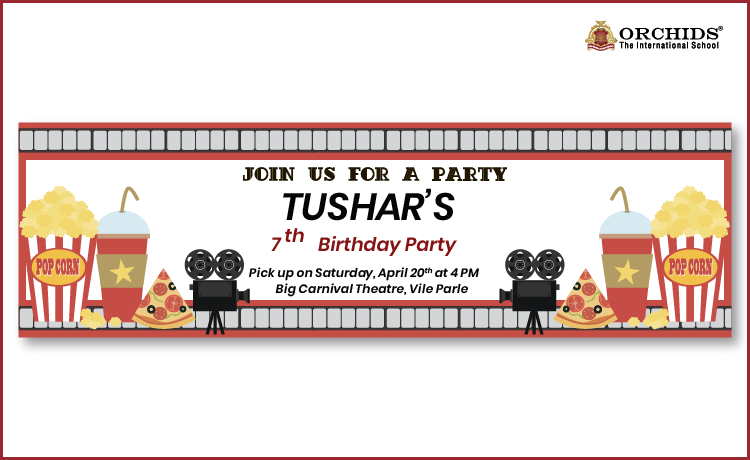
Answer: The main idea of this picture is an invitation to Tushar’s 7th birthday party at a movie theatre.
Exercise 2: Read the following paragraph and answer the questions that follow.
There was once a king named Midas. He was greedy for gold. He impressed a Greek god and
got the reward of his choice, that anything he touched would turn into gold. Excitedly, King Midas went touching everything around him and turned them into gold. After a while, King Midas was hungry; he picked up a fruit. It also turned into gold. Midas had a daughter whom he loved a lot. His daughter came running to him. His reward turned into a curse. He repented for his greed and went to the river and wept. King Midas washed away his boon. When he returned to his palace, all the things that he had touched were back to their original form. He was now a happy and content king.
-
Who is the main character of this story?
-
Name two supporting characters.
-
When did he realise that the boon was actually a curse?
-
After he touched the first thing.
-
After he reached the river.
-
After he entered his palace.
-
After he touched his daughter.
-
What is the main idea of the story?
Answers:
-
King Midas
-
The supporting characters are King Midas’s daughter and a Greek god.
-
After he touched his daughter.
-
The main idea of the story is King Midas's greed for gold and how it turns into a curse and teaches him a lesson.
Frequently Asked Questions About the Main Idea
1. What is the main idea of the story?
Answer: The main idea of a story is the most important message or the big point the author wants to share. It tells what the whole story is mostly about.
2. How to find the main idea of a story?
Answer: The main idea of a story can be found by reading the title, first and last sentence, looking for repeated words or ideas, and pictures. Then ask yourself, “What is this story mostly about?”
3. Why is it important to understand the main idea of a story?
Answer: Understanding the main ideas of a story helps you understand the story better, remember important information, and know what the author wants to say.
Strong language skills open doors well beyond the classroom, shaping how confidently a child reads, writes and expresses ideas. If you want to know more about how Orchids The International School builds these skills through its English curriculum, get in touch with our admissions team.


Admissions Open for 2026-27
What type of concept pages would you prefer?
CBSE Schools In Popular Cities
- CBSE Schools in Bangalore
- CBSE Schools in Mumbai
- CBSE Schools in Pune
- CBSE Schools in Hyderabad
- CBSE Schools in Chennai
- CBSE Schools in Gurgaon
- CBSE Schools in Kolkata
- CBSE Schools in Indore
- CBSE Schools in Sonipat
- CBSE Schools in Delhi
- CBSE Schools in Rohtak
- CBSE Schools in Bhopal
- CBSE Schools in Aurangabad
- CBSE Schools in Jabalpur
- CBSE Schools in Jaipur
- CBSE Schools in Jodhpur
- CBSE Schools in Nagpur
- CBSE Schools in Ahmednagar
- CBSE School In Tumkur











Orchids The International School is one of India's leading chains of CBSE and ICSE schools, with 110+ schools across the country.