

Mastering Modal Auxiliary Verbs for Class 7: Meaning, Uses, and Real-Life Examples
Modal auxiliary verbs help us express ideas such as ability, permission, possibility, advice, obligation, and certainty. These verbs work with main verbs to add meaning and show the speaker’s intention or attitude.
In this article, students will learn how modal auxiliaries function in different contexts and how their meanings change depending on the situation.
Table of Contents
- What Are Modal Auxiliary Verbs?
- Why Do We Use Modal Verbs?
- Functions of Modal Auxiliaries
- Key Rules to Remember
- Common Errors
- Apply Your Learning
- Frequently Asked Questions about Modal Auxiliary Verbs

What Are Modal Auxiliary Verbs? (Let’s Break It Down Simply)
Read the following conversation and observe the use of the highlighted words:
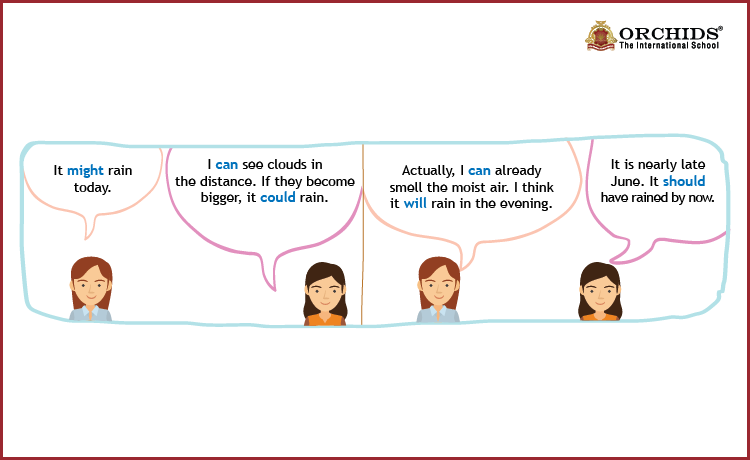
Here, words like 'might', 'can', 'should', and 'could', which indicate different degrees of certainty or obligatory actions about rain, are called 'modal verbs' or 'modal auxiliaries'.
Why Do We Use Modal Verbs
We use modal verbs when we want to:
- Ask politely
- Give advice
- Show certainty or doubt
- Talk about rules or responsibilities
- Make offers or suggestions
Instead of saying “You go home”, we say:
- You should go home (advice)
- You must go home (strong obligation)
Functions of Modal Auxiliaries
Modal verbs are best understood through their functions. The same modal can express different meanings depending on the context.
1. Ability
Used to describe what someone is capable of doing.
Modals used: can, could
Examples:
- Megha can play the guitar.
- I could also play it when I was young.
2. Possibility
Used to express that something may or is likely to happen.
Modals used: can, could, may, might, would
Examples:
- Chicken pox can be really dangerous.
- The ring you gave her could be very valuable.
- Father may be waiting for us at the theatre.
- He might not come to your anniversary party.
- Would Meena accompany us if we asked her?
3. Suggestion
Used to suggest an idea or recommend a course of action.
Modals used: could, shall
Examples:
- You could give me some money.
- Shall we buy a present for her?
4. Asking or Giving Permission
Used to seek or grant approval to do something.
Modals used: can, could, may
Examples:
- You can go to the playground.
- We could watch a movie tomorrow.
- May I leave the room? (polite)
- You may leave the room.
- Can I go to the party tonight? (less polite)
5. Prohibition
Used to show that something is not allowed.
Modals used: mustn’t, should never
Examples:
- You mustn’t disobey your teacher.
- One should never repeat one’s mistakes.
6. Future Action
Used to talk about decisions or events in the future.
Modal used: will
Example:
- Manu will visit her grandmother during the summer vacation.
7. Probability
Used to indicate how likely something is to happen.
Modals used: may, might, would, will, must
Examples:
- Megan may have gone to France.
- Tina might have already told the news. (weak)
- What would they have done without your help?
- Madhu will enjoy the movie, Captain Marvel.
- Mena must be joking. (strong)
8. Offer
Used to offer help, services, or something to someone.
Modals used: shall, will,
Examples:
- Shall I bring tea for you?
- Will you have a samosa?
9. Obligation
Used to express duty or responsibility.
Modals used: must, should
Examples:
- You must study harder or you’ll fail! (strong)
- I should be working, but I’m too worn out to work. (weak)
10. Request
Used to ask someone to do something, often politely.
Modals used: can, could, would
Examples:
- Can Shina go to the party tonight?
- Could you lend him some money, please?
- Would you please switch off the light? (polite request)
11. Necessity
Used to show that something is required or essential.
Modals used: must, have to, has to
Examples:
- We must take care of our health.
- We have to work diligently to succeed.
- Sumi has to go to the market because she has run out of pens.
12. Advice
Used to guide or recommend what someone should do.
Modals used: should, must
Examples:
- You should visit the doctor tomorrow. (less emphatic)
- You must visit the doctor tomorrow! (emphatic advice)
Key Rules to Remember
- Modal auxiliaries are always followed by the base form of the verb.
- They do not change form based on the subject.
- They do not require do/does/did to form questions.
- Negative forms are made by adding not (cannot, should not, must not).
Common Errors
1. Using the wrong verb form after a modal
Wrong: She might goes to school.
Right: She might go to school.
2. Using more than one modal in a sentence
Wrong: He will must complete the task.
Right: He must complete the task.
3. Incorrect negative structure
Wrong: She not can attend the meeting.
Right: She cannot attend the meeting.
4. Confusing levels of certainty
Wrong: It might definitely happen.
Right: It will definitely happen.
Apply Your Learning
1. Match the sentences in column A with the functions of the modals used in column B:
|
A |
B |
|
1. It might be difficult to find a taxi during peak hours. |
a. asking for permission |
|
2. Could you please hand me the scissors? |
b. ability |
|
3. May I leave a few minutes before the break? |
c. offer |
|
4. Rajeev says that he can swim well, even in cold water. |
d. strong obligation |
|
5. You should not sit with your back crouched. |
e. future action |
|
6. Shall I buy you lunch today? |
f. probability |
|
7. Everyone must carry their identity cards. |
g. advice |
|
8. I will be in Ahmedabad tomorrow. |
h. polite request |
2. Fill in the blanks with the correct modals. There may be more than one answer.
(can, might, should, will, would)
- If you don’t finish your lunch quickly, we .................... be late.
- The amusement park is so huge, one .................... easily get lost.
- .................... you please help me carry these bags to the car?
- The president .......... visit our city, but I am not sure.
- We ............... wash our hands regularly to avoid infection.
3. Re-write the following sentences using modals without changing the meaning of the sentences. One has been done for you.
a) I suggest that the patient goes to a good doctor!
The patient should go to a good doctor.
b) I think a bachelor’s degree is necessary for this job.
You .........................................................................................................
c) Perhaps your friend will pick you up from the airport.
Your friend ...............................................................................................
d) Eating is not allowed in the class!
You .........................................................................................................
e) Probably, the government will declare a holiday tomorrow.
The government .........................................................................................
Frequently Asked Questions about Modal Auxiliary Verbs
1. What are modal auxiliary verbs?
Modal auxiliary verbs are helping verbs that express ideas such as ability, permission, possibility, obligation, or advice. They are always used with the base form of the main verb to add meaning to a sentence.
2. What are some common modal verbs?
Some common modal verbs include can, could, may, might, must, shall, should, will, would, and ought to. Each of these is used to express different functions like ability, suggestion, or certainty.
3. Can a modal verb be used alone in a sentence?
No, modal verbs cannot be used alone. They must always be followed by a main verb in its base form to complete the meaning of the sentence.
4. What is the difference between ‘may’ and ‘might’?
Both may and might are used to express possibility. However, might is used when the possibility is less certain compared to may.
5. How do we form negative sentences with modal verbs?
Negative sentences are formed by adding not after the modal verb. For example: cannot, should not, must not. These forms help express prohibition, advice, or lack of possibility.
6. Can we use two modal verbs together?
No, only one modal verb should be used in a sentence at a time. Using more than one modal can make the sentence grammatically incorrect.
Strong language skills open doors well beyond the classroom, shaping how confidently a child reads, writes and expresses ideas. If you want to know more about how Orchids The International School builds these skills through its English curriculum, get in touch with our admissions team.


Admissions Open for 2026-27
What type of concept pages would you prefer?
CBSE Schools In Popular Cities
- CBSE Schools in Bangalore
- CBSE Schools in Mumbai
- CBSE Schools in Pune
- CBSE Schools in Hyderabad
- CBSE Schools in Chennai
- CBSE Schools in Gurgaon
- CBSE Schools in Kolkata
- CBSE Schools in Indore
- CBSE Schools in Sonipat
- CBSE Schools in Delhi
- CBSE Schools in Rohtak
- CBSE Schools in Bhopal
- CBSE Schools in Aurangabad
- CBSE Schools in Jabalpur
- CBSE Schools in Jaipur
- CBSE Schools in Jodhpur
- CBSE Schools in Nagpur
- CBSE Schools in Ahmednagar
- CBSE School In Tumkur











Orchids The International School is one of India's leading chains of CBSE and ICSE schools, with 110+ schools across the country.