

What Is a Prefix in English: Definition, Meaning, Types and Examples
A prefix is a set of letters added to the beginning of a word to change its meaning or form a new word. Prefixes help you to understand word structure, expand vocabulary, and decode unfamiliar terms more easily. They make reading, writing, and communication clearer by giving clues about what a word means even before you read the whole phrase. Here, you will get a clear understanding of what prefixes are, how they work, and how to use them with examples and practice.
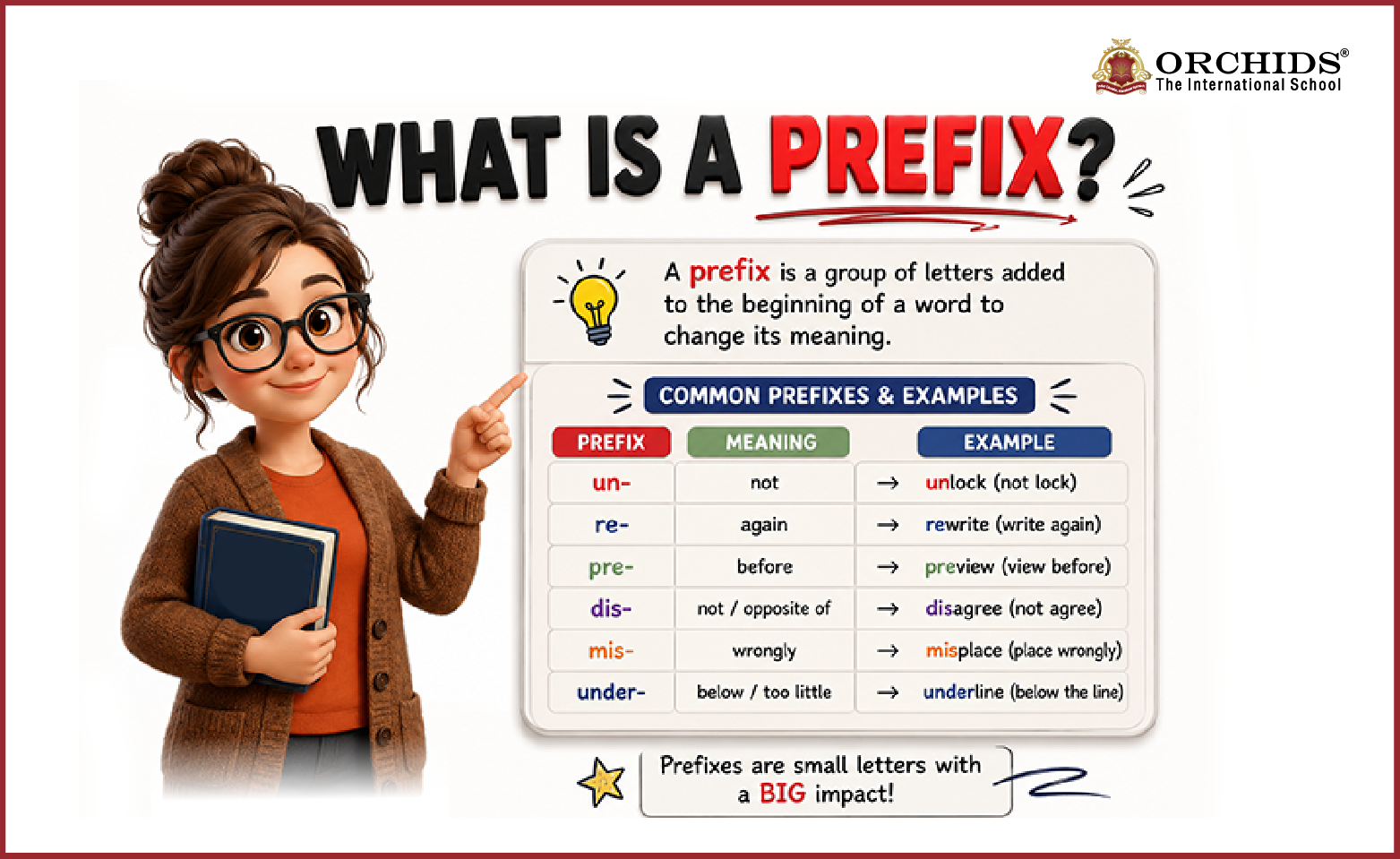
Table of Contents
- What Is a Prefix? – Definition and Meaning
- What Are the Types of Prefixes in English?
- How Prefixes Change Word Meanings
- List of 100+ Common Prefixes with Examples
- How to Use Prefixes Correctly
- Frequently Asked Questions on Prefix

What Is a Prefix? - Definition and Meaning
A prefix is a group of letters added to the beginning of a root word to change its meaning. Prefixes do not stand alone as complete words. They only add additional meaning, such as negation, number, size, time, repetition, or direction. By understanding the meaning of a prefix, you can often guess the meaning of the complete word.
Prefixes are helpful tools for students because they make vocabulary easier to understand. Once you are familiar with the most common prefixes, words that looked difficult earlier start to make sense. For example, if you know that “pre-” means before, you can understand that “preview” means to view something before others. Similarly, “un-” means not, so “unfair” clearly means not fair.
Learning prefixes also encourages better spelling and improves reading comprehension. Now, let us explore the different types of prefixes and how they function.
What Are the Types of Prefixes in English?
English has dozens of prefixes, but some are used far more frequently than others. Understanding the most common ones gives you the foundation to interpret hundreds of words. In this section, we will look at each type with clear explanations and examples.
Prefixes can be broadly grouped according to the purpose they serve. Some prefixes show negation, some show numbers, some show time, and some show direction or position. Learning prefixes in groups makes them easier to remember because you can connect them with a specific meaning.
Below are the main categories of prefixes studied in school-level English.
1. Negative Prefixes
Negative prefixes are some of the most commonly used prefixes. They simply change a word into its opposite.
Negative prefixes include:
-
un- (not) → unhappy, unfair, unclear
-
in- / im- / ir- / il- (not) → incorrect, impossible, irregular, illegal
-
non- (not) → nonstop, nonfiction, nonliving
These prefixes help create the opposite meaning. For example, “possible” becomes “impossible” and “legal” becomes “illegal”. They are especially helpful in academic writing where contrasts and comparisons are often used.
2. Number Prefixes
Number prefixes indicate how many of something exists. These prefixes come from Latin or Greek roots.
Common examples include:
-
uni- (one) → unicorn, universe
-
bi- (two) → bicycle, bilingual
-
tri- (three) → triangle, tricycle
-
multi- (many) → multicolour, multicultural
Understanding number prefixes is useful in mathematics, science, and general vocabulary building.
3. Time Prefixes
Some prefixes tell us whether something comes before, after, or happens again. Popular time-related prefixes:
-
pre- (before) → prepaid, preschool, preview
-
post- (after) → postpone, postwar
-
re- (again) → rewrite, revisit, redo
These prefixes help us understand the order of events. For example, “preheat” means to heat something before cooking begins.
4. Size and Degree Prefixes
Certain prefixes describe how large, small, or important something is.
Examples include:
-
super- (above, very) → superfast, superhero
-
mini- (small) → minibus, miniskirt
-
hyper- (too much) → hyperactive
-
sub- (below) → submarine, subtitle
These prefixes add intensity or scale to the meaning of a root word.
5. Direction and Position Prefixes
Prefixes can also tell us where something is located or what direction it is moving.
Examples:
-
inter- (between) → international, interact
-
trans- (across) → transport, transfer
-
sub- (under) → subway, subzero
-
ex- (out of, former) → ex-president, extract
These prefixes appear frequently in geography, science, and everyday vocabulary.
How Prefixes Change Word Meanings
Once you understand prefixes, you automatically understand how they modify a word’s meaning. A prefix does not change the root word’s spelling (except sometimes adding or removing letters for pronunciation), but it changes the entire sense of the word. In this section, you’ll explore how the addition of a simple prefix can turn a root word into something completely new.
Prefixes are like small clues that help you decode the meaning of unfamiliar words. When you see a word such as misunderstand, even if you have never heard it before, you know that “mis-” means wrongly and “understand” is the root word. So you can guess that “misunderstand” means to understand wrong. This helps in reading comprehension, especially when dealing with long or unfamiliar terms in science or literature.
Prefixes also increase the flexibility of the English language. Instead of creating entirely new words, you can take one base word and form many variations based on the prefix used. For example:
-
write → rewrite, miswrite, overwrite, underwrite
-
connect → disconnect, reconnect, interconnect
-
place → replace, displace, misplace
This shows how powerful prefixes can be in word formation.
List of 100+ Common Prefixes with Examples
Below is a comprehensive list of more than 100 commonly used prefixes in English. Each prefix includes its meaning and example words so you can clearly see how the meaning changes.
-
un-: not → unhappy, unfair, unlock
-
in- / im- / ir- / il-: not → incorrect, impossible, irrelevant, illegal
-
non-: not → nonstop, nonfiction, nonliving
-
dis-: opposite of, remove → disagree, disconnect, disapprove
-
a- / an-: not → amoral, anonymous
-
pre-: before → preview, preschool, preheat
-
fore-: earlier, before → forecast, foretell
-
ante-: before → antecedent, antedate
-
post-: after → postpone, postgraduate
-
ex-: former → ex-president, ex-employee
-
re-: again → rewrite, redo, reconsider
-
mono-: one → monologue, monotone
-
uni-: one → uniform, unicorn
-
bi- / di-: two → bilingual, dioxide
-
tri-: three → triangle, tricycle
-
quad-: four → quadrant, quadrilateral
-
penta-: five → pentagon
-
hexa-: six → hexagon
-
octa-: eight → octagon
-
deca-: ten → decade, decathlon
-
multi-: many → multicolor, multicultural
-
poly-: many → polysyllable, polygon
-
semi-: half → semicircle, semiannual
-
mini-: small → minibus, minimize
-
micro-: tiny → microscope, microorganism
-
macro-: large → macroeconomics, macrostructure
-
sub-: under → submarine, subway
-
super-: above, beyond → superhuman, superstar
-
inter-: between → international, interact
-
intra-: within → intranet, intravenous
-
trans-: across → transport, translate
-
peri-: around → perimeter, periscope
-
mid-: middle → midday, midterm
-
over-: above, too much → overeat, overreact
-
under-: below, insufficient → underpay, underestimate
-
co- / com- / con-: together → cooperate, combine, connect
-
de-: remove, reverse → defrost, deactivate
-
pro-: forward → progress, promote
-
counter-: against → counterattack, counteract
-
anti-: against → antivirus, antibiotic
-
contra-: against → contradict, contrast
-
hyper-: too much → hyperactive, hypersensitive
-
hypo-: too little → hypothermia, hypodermic
-
geo-: earth → geography, geothermal
-
bio-: life → biology, biography
-
tele-: distant → telephone, television
-
auto-: self → autograph, autobiography
-
mal-: bad → malfunction, malpractice
-
mis-: wrongly → misunderstand, misuse
For better understanding: What Is a Suffix? Definition, Types, Examples and More
How to Use Prefixes Correctly
Learning prefixes is not just about memorising lists. You must also learn the rules that guide correct usage. Although English prefixes generally follow regular patterns, some important points help in avoiding spelling or meaning errors. Here are key guidelines:
1. A prefix does not change the root word’s form
Example: kind → unkind, wrap → unwrap
2. Some prefixes change spelling based on pronunciation
For example: in- becomes im- before “p” or “m”: impossible, immature
3. A prefix should not be separated from the word
Incorrect: un happy
Correct: unhappy
4. Some words already include a prefix even if they look simple
For example, reply has “re-”, but it doesn’t mean “reply again”.
Some words do not follow prefix rules because of their historical origin.
Learn more about: Prefix and Suffix – Meaning, Rules, and Examples
Frequently Asked Questions on Prefix
1. What is a prefix and an example?
A prefix is a letter or group of letters added to the beginning of a word to change its meaning. For example, adding "un-" to "happy" creates "unhappy," and adding "re-" to "write" becomes "rewrite". Prefixes alter the meaning of the root word, often creating the opposite meaning (e.g., "impossible"), signifying a time period (e.g., "pre-war"), or indicating quantity (e.g., "bicycle").
2. What is a prefix for your name?
You can use a prefix to describe the title you put before someone's name. For example, Mr., Mrs., and Dr. are all common prefixes.
3. What are a prefix and a suffix?
A prefix is a word part added to the beginning of a root word to change its meaning (e.g., "un-happy"). A suffix is a word part added to the end of a root word to change its meaning or grammatical function.
4. What are the prefixes for 10, 100, and 1000?
The prefixes are deca (10), hecto (100), and kilo (1000). These are part of the International System of Units (SI) and are used to create multiples or fractions of a base unit, such as a decameter, hectoliter, or kilogram.
Strong language skills open doors well beyond the classroom, shaping how confidently a child reads, writes and expresses ideas. If you want to know more about how Orchids The International School builds these skills through its English curriculum, get in touch with our admissions team.


Admissions Open for 2026-27
What type of concept pages would you prefer?
CBSE Schools In Popular Cities
- CBSE Schools in Bangalore
- CBSE Schools in Mumbai
- CBSE Schools in Pune
- CBSE Schools in Hyderabad
- CBSE Schools in Chennai
- CBSE Schools in Gurgaon
- CBSE Schools in Kolkata
- CBSE Schools in Indore
- CBSE Schools in Sonipat
- CBSE Schools in Delhi
- CBSE Schools in Rohtak
- CBSE Schools in Bhopal
- CBSE Schools in Aurangabad
- CBSE Schools in Jabalpur
- CBSE Schools in Jaipur
- CBSE Schools in Jodhpur
- CBSE Schools in Nagpur
- CBSE Schools in Ahmednagar
- CBSE School In Tumkur











Orchids The International School is one of India's leading chains of CBSE and ICSE schools, with 130+ schools across the country.