

Instruments used by Sailors: Directional Tools, Important Navigation Terms and Concepts
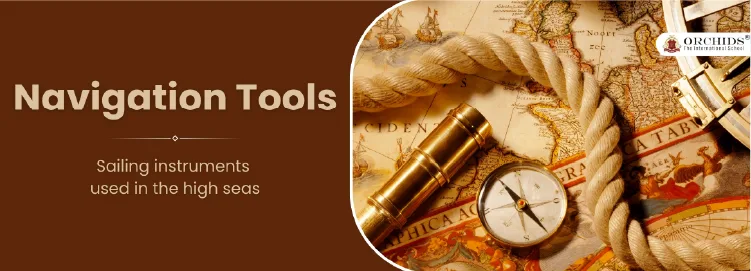
Imagine being on a ship in the middle of the ocean with water all around you. There are no directional signs, no landmarks and no roads. How will you decide which direction to go safely? For navigating safely in the ocean, there are some important directional instruments used by sailors. These instruments are helpful for sailing through the deep sea water while avoiding hidden dangers. Here are some of the important instruments used by sailors to navigate safely through the oceans along with related terms and concepts.
Table of Contents
- Compass
- Sextant
- Marine Radar
- GPS and Electronic Charts
- Echo Sounder
- Frequently Asked Questions about Instruments used by Sailors

Compass
It is a reliable directional tool used by sailors for over 1,000 years. It has a magnetic needle that alights with earth’s magnetic field to always point towards north. Once the sailors know where north is, they can easily tell the rest of the three directions. Even in the darkest stormy night a sailor can steer the ship in the right direction using a compass. If the technology in ships fails for some reasons, compass remains a crucial source of information for sailors guiding them through the right direction in the water.
Sextant
A small triangular metal device that looks like the slice of a pizza has a mirror, a small telescope and a scale attached to the bottom edge. It computes the angle between horizon and sun or a star to help sailors understand their location on earth. By aligning the north star or sun through the sextant the sailors can detect the angle formed between horizon and celestial object to calculate the exact latitude on earth.
Marine Radar
Short for radio detection and ranging(RADAR), it is one of the most important tools used by sailors to detect other objects such as icebergs, islands or ships sailing in the water to avoid collision. There is an antenna on the top of the ship that revolves around and sends radio or microwave electromagnetic waves. It detects the targets by reflected waves and generates a picture on a display of the ship about the surroundings. In modern ships these devices are used along with a GPS navigation system or sonar display to provide a combined view of the surroundings.
GPS and Electronic Charts
Global positioning system or GPS is fixed into the ship’s control room to monitor the map of the ocean with a red dot blinking to show the ship’s position and the direction it is heading to. This device on the ship is used by sailors to detect their location in the ocean. It receives signals from one of the GPS satellites orbiting earth. With the help of time each signal took to travel from space to the ship, the GPS system on the ship depicts the position of the ship on the map.
Echo Sounder
An echo sounder is a device that sends out the sonar waves into water through a transmitter. The waves transmitted into the water, bounce back after hitting objects like rocks, fishes, ocean floor or wrecks of sunken ships. A receiver on the device listens to these waves and helps to detect any danger or obstacles beneath the water. The time it took for sound to echo back helps determine the distance of the dangerous objects from the ship. This instrument is extremely important for avoiding shipwrecks.
For many years, humans created tools that can help them navigate safely. From simple sticks that measured the angle of the sun to magnetic needles that always pointed north, we are still using these basic ideas as the foundation of modern technological tools and instruments used in the navigation by sailors. So, next time when you see a ship sailing in the ocean remember the names and functions of all the amazing instruments used by sailors.
Frequently Asked Questions about Instruments used by Sailors
1. What is the primary instrument sailors used to find directions in the sea?
A compass is the primary instrument used by sailors to find directions in the sea.
2. Why does the compass needle always point to the north?
A compass needle is a small magnet that aligns itself with earth’s giant magnetic field. It points always towards north under the influence of the invisible magnetic field of earth.
3. What are the common navigational instruments used by sailors?
Global positioning satellite (GPS) systems, radars, compasses, range and depth finders, map measurers and many other common instruments are used by sailors to navigate through the sea.
4. What are the three types of compasses?
Three different types of compasses are gyrocompass, magnetic compass and electronic or satellite compass that uses GPS sensors.
Understanding the world starts with the environment around us. To see how Orchids The International School brings EVS to life, reach out to our admissions team.


Admissions Open for 2026-27
What type of concept pages would you prefer?
CBSE Schools In Popular Cities
- CBSE Schools in Bangalore
- CBSE Schools in Mumbai
- CBSE Schools in Pune
- CBSE Schools in Hyderabad
- CBSE Schools in Chennai
- CBSE Schools in Gurgaon
- CBSE Schools in Kolkata
- CBSE Schools in Indore
- CBSE Schools in Sonipat
- CBSE Schools in Delhi
- CBSE Schools in Rohtak
- CBSE Schools in Bhopal
- CBSE Schools in Aurangabad
- CBSE Schools in Jabalpur
- CBSE Schools in Jaipur
- CBSE Schools in Jodhpur
- CBSE Schools in Nagpur
- CBSE Schools in Ahmednagar
- CBSE School In Tumkur











Orchids The International School is one of India's leading chains of CBSE and ICSE schools, with 110+ schools across the country.