

Time Zones around the World: Meaning, Types and Significance Explained
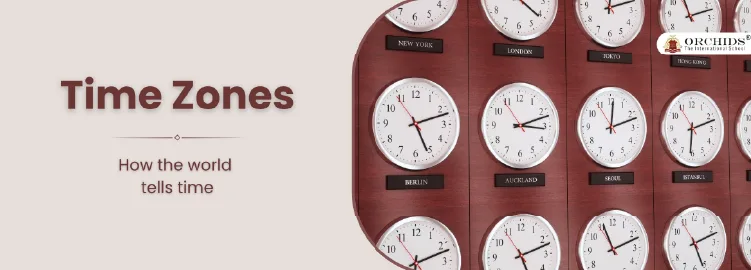
Time zones are defined by the imaginary lines that run from the north pole to the south pole. These imaginary lines are called longitudes. These lines divide earth into 24 time zones, each of which is approximately 15° wide. In the past, people used to tell time based on the position of the sun. However, the sun is not shining down on the whole planet at once. So, different parts of the earth receive sunlight at different times as it spins. If it is daytime in one part of the earth, it is night in the other. Different time zones ensure that noon i.e., 12:00 PM always happens when the sun is high in the sky right at 90° above earth no matter which part we are in. This means different parts will have different time zones. Explore how earth is divided into different time zones and how they work and linked to each other.
Table of Contents
- What is a Time Zone
- Why do We Need Different Time Zones
- Types of Time Zones
- Frequently Asked Questions on Time Zones around the World

What is a Time Zone
A time zone in simple words is an area of the globe which follows a uniform clock time. This means everyone in one time zone agrees to set their clocks at the same time. For example, everywhere in India we follow the same time zone called Indian standard time or IST. Similarly, other countries of the world follow single or multiple time zones. For example, France is the country that follows the highest number of time zones. It has 12 different time zones. Let’s understand why we need them.
Why do we Need Different Time Zones
Time zones exist because the Earth is round and spins. This means two places on the globe can have day and night at the same time. Now imagine we want to contact our friend living in another country, so we call them in the afternoon but we accidentally wake them up at 3 AM in the morning as it's night time in that part of the world and. Time zones were created to avoid such mismatches. By understanding the time zones we can plan our travel and manage global dealing and understand global events easily. They allow us to manage business, transport, travel and communication between different parts of the world without disruptions.
Types of Time Zones
It takes earth exactly 24 hours to spin once around, which is 360 degrees. So to measure the width of each time zone scientists divide 360 degrees by 24 hours. 15 degrees is the width of each time zone and longitude is the imaginary line that divides the earth into those zones. When we travel globally towards the east direction, one hour gets added to each zone. When we travel west, time gets earlier, subtracting one hour per zone.
Time zones start from 0° longitude that divides the globe into the north and south hemisphere. It is the reference for standard time zones. This starting line running through the Royal Observatory in Greenwich, London is called prime meridian and is the anchor for all the world's clocks. UTC is the global reference of time which is the short for coordinated universal time.
Each time zone adopts a fixed offsite from the UTC. For example, Indian standard time or IST zone is UTC+5:30. Although all 24 time zones differ from UTC by a full hour, some are there that are offset at 30 or 45 minutes just like IST. Based on this reference with UTC there are over 38 distinct time zones on earth. Here is a complete list of time zones:
|
UTC Offset |
Time Zone Name |
Countries / Regions |
|
UTC−12:00 |
International Date Line West |
Baker Island, Howland Island (US) |
|
UTC−11:00 |
Niue Time, Samoa Standard Time |
Niue, American Samoa |
|
UTC−10:00 |
Hawaii–Aleutian Standard Time |
Hawaii (US), Cook Islands |
|
UTC−09:30 |
Marquesas Time |
Marquesas Islands (French Polynesia) |
|
UTC−09:00 |
Alaska Standard Time |
Alaska (US), Gambier Islands |
|
UTC−08:00 |
Pacific Standard Time |
California, Nevada, Washington (US), British Columbia (Canada) |
|
UTC−07:00 |
Mountain Standard Time |
Arizona, Colorado, Utah (US), Alberta (Canada) |
|
UTC−06:00 |
Central Standard Time |
Texas, Illinois (US), Mexico City, Saskatchewan (Canada) |
|
UTC−05:00 |
Eastern Standard Time |
New York, Florida (US), Ontario (Canada), Peru, Ecuador |
|
UTC−04:00 |
Atlantic Standard Time |
Nova Scotia (Canada), Venezuela, Bolivia, Puerto Rico |
|
UTC−03:30 |
Newfoundland Standard Time |
Newfoundland (Canada) |
|
UTC−03:00 |
Argentina Time, Brasília Time |
Brazil, Argentina, Uruguay, Greenland |
|
UTC−02:00 |
South Georgia Time |
South Georgia Island, Fernando de Noronha (Brazil) |
|
UTC−01:00 |
Azores Standard Time |
Azores (Portugal), Cape Verde |
|
UTC±00:00 |
Greenwich Mean Time |
UK, Ireland, Portugal, Iceland, Ghana, Senegal |
|
UTC+01:00 |
Central European Time |
France, Germany, Italy, Spain, Nigeria, Algeria |
|
UTC+02:00 |
Eastern European Time |
Greece, Egypt, South Africa, Ukraine, Finland |
|
UTC+03:00 |
Moscow Standard Time |
Russia (Moscow), Saudi Arabia, Kenya, Turkey |
|
UTC+03:30 |
Iran Standard Time |
Iran |
|
UTC+04:00 |
Gulf Standard Time |
UAE, Oman, Azerbaijan, Georgia, Armenia |
|
UTC+04:30 |
Afghanistan Time |
Afghanistan |
|
UTC+05:00 |
Pakistan Standard Time |
Pakistan, Uzbekistan, Tajikistan, Maldives |
|
UTC+05:30 |
India Standard Time |
India, Sri Lanka |
|
UTC+05:45 |
Nepal Time |
Nepal |
|
UTC+06:00 |
Bangladesh Standard Time |
Bangladesh, Bhutan, Kazakhstan (Almaty) |
|
UTC+06:30 |
Cocos Islands Time, Myanmar Time |
Myanmar, Cocos Islands |
|
UTC+07:00 |
Indochina Time |
Thailand, Vietnam, Indonesia (West), Cambodia, Laos |
|
UTC+08:00 |
China Standard Time |
China, Singapore, Malaysia, Philippines, Western Australia |
|
UTC+08:45 |
Australian Central Western Time |
Eucla region (Australia) |
|
UTC+09:00 |
Japan Standard Time |
Japan, South Korea, North Korea, East Timor |
|
UTC+09:30 |
Australian Central Standard Time |
Northern Territory, South Australia |
|
UTC+10:00 |
Australian Eastern Standard Time |
Queensland, New South Wales, Victoria, Papua New Guinea |
|
UTC+10:30 |
Lord Howe Standard Time |
Lord Howe Island (Australia) |
|
UTC+11:00 |
Solomon Islands Time |
Solomon Islands, Vanuatu, New Caledonia |
|
UTC+12:00 |
New Zealand Standard Time |
New Zealand, Fiji, Kiribati (Gilbert Islands) |
|
UTC+12:45 |
Chatham Standard Time |
Chatham Islands (New Zealand) |
|
UTC+13:00 |
Tonga Time, Phoenix Islands Time |
Tonga, Samoa, Kiribati (Phoenix Islands) |
|
UTC+14:00 |
Line Islands Time |
Kiribati (Line Islands) |
This is how we calculate the standard time for the entire world using time zones. Today, the whole world follows this approach of standard time to relate with different time zones on the globe for trade, communication, financial deals, travel and more.
Frequently Asked Questions on Time Zones around the World
1. How many time zones does the world have?
The world is divided into 24 time zones each of which is 15 degrees.
2. Who invented the modern time zone system?
In 1876, a brilliant Scottish-Canadian engineer named Sir Sandford Fleming invented the time zone.
3. Each time zone is how many degrees of longitude wide?
Each time zone is fifteen degrees longitude wide. Since earth completes a 360° rotation in 24 hours. It can be divided into 15 time zones as: 360/24 = 15
4. Which country has the most time zones?
France is the only country with 12 time zones. It has the highest number of time zones.
5. What is prime meridian?
Prime Meridian is the starting line of time zones that goes through the Royal Observatory in Greenwich, London.
Understanding the world starts with the environment around us. To see how Orchids The International School brings EVS to life, reach out to our admissions team.


Admissions Open for 2026-27
What type of concept pages would you prefer?
CBSE Schools In Popular Cities
- CBSE Schools in Bangalore
- CBSE Schools in Mumbai
- CBSE Schools in Pune
- CBSE Schools in Hyderabad
- CBSE Schools in Chennai
- CBSE Schools in Gurgaon
- CBSE Schools in Kolkata
- CBSE Schools in Indore
- CBSE Schools in Sonipat
- CBSE Schools in Delhi
- CBSE Schools in Rohtak
- CBSE Schools in Bhopal
- CBSE Schools in Aurangabad
- CBSE Schools in Jabalpur
- CBSE Schools in Jaipur
- CBSE Schools in Jodhpur
- CBSE Schools in Nagpur
- CBSE Schools in Ahmednagar
- CBSE School In Tumkur











Orchids The International School is one of India's leading chains of CBSE and ICSE schools, with 130+ schools across the country.