

130 in Roman Numerals
130 in Roman numerals is written as CXXX. The Roman numeral system uses letters to represent values according to addition and subtraction rules. To convert 130, we break it into parts: 130 = 100 + 30. Here, 100 is represented by C, and 30 is written as XXX (10 + 10 + 10). Putting them together gives CXXX. Understanding 130 in Roman numerals helps students learn how Roman symbols are combined logically to form larger numbers and improves number sense in historical number systems.
Table of Contents
- How to Write 130 in Roman Numerals?
- Roman Numerals for Numbers Related to 130
- Solved Examples on 130 in Roman Numerals
- Fun Facts on 130 in Roman Numerals
- Practice Questions on 130 in Roman Numerals
- Conclusion
- Frequently Asked Questions on 130 in Roman Numerals

How to Write 130 in Roman Numerals?
To write 130 in Roman numerals, we use a simple place-value method. Roman numerals are formed by combining symbols that represent specific values.
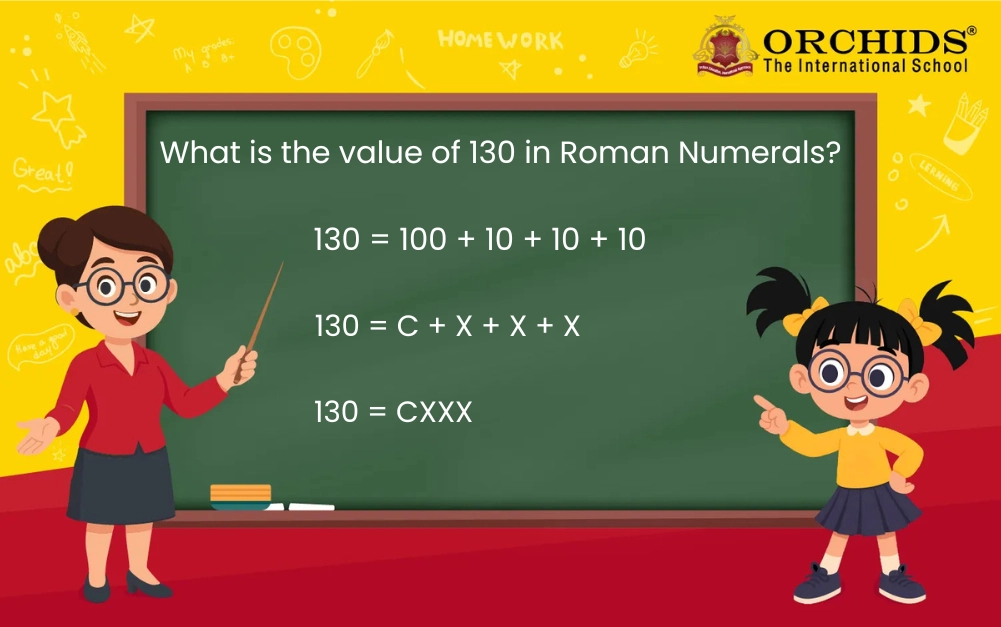
First, break 130 into smaller place values:
-
130 = 100 + 10 + 10 + 10
Now convert each number into its Roman symbol:
-
100 = C
-
30 = XXX (10 + 10 + 10)
Next, combine the symbols: C + XXX = CXXX
So, 130 in Roman numerals is written as CXXX.
Know more about related topics:
Roman Numerals for Numbers Related to 130
|
Number |
Roman Numeral |
|
125 |
CXXV |
|
126 |
CXXVI |
|
127 |
CXXVII |
|
128 |
CXXVIII |
|
129 |
CXXIX |
|
130 |
CXXX |
|
131 |
CXXXI |
|
132 |
CXXXII |
|
133 |
CXXXIII |
|
134 |
CXXXIV |
|
135 |
CXXXV |
Solved Examples on 130 in Roman Numerals
Example 1: What is the remainder when CXXX is divided by XI?
Solution:
First, convert the Roman numerals into numbers:
-
CXXX = 130
-
XI = 11
Now divide:
130 ÷ 11 = 11 remainder 9
Convert the remainder 9 into Roman numerals:
-
9 = IX
Therefore, when CXXX is divided by XI, the remainder is IX.
Example 2: Find the sum of 130 and 45 in Roman numerals.
Solution:
Add the numbers:
-
130 + 45 = 175
Now convert 175 into Roman numerals:
175 = 100 + 70 + 5
= C + LXX + V
= CLXXV
So, the sum of 130 and 45 in Roman numerals is CLXXV.
Example 3: Find the Value of (50 − 20) + 130 in Roman Numerals.
Solution:
First solve inside the bracket:
50 − 20 = 30
Now add 130:
-
30 + 130 = 160
Convert 160 into Roman numerals:
160 = 100 + 50 + 10
= C + L + X
= CLX
Therefore, the answer in Roman numerals is CLX.
Example 4: What is the Difference Between 500 and 130 in Roman Numerals?
Solution:
Subtract the numbers:
-
500 − 130 = 370
Now convert 370 into Roman numerals:
370 = 300 + 70
= CCC + LXX
= CCCLXX
Hence, the difference written in Roman numerals is CCCLXX.
Example 5: If CXXX is increased by XXV, what is the result in Roman numerals?
Solution:
Convert to numbers:
-
CXXX = 130
-
XXV = 25
Now add:
-
130 + 25 = 155
Convert 155 into Roman numerals:
155 = 100 + 50 + 5
= C + L + V
= CLV
Therefore, increasing 130 in Roman numerals (CXXX) by XXV gives CLV.
Fun Facts on 130 in Roman Numerals
-
130 in Roman numerals is CXXX, made from C (100) and three X (10 + 10 + 10).
-
It follows only the addition rule; no subtraction symbols are used.
-
The symbol X is repeated three times, which is the maximum allowed repetition.
-
'C' comes from the Latin word 'centum', meaning 'one hundred'.
-
Roman numerals like CXXX are still used in clocks, book chapters, and monuments today.
Practice Questions on 130 in Roman Numerals
1. Add 130 and 60. Write the final answer in Roman numerals.
2. Subtract 30 from 130 and express the result in Roman numerals.
3. Multiply 130 by 2 and convert the answer into Roman numerals.
4. Divide 130 by 10. Write the quotient in Roman numerals.
5. Identify the Roman symbols used to form 130 in Roman numerals.
Conclusion
130 in Roman numerals is written as CXXX. It is formed by combining 100 (C) and 30 (XXX). The number 30 is shown by writing X three times, which means 10 + 10 + 10. In this case, Roman numerals use the addition rule to build the number step by step. Understanding how to write 130 in Roman numerals helps students clearly see how repeated symbols increase value. Practising nearby numbers like 129 (CXXIX), 131 (CXXXI), and 140 (CXL) makes it easier to recognise patterns and improve confidence in reading Roman numerals found in chapters, clocks, and important dates.
Learn 130 in Roman numerals in a simple and clear way with guided lessons at Orchids International School.
Numbers make sense when they're taught right. To see how Orchids The International School turns Maths from intimidating to intuitive, reach out to our admissions team.
Frequently Asked Questions on 130 in Roman Numerals
1. How is 130 calculated in Roman numerals?
-
130 is written using the addition rule in Roman numerals. First, break the number into parts: 130 = 100 + 30
-
100 is written as C, and 30 is written as XXX (10 + 10 + 10). So, 130 = C + XXX = CXXX.
2. Why is 130 written as CXXX instead of another combination?
In the Roman numeral system, the symbol X (10) can be repeated up to three times in a row. Since 30 equals 10 + 10 + 10, it is written as XXX. When placed after C (100), it becomes CXXX, which correctly represents 130.
3. What basic Roman numeral symbols are used to write 130?
Only two main Roman symbols are required:
-
C = 100
-
X = 10
By combining these symbols properly, we get CXXX.
4. What are some numbers close to 130 in Roman numerals?
Here are a few related numbers:
-
129 = CXXIX
-
131 = CXXXI
-
140 = CXL (40 is written as XL using the subtraction rule: 50 − 10)
5. Is CXXX a prime number?
No, 130 is not a prime number. It is a composite number because it has several divisors, such as 1, 2, 5, 10, 13, 26, 65, and 130.
Related Links


Admissions Open for 2026-27
What type of concept pages would you prefer?
CBSE Schools In Popular Cities
- CBSE Schools in Bangalore
- CBSE Schools in Mumbai
- CBSE Schools in Pune
- CBSE Schools in Hyderabad
- CBSE Schools in Chennai
- CBSE Schools in Gurgaon
- CBSE Schools in Kolkata
- CBSE Schools in Indore
- CBSE Schools in Sonipat
- CBSE Schools in Delhi
- CBSE Schools in Rohtak
- CBSE Schools in Bhopal
- CBSE Schools in Aurangabad
- CBSE Schools in Jabalpur
- CBSE Schools in Jaipur
- CBSE Schools in Jodhpur
- CBSE Schools in Nagpur
- CBSE Schools in Ahmednagar
- CBSE School In Tumkur











Orchids The International School is one of India's leading chains of CBSE and ICSE schools, with 110+ schools across the country.