

150 in Roman Numerals: Rules, Solved Examples & Practice Questions
150 in Roman numerals is written as CL, an ancient method used by the Romans to represent numbers. In this form, C means 100 and L means 50, so CL means 100 + 50 = 150. Understanding how to read and write numbers in Roman numerals strengthens math skills and logical thinking, showing how values combine to form bigger numbers. The study of CL is not only a mathematical skill but also a link to the past, which makes number study more interesting and meaningful in everyday life.
Table of Contents
- How to Write 150 in Roman Numeral?
- Basic Rules to Write 150 in Roman Numerals
- Roman Numerals for Numbers Related to 150
- Solved Examples on Roman Numeral 150
- Facts About 150 in Roman Numerals
- Practice Questions on 150 in Roman Numeral
- Conclusion
- Frequently Asked Questions on 150 in Roman Numerals

How to Write 150 in Roman Numeral?
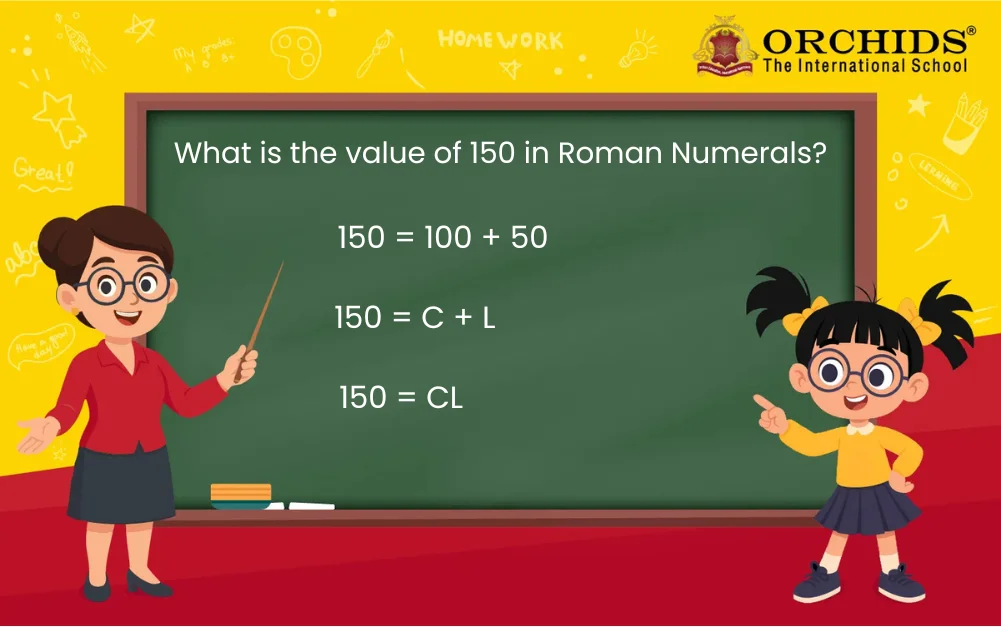
To write 150 in Roman numerals, we use the symbols that represent tens and units. The principal Roman numeral symbols are:
Step-by-step:
- C = 100
- L = 50
- Add them: 100 + 50 = 150
Therefore, 150 in Roman numerals = CL
Know more about related topics:
Basic Rules to Write 150 in Roman Numerals
1. Know the values:
-
I = 1
-
V = 5
-
X = 10
-
L = 50
-
C = 100
-
D = 500
-
M = 1000
2. Write numerals from largest to smallest:
-
Write the largest numeral first. For 100, write C (for 100) followed by L (for 50).
3. Add the values when smaller or equal numerals follow larger ones:
- When a smaller symbol follows a larger one, add their values.
So, C (100) + L (50) = CL (150).
4. No subtractive rules needed:
-
Since 150 doesn’t require subtraction like XL (40) or IX (9), simply add the numeral values.
Roman Numerals for Numbers Related to 150
-
CL = 100 + 50 = 150
-
CLI = 100 + 50 + 1 = 151
-
CLII = 100 + 50 + 2 = 152
-
CLIII = 100 + 50 + 3 = 153
-
CLIV = 100 + 50 + 4 = 154
-
CLV = 100 + 50 + 5 = 155
-
CLVI = 100 + 50 + 6 = 156
-
CLVII = 100 + 50 + 7 = 157
-
CLVIII = 100 + 50 + 8 = 158
-
CLIX = 100 + 50 + 9 = 159
-
CLX = 100 + 50 + 10 = 160
Solved Examples on Roman Numeral 150
Example 1: A box contained C (100) crayons, and the teacher added L (50) more crayons. Express the total number of crayons in Roman numerals.
Solution:
100 + 50 = 150
Therefore, 150 = CL.
Example 2: Add LX (60) and XC (90). Write the total in Roman numerals.
Solution:
60 + 90 = 150
Therefore, 150 = CL.
Example 3: Subtract L (50) from CC (200). Express the result in Roman numerals.
Solution:
200 - 50 = 150
Therefore, 150 = CL.
Example 4: Multiply XV (15) by X (10). Write the answer in Roman numerals.
Solution:
15 × 10 = 150
Therefore, 150 = CL.
Example 5: What is the sum of C (100) and L (50)? Write the result in Roman numerals.
Solution:
100 + 50 = 150
Therefore, 150 = CL.
Facts About 150 in Roman Numerals
-
Roman Numeral: 150 is written as CL (100 + 50).
-
Symbol Set: Only two symbols are used: C and L.
-
No Subtraction Needed: 150 doesn’t use forms like XL (40) or XC (90); it is written using simple addition.
-
Decomposition: C = 100, L = 50. 100 + 50 = 150.
-
Number Property: 150 is an even composite number; some of its divisors are 1, 2, 3, 5, 6, 10, 15, 25, 30, 50, 75, and 150.
Practice Questions on 150 in Roman Numeral
- Write the predecessor and successor of CL in Roman numerals.
- Break CL into hundreds and tens using Roman numerals.
- Add XX to CL and write the result in Roman numerals.
- Subtract L from CL and express the result in Roman numerals.
- How many fifties are there in CL? Write your answer in Roman numerals.
- Write CL using only addition of symbols (expanded form).
- Compare CL and CXL using >, <, or =.
- If CL is divided by V, what is the quotient? Write in Roman numerals.
- A shop distributes CL items equally among V people. How many items does each person get? Write in Roman numerals.
- Is CL divisible by X? Justify your answer by converting and checking.
Conclusion
In Roman numerals, 150 is written as CL by combining C (which represents 100) and L (which represents 50). This is a simple example that helps students understand how Roman numerals are used similarly to creating numbers. Learning it also makes it easier to read and write different Roman numerals.
Discover more articles on 150 in Roman numerals (CL) and related Maths concepts at Orchids The International School, we explain topics with simple steps for easy learning.
Frequently Asked Questions on 150 in Roman Numerals
1. What is 150 in Roman Numerals?
150 in Roman Numerals is written as CL.
This is because:
-
C = 100
-
L = 50
100 + 50 = 150 is CL
Therefore, 150 in Roman numerals is CV.
2. What are some numbers near 150 in Roman numerals?
Here are the numbers around 150:
-
148 = CXLVIII
-
149 = CXLIX
-
150 = CL
-
151 = CLI
-
152 = CLII
These help learners understand the pattern before and after 150 in Roman numerals.
3. Why is 150 in Roman Numerals written as CL?
150 is written as CL because Roman numerals follow an additive rule here:
-
Write C (100)
-
Then add L (50)
-
Together they form CL = 150
No subtraction rule is needed for this number since both symbols add directly.
4. is 150 in Roman Numerals a prime number?
No, 150 in Roman numerals (CL) is not a prime number.
Explanation:
-
CL = 150
-
A prime number has only two factors: 1 and itself.
-
But 150 has many factors, such as:
1, 2, 3, 5, 6, 10, 15, 25, 30, 50, 75, 150
Since 150 has more than two factors, it is not a prime number.
So, 150 in Roman Numerals (CL) is not prime.
Numbers make sense when they're taught right. To see how Orchids The International School turns Maths from intimidating to intuitive, reach out to our admissions team.


.%20Easy%20to%20understand%20step-by-step%20conversion%20rules%2C%20examples%2C%20and%20FAQs%20to%20help%20you%20convert%20quickly.)

Admissions Open for 2026-27
What type of concept pages would you prefer?
CBSE Schools In Popular Cities
- CBSE Schools in Bangalore
- CBSE Schools in Mumbai
- CBSE Schools in Pune
- CBSE Schools in Hyderabad
- CBSE Schools in Chennai
- CBSE Schools in Gurgaon
- CBSE Schools in Kolkata
- CBSE Schools in Indore
- CBSE Schools in Sonipat
- CBSE Schools in Delhi
- CBSE Schools in Rohtak
- CBSE Schools in Bhopal
- CBSE Schools in Aurangabad
- CBSE Schools in Jabalpur
- CBSE Schools in Jaipur
- CBSE Schools in Jodhpur
- CBSE Schools in Nagpur
- CBSE Schools in Ahmednagar
- CBSE School In Tumkur











Orchids The International School is one of India's leading chains of CBSE and ICSE schools, with 130+ schools across the country.