

250 in Roman Numerals
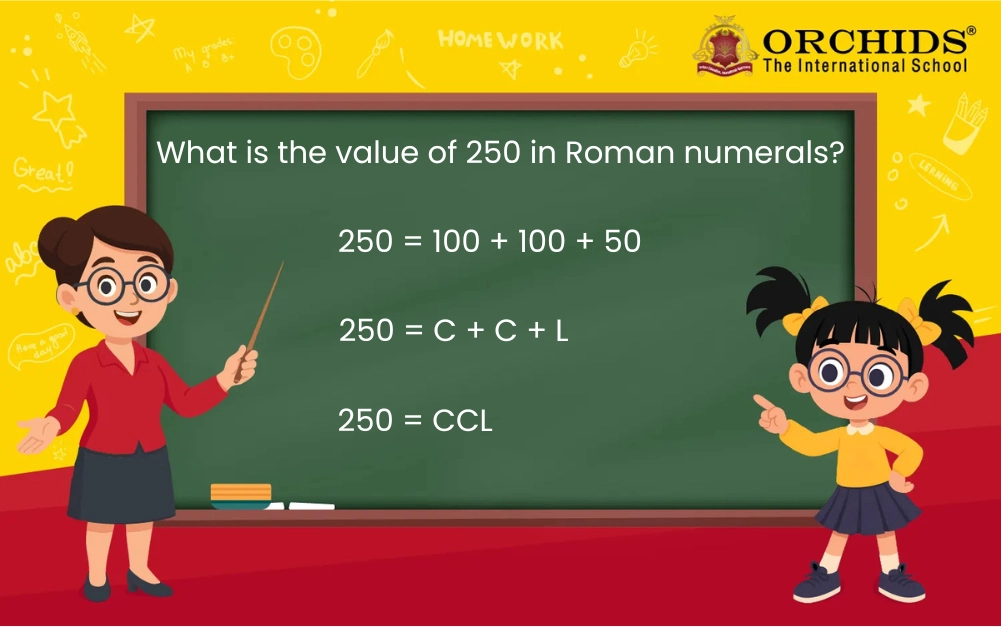
250 in Roman numerals is written as CCL, a traditional number system used by the Romans. To convert 250, we express it in expanded form: 250 = 100 + 100 + 50. Replacing these values with Roman symbols gives C + C + L = CCL. Learning how to read and write numbers like 250 in Roman numerals helps students understand mathematical patterns and improve logical thinking. It also shows how addition is applied in Roman notation to form larger numbers. Studying the Roman numeral CCL not only builds math skills but also connects learners to ancient history, making number learning more interesting and practical in everyday life.
Table of Contents
- How to Write 250 in Roman Numerals?
- Roman Numerals for Numbers Related to 250
- Solved Examples on 250 in Roman Numerals
- Fun Facts on 250 in Roman Numerals
- Practice Questions on 250 in Roman Numerals
- Conclusion
- Frequently Asked Questions on 250 in Roman Numerals
How to Write 250 in Roman Numerals?
The number 250 in Roman numerals can be written by breaking it into smaller values and using Roman letters.
Step 1: Break the number
Divide 250 into parts based on Roman numeral values:
-
250 = 100 + 100 + 50
Step 2: Replace with Roman letters
-
100 = C
-
100 = C
-
50 = L
Combine them together: C + C + L
Step 3: Final Roman numeral
-
So, 250 in Roman numerals = CCL

Roman Numerals for Numbers Related to 250
|
Number |
Roman Numeral |
|
241 |
CCXLI |
|
242 |
CCXLII |
|
243 |
CCXLIII |
|
244 |
CCXLIV |
|
245 |
CCXLV |
|
246 |
CCXLVI |
|
247 |
CCXLVII |
|
248 |
CCXLVIII |
|
249 |
CCXLIX |
|
250 |
CCL |
Know more about related topics:
Solved Examples on 250 in Roman Numerals
Example 1: Express 200 + 50 in Roman numerals.
Solution:
-
200 = CC, 50 = L
-
CC + L = CCL
-
Therefore, 200 + 50 = CCL (250).
Example 2: Subtract L(50) from CCC(300).
Solution:
-
CCC = 300, L = 50
-
300 - 50 = 250
-
In Roman numerals, 250 = CCL
Example 3: Multiply L(50) by V(5). Write the answer in Roman numerals.
Solution:
-
L = 50, W = 5
-
50 × 5 = 250
-
In Roman numerals, 250 = CCL
Example 4: In a museum, there are 200 ancient coins in one box and 50 in another. Write the total in Roman numerals.
Solution:
-
200 = CC, 50 = L
-
Total = CC + L = CCL
Example 5: What is the difference between CCL (250) and C (100)?
Solution:
-
250 - 100 = 150
-
In Roman numerals, 150 = CL
Fun Facts on 250 in Roman Numerals
-
In Roman numerals, 250 = CCL, which is fully additive (no subtraction rules are used).
-
There is no symbol for zero in Roman numerals.
-
The number L always represents 50, no matter its position.
-
Roman numerals such as CCL can often be found on clock faces, monuments, and books.
-
The year CCL (250) corresponds to the early period in the history of the Roman Empire.
Practice Questions on 250 in Roman Numerals
1. Convert the number 245 into Roman numerals.
2. Add CCL (250) and L (50). What is the result in Roman numerals?
3. What will you get if you subtract C (100) from CCL (250)?
4. Write the next four Roman numerals after 250.
5. A library has 150 books on one shelf and 100 on another.
Conclusion
250 in Roman numerals is written as CCL, formed by adding 100 (C) + 100 (C) + 50 (L). Understanding CCL helps learners see how Roman numerals use addition to form larger numbers. Practicing nearby numbers like 249 (CCXLIX), 251 (CCLI), and 255 (CCLV) makes it easier to recognize patterns. Learning 250 and related numbers strengthens number sense and logical thinking and helps read Roman numerals in clocks, books, and historical inscriptions.
Explore 250 in Roman numerals and similar topics at Orchids International School.
Numbers make sense when they're taught right. To see how Orchids The International School turns Maths from intimidating to intuitive, reach out to our admissions team.
Frequently Asked Questions on 250 in Roman Numerals
1. Which Roman numerals come immediately before and after 250?
Answer:
-
Before 250: CCXLIX (249)
-
After 250: CCLI (251)
2. What are some real-life uses of 250 in Roman numerals?
Answer: CCL (250) can be seen on clock faces, historical year markings, movie titles, and building inscriptions to represent the number 250 stylishly.
3. Can 250 be written using subtraction rules in Roman numerals?
Answer: No, 250 is a simple additive numeral (C + C + L). Subtraction rules are used only in numbers like 90 (XC) or 400 (CD).
4. What is 250 in Roman numerals, and how do we write it?
Answer: 250 in Roman numerals is CCL, which is formed by combining 100 (C) + 100 (C) + 50 (L).
5. Why is 250 written as CCL and not as CCD?
Answer: Because there is no Roman symbol for 250 directly, it’s expressed by adding two Cs (200) and one L (50). The combination CCD would mean 400 - 100, which is incorrect.
Related Links


Admissions Open for 2026-27
What type of concept pages would you prefer?
CBSE Schools In Popular Cities
- CBSE Schools in Bangalore
- CBSE Schools in Mumbai
- CBSE Schools in Pune
- CBSE Schools in Hyderabad
- CBSE Schools in Chennai
- CBSE Schools in Gurgaon
- CBSE Schools in Kolkata
- CBSE Schools in Indore
- CBSE Schools in Sonipat
- CBSE Schools in Delhi
- CBSE Schools in Rohtak
- CBSE Schools in Bhopal
- CBSE Schools in Aurangabad
- CBSE Schools in Jabalpur
- CBSE Schools in Jaipur
- CBSE Schools in Jodhpur
- CBSE Schools in Nagpur
- CBSE Schools in Ahmednagar
- CBSE School In Tumkur











Orchids The International School is one of India's leading chains of CBSE and ICSE schools, with 110+ schools across the country.