

30 in Roman Numerals: How to Write XXX with Rules and Examples
30 in Roman numerals is written as XXX. It is formed by repeating the Roman numeral X, which represents 10, three times. This follows the Roman numeral rule that allows certain symbols to be repeated up to three times to represent larger numbers.
Learning how to write 30 as XXX helps you understand the basic rules of Roman numerals and makes it easier to read and write other numbers. In this article, you'll learn how to convert 30 into Roman numerals, explore the rules used to form it, look at nearby Roman numerals, and solve practice questions to strengthen your understanding.
Table of Contents
- How to Write 30 in Roman Numerals?
- Roman Numerals for Numbers Related to 30
- Basic Rules to Write Roman Numerals
- Solved Examples on 30 in Roman Numerals
- Practice Question on 30 in Roman Numerals
- Frequently Asked Questions on 30 in Roman Numerals

How to Write 30 in Roman Numerals?
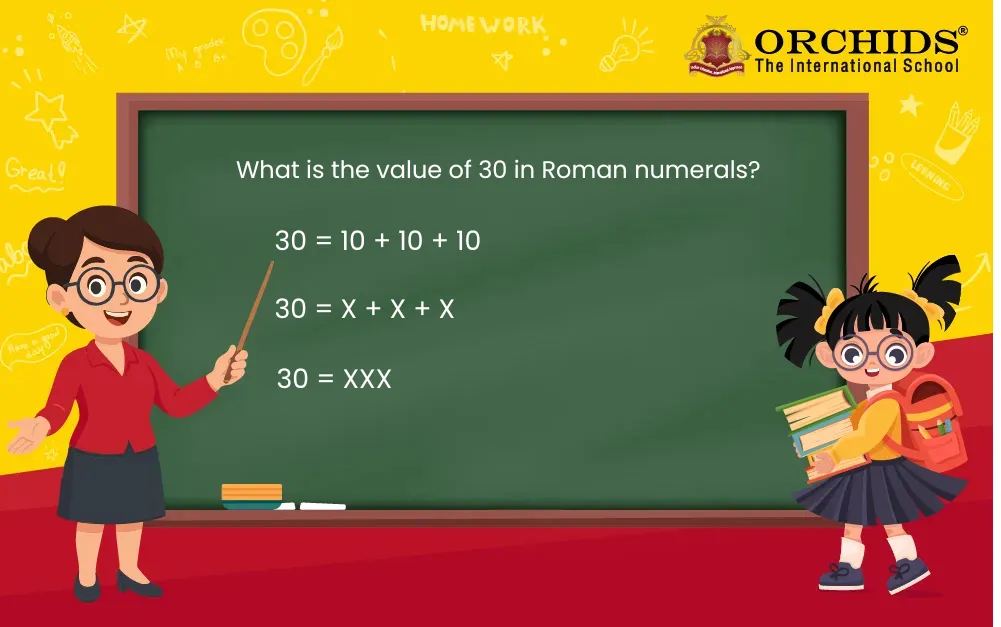
Writing 30 in Roman numerals involves representing 30 as the repetition of the fundamental Latin symbol X as: 30 = XXX. As per Roman numeral rules the multiples of 10 like 20 and 30 are represented by repetition of X as XX and XXX. Hence, 30 is written as XXX. Let’s learn the step by step conversion process of 30 in Roman numerals:
Step 1: Expand and write number 30 in parts as: 30 = 10 + 10 + 10
Step 2: Replace each number with its respective symbol: 30 = X + X + X
Step 3: Combine them together as per Roman numeral Rules: 30 = XXX
Therefore, 30 in Roman numerals is written as XXX.
Know more about related topics:
Roman Numerals for Numbers Related to Number 30
Here are Roman numerals close to 30:
30 = 10 + 10 + 10 = XXX
31 = 10 + 10 + 10 + 1 = XXXI
32 = 10 + 10 + 10 + 2 = XXXII
33 = 10 + 10 + 10 + 3 = XXXIII
34 = 10 + 10 + 10 + 4 = XXXIV
35 = 10 + 10 + 10 + 5 = XXXV
36 = 10 + 10 + 10 + 6 = XXXVI
37 = 10 + 10 + 10 + 7 = XXXVII
38 = 10 + 10 + 10 + 8 = XXXVIII
39 = 10 + 10 + 10 + 9 = XXXIX
40 = 50 – 10 = XL
Basic Rules of Writing Roman Numerals
-
A symbol is added to itself if repeated. Example: II = 2, XX = 20, XXX = 30
-
A symbol can be repeated only 3 times. Example: XXX = 30, CC = 200
Symbols V(5), L(50), and D(500) are never repeated.
-
If a smaller symbol comes after a bigger one, we add.
Example: VI = 5 + 1 = 6 -
If a smaller symbol precedes a larger one, we subtract.
Example: IX = 10 - 1 = 9 -
Symbols V, L, and D are never subtracted.
I can be subtracted only from V and X.
X can be subtracted only from L, C, and M.
Solved Examples on 30 in Roman Numerals
Example 1: Find the difference between LXX(70) and XL(40) in Roman numerals?
Solution: We know the value of LXX = 70 and XL = 40.
By subtracting the numeric values of LXX and XL we get: 70 – 40 = 30.
As, 30 is written as XXX in Roman numerals
Therefore, LXX – XL = XXX.
Example 2: What is the value of XVIII(18) + XII(12) in Roman numerals?
Solution: First, write the value of XVIII and XII in numbers:
XVIII = 18 and XII = 12
Now add them to get their sum: 18 + 12 = 30
30 in Roman numerals is XXX.
Therefore, XVIII + XII = XXX.
Example 3: Multiply XV(15) by II(2) and express the result in Roman numerals.
Solution: The value of XV = 15 and II = 2
By multiplying the values, we get: 15 X 2 = 30
Therefore, the result of XV multiplied by II is XXX.
Example 4: Divide CXX(120) by IV(4) and write the answer in Roman form.
Solution: The value of CXX = 120 and IV = 4
By dividing the 120 by 4, we get: 120 ÷ 4 = 30
Therefore, CXX ÷ IV = XXX.
Practice Questions on 30 in Roman Numerals
1. Write 30 in Roman numerals.
2. Add X (10) and XX(20). Write answers in Roman numerals.
3. Divide CL (150) by V (5). Express results in Roman numerals.
4. Write the next three numerals after 30 in Roman numerals.
5. Subtract XX (20) from L (50) and write the result in Roman numerals.
Frequently Asked Questions on 30 in Roman Numerals
1. Write 30 in Roman numerals.
30 is written as XXX in Roman numerals.
2. How do you read 30 in Roman numerals?
It is read as X + X + X = 30, or simply “thirty.”
3. How do you convert 30 into Roman numerals?
Break 30 into 10 + 10 + 10 → replace with Roman equivalents (X + X + X) → XXX. In short, 30 in Roman numerals is XXX. It represents three tens, representing the use of repetition and the additive rule in Roman numeral conversion.
Numbers make sense when they're taught right. To see how Orchids The International School turns Maths from intimidating to intuitive, reach out to our admissions team.


Admissions Open for 2026-27
What type of concept pages would you prefer?
CBSE Schools In Popular Cities
- CBSE Schools in Bangalore
- CBSE Schools in Mumbai
- CBSE Schools in Pune
- CBSE Schools in Hyderabad
- CBSE Schools in Chennai
- CBSE Schools in Gurgaon
- CBSE Schools in Kolkata
- CBSE Schools in Indore
- CBSE Schools in Sonipat
- CBSE Schools in Delhi
- CBSE Schools in Rohtak
- CBSE Schools in Bhopal
- CBSE Schools in Aurangabad
- CBSE Schools in Jabalpur
- CBSE Schools in Jaipur
- CBSE Schools in Jodhpur
- CBSE Schools in Nagpur
- CBSE Schools in Ahmednagar
- CBSE School In Tumkur











Orchids The International School is one of India's leading chains of CBSE and ICSE schools, with 110+ schools across the country.