

57 in Roman Numerals
57 in Roman numerals is written as LVII. Roman numerals are an ancient number system still used today on clocks, book chapters, and monuments. To convert 57, we break it into smaller values: 57 = 50 + 5 + 2. In Roman symbols, 50 is L, 5 is V, and 1 is I. Combining them gives L + V + I + I = LVII. Learning numbers like 57 in Roman numerals helps students understand addition rules and builds strong number sense while connecting math with history.
Table of Contents
- How to Write 57 in Roman Numerals?
- Roman Numerals for Numbers Related to 57
- Solved Examples on 57 in Roman Numerals
- Fun Facts on 57 in Roman Numerals
- Practice Questions on 57 in Roman Numerals
- Conclusion
- Frequently Asked Questions on 57 in Roman Numerals
How to Write 57 in Roman Numerals?
To write 57 in Roman numerals, we convert the number by splitting it into values that have Roman numeral symbols.
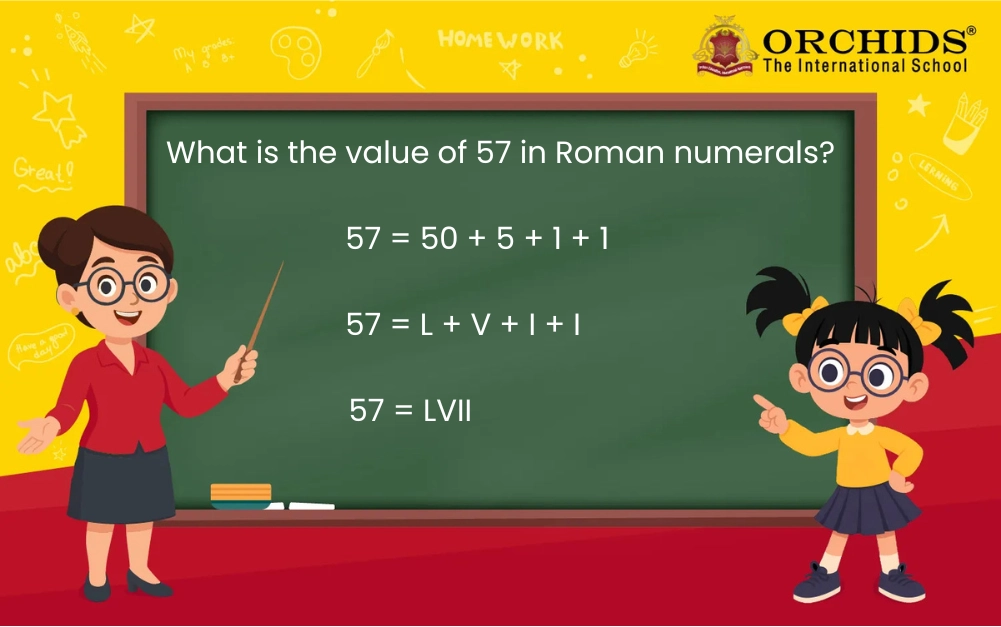
Step-by-step method:
-
Start by breaking 57 into 50 + 7
-
50 is represented by L
-
7 is written as V (5) + I (1) + I (1)
Now combine all the symbols in order:
-
L + V + I + I = LVII
-
57 in Roman numerals is written as LVII.

Roman Numerals for Numbers Related to 57
|
Number |
Roman Numeral |
|
50 |
L |
|
51 |
LI |
|
52 |
LII |
|
53 |
LIII |
|
54 |
LIV |
|
55 |
LV |
|
56 |
LVI |
|
57 |
LVII |
|
58 |
LVIII |
|
59 |
LIX |
|
60 |
LX |
Know more about related topics:
Solved Examples on 57 in Roman Numerals
Example 1: Write 57 in Roman numerals.
Solution:
-
Divide 57 into 50 + 7.
-
L = 50, VII = 7
-
Combine: L + VII = LVII.
-
Therefore, 57 = LVII.
Example 2: Write 59 in Roman numerals.
Solution:
-
Break 59 into 50+9.
-
L = 50, IX = 9
-
Combine: L + IX = LIX
Example 3: Add XXVII (27) and XXX (30). Write the result in Roman numerals.
Solution:
-
Convert to numbers: 27 + 30 = 57
-
Convert back: 57 = LVII
Example 4: Subtract III (3) from LX (60). Write the result in Roman numerals.
Solution:
-
Convert: 60 - 3 = 57
-
Convert back: 57 = LVII
Example 5: Multiply XIX (19) by III (3). Expression in Roman numerals.
Solution:
-
19 × 3 = 57
-
57 = LVII
Fun Facts on 57 in Roman Numerals
-
57 = LVII, made of L (50) and VII (7).
-
The Roman numeral system does not use zero.
-
This is an additive combination, which means that the values are simply added.
-
Roman numerals are still used in book chapters, monuments, and movie sequels.
-
LVII would represent the year AD 57 in ancient Roman records.
Practice Questions on 57 in Roman Numerals
1. Add XXX (30) and XXVII (27). Express the result in Roman numerals.
2. Subtract VII (7) from LXIV (64). Write the result in Roman numerals.
3. If you multiply XIX (19) by III (3), what Roman numeral do you get?
4. Write the Roman numeral for 60 and compare it to 57.
5. Which Roman numeral represents 50 less than 107?\
Conclusion
57 in Roman numerals is written as LVII, following the addition rule where values are added from left to right. It is formed using L (50), V (5), and I (1) twice to make 57. Understanding LVII helps learners see how Roman numerals use simple addition. Practicing nearby numbers like 56 (LVI), 58 (LVIII), and 59 (LIX) makes it easier to spot patterns and read Roman numerals confidently. Learning numbers like 57 strengthens number sense and helps students recognize Roman numerals used on clocks, books, and monuments.
Learn more about 57 in Roman numerals and many similar topics with step-by-step explanations and examples at Orchids International School.
Numbers make sense when they're taught right. To see how Orchids The International School turns Maths from intimidating to intuitive, reach out to our admissions team.
Frequently Asked Questions on 57 in Roman Numerals
1. What comes before and after 57 in Roman numerals?
Answer:
-
Before 57: LVI (56)
-
After 57: LVIII (58)
2. How do you write 57 using Roman numeral rules?
Answer: The Roman numeral for 57 follows the additive rule, where symbols are placed from largest to smallest and added together: L(50) + V(5) + I(1) + I(1) = LVII.
3. Where do we see the Roman numeral LVII in modern life?
Answer: LVII can appear on clock dials, historic buildings, movie sequels, and sporting events (such as Super Bowl LVII to be held in 2023).
4. Can 57 be written using subtraction in Roman numerals?
Answer: 57 only uses additive symbols. Subtractive notation (such as IV or IX) is only used for numbers such as 4 or 9.
5. How can students easily remember that 57 = LVII?
Answer: Remember this as "L(50) + VII(7)", or think of it as "50 and 7 more".
Related Links


Admissions Open for 2026-27
What type of concept pages would you prefer?
CBSE Schools In Popular Cities
- CBSE Schools in Bangalore
- CBSE Schools in Mumbai
- CBSE Schools in Pune
- CBSE Schools in Hyderabad
- CBSE Schools in Chennai
- CBSE Schools in Gurgaon
- CBSE Schools in Kolkata
- CBSE Schools in Indore
- CBSE Schools in Sonipat
- CBSE Schools in Delhi
- CBSE Schools in Rohtak
- CBSE Schools in Bhopal
- CBSE Schools in Aurangabad
- CBSE Schools in Jabalpur
- CBSE Schools in Jaipur
- CBSE Schools in Jodhpur
- CBSE Schools in Nagpur
- CBSE Schools in Ahmednagar
- CBSE School In Tumkur











Orchids The International School is one of India's leading chains of CBSE and ICSE schools, with 110+ schools across the country.