

MM Roman Numerals
MM Roman numerals refer to 2000 since M represents 1000 and M + M is 2000. M is one of the basic Roman numerals: I, V, X, L, C, and M. Understanding how to read and write numbers like 2000 in Roman numerals helps learners build a strong foundation in number representation. It also improves logical thinking by showing how values are added step by step to form larger numbers. Studying MM not only strengthens mathematical understanding but also connects students to historical number systems still seen today in books, monuments, and year markings. In this article, we will learn how to read, write, and convert MM Roman numerals into numbers, along with sample examples and practice problems.
Table of Contents
- How to Write "MM" Roman Numerals in Numbers?
- Numbers Related to MM Roman Numerals
- Basic Rules for Writing Roman Numerals
- Solved Examples on MM Roman Numerals
- Practice Questions on MM Roman Numerals
- Conclusion
- Frequently Asked Questions on MM Roman Numerals
How to Write "MM" Roman Numerals in Numbers?
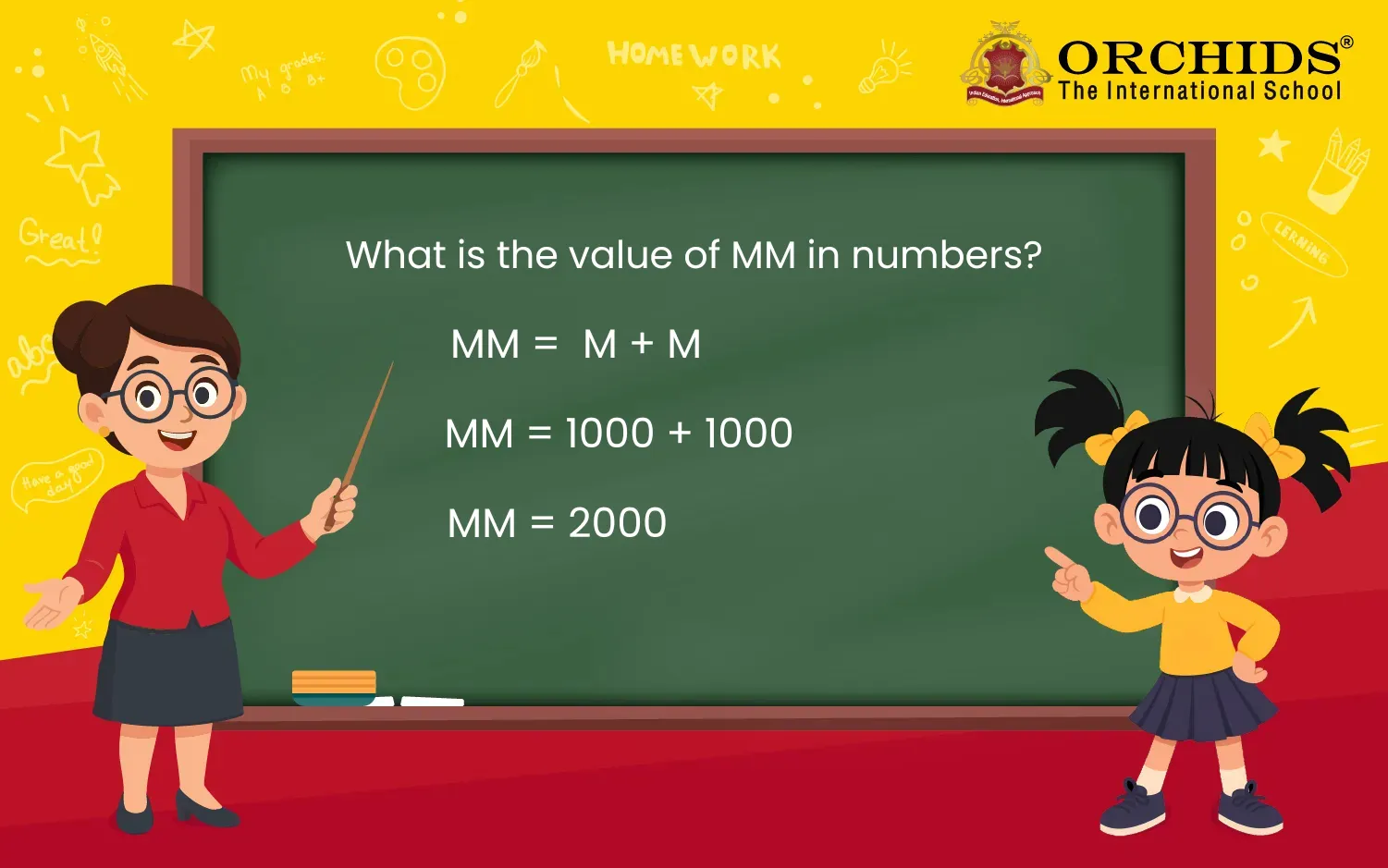
In numbers, Roman numeral MM is written as 2000. Letter M is one of the basic symbols of the Roman numbering system that represents 1000.
As Roman numerals follow repetition rules to represent values, the symbol M is repeated twice to represent 2000.
Breakdown:
MM = M + M = 1000 + 1000 = 2000

Numerals Related to MM Roman Numerals
|
Roman Numerals |
Expansion |
Number |
|
MM |
M + M |
1000 + 1000 |
|
MMI |
M + M + I |
1000 + 1000 + 1 |
|
MMII |
M + M + I + I |
1000 + 1000 + 1 + 1 |
|
MMIII |
M + M + I + I + I |
1000 + 1000 + 1 + 1 + 1 |
|
MMIV |
M + M + IV |
1000 + 1000 + (5 - 1) |
|
MMV |
M + M + V |
1000 + 1000 + 5 |
|
MMVI |
M + M + V + I |
1000 + 1000 + 5 + 1 |
| MMVII |
M + M + V + I + I |
1000 + 1000 + 5 + 1 + 1 |
|
MMVIII |
M + M + V + I + I + I |
1000 + 1000 + 5 + 1 + 1 + 1 |
|
MMIX |
M + M + IX |
1000 + 1000 + (9 - 1) |
|
MMX |
M + M + X |
1000 + 1000 + 10 |
Know more about related topics:
Basic Rules of Writing Roman Numerals
All Roman numerals are written by arranging the same Latin letters in a different order, but there are important rules that should be followed to write them correctly and convert them back to numbers. They involve understanding the placement and repetition of letters and symbols. As Roman numerals apply both addition and subtraction to represent numbers, it’s essential to follow the fundamental rules that govern Roman numeral construction to ensure accuracy.
-
No numeral can appear more than three times in a row (e.g., XX = 20, but 4 is IV).
-
Smaller numerals before larger ones indicate subtraction (e.g., IX = 9).
-
Smaller numerals after larger ones indicate addition (e.g., VI = 6).
-
Only certain pairs use the subtraction rule, such as:
I before V and X
X before L and C
These basic rules help avoid common mistakes when writing Roman numerals.
Solved Examples on MM Roman Numerals
Example 1: Determine the value of MM - II.
Solution: To solve MM-II, let’s write MM = 2000 and II = 2 in numbers as:
MM - II = 2000 - 2 = 1998
Therefore, MM - II = MCMXCVIII.
Example 2: What is the value of MM + VII in Roman numerals?
Solution: To determine the value of MM + VII in Roman numerals, let’s convert it into numbers and add:
MM + VII = 2000 + 7
MM + VII = MMVII
Example 3: What is MCMXCIX + I?
Solution: Let’s expand MCMXCIX to convert it into numbers as:
MCMXCIX = M (1000) + CM (900) + XC ( 90) + IX( 9 ) = 1999
MCMXCIX + I = 1999 + 1 = 2000
MCMXCIX + I = MM
Practice Questions on MM Roman Numerals
- How to convert Roman numerals MM in numbers?
- Multiply M(1000) by II(2) and write the answer in Roman numerals.
- Write next 5 Roman numerals before and after MM.
- Find the value of MCD + DC in Roman numerals.
Conclusion
Roman numbers are part of an ancient number system that is still in use. It originated in ancient Rome. It uses a combination of letters and specific rules for addition and subtraction to write numbers. By learning these numerals, their conversion rules students can easily interpret the Roman numerals in daily life.
Master MM Roman numerals and more such math concepts with Orchids The International School!
Numbers make sense when they're taught right. To see how Orchids The International School turns Maths from intimidating to intuitive, reach out to our admissions team.
Frequently Asked Questions on MM Roman Numerals
1. How to write the Roman Numeral MM in numbers?
Answer: The Roman Numeral MM is written as 2000 in numbers.
2. Does MM represent Roman Numerals?
Answer: Yes, MM represents Roman Numerals and equals 2000.
3. What is the year MM in numbers?
Answer: The year MM in numbers is 2000.
4. What comes before MM?
Answer: The numeral before MM is MCMXCIX(1999).
5. What comes after MM?
Answer: The numeral after MM is MMI (2001).
Related Links


Admissions Open for 2026-27
What type of concept pages would you prefer?
CBSE Schools In Popular Cities
- CBSE Schools in Bangalore
- CBSE Schools in Mumbai
- CBSE Schools in Pune
- CBSE Schools in Hyderabad
- CBSE Schools in Chennai
- CBSE Schools in Gurgaon
- CBSE Schools in Kolkata
- CBSE Schools in Indore
- CBSE Schools in Sonipat
- CBSE Schools in Delhi
- CBSE Schools in Rohtak
- CBSE Schools in Bhopal
- CBSE Schools in Aurangabad
- CBSE Schools in Jabalpur
- CBSE Schools in Jaipur
- CBSE Schools in Jodhpur
- CBSE Schools in Nagpur
- CBSE Schools in Ahmednagar
- CBSE School In Tumkur











Orchids The International School is one of India's leading chains of CBSE and ICSE schools, with 110+ schools across the country.