

MMI Roman Numerals
MMI Roman numerals represent the number 2001. It is formed using M = 1000, M = 1000, and I = 1. By combining these values according to the addition rule, 1000 + 1000 + 1 = 2001. Understanding MMI Roman numerals helps students read numbers in Roman form, recognize addition patterns, and interpret historical dates, book chapters, timelines, and other real-life uses.
Table of Contents
- How to Write MMI Roman Numerals in Numbers?
- Numbers Related to MMI Roman Numerals
- Basic Rules for Writing Roman Numerals
- Solved Examples on MMI Roman Numerals
- Conclusion
- Frequently Asked Questions on MMI Roman Numerals
How to Write MMI Roman Numerals in Numbers?
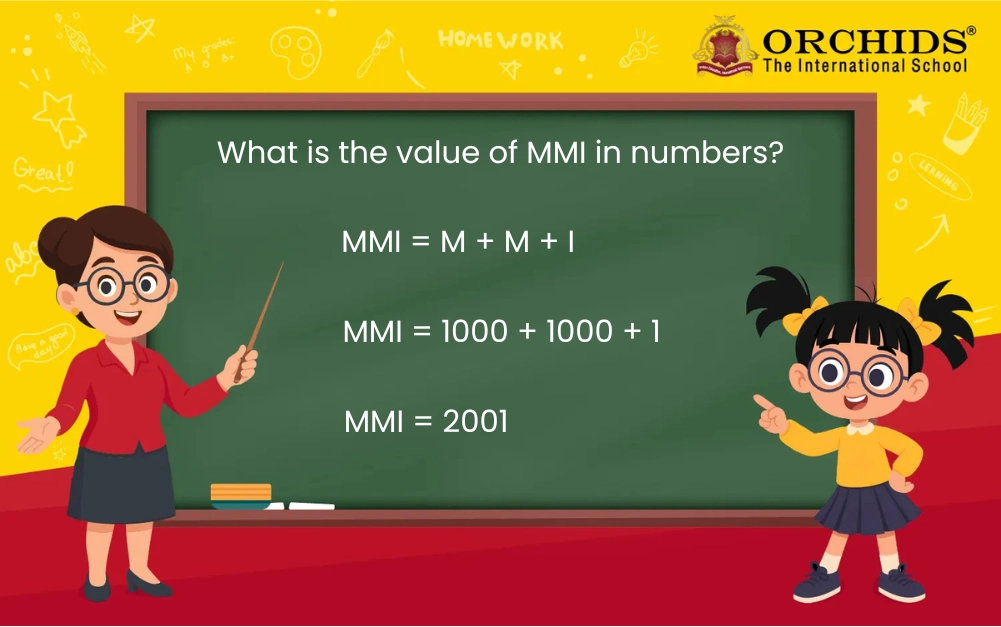
The Roman numeral MMI represents the number 2001. You can understand this by looking at each Roman letter and combining its values carefully.
Step 1: Break the numeral into parts
Split MMI into individual Roman letters or groups:
-
M = 1000
-
M = 1000
-
I = 1
Step 2: Add the values
Now, add all the parts together:
-
1000 + 1000 + 1 = 2001
Step 3: Grouping method
Alternatively, you can group the letters for easier calculation:
-
MMI = MM + I
-
MMI = 2000 + 1
-
MMI = 2001

Numbers Related to MMI Roman Numerals
|
Number |
Expanded Form |
Roman Numeral Expression |
Final Roman Numeral |
|
2000 |
1000 + 1000 |
M + M |
MM |
|
2001 |
1000 + 1000 + 1 |
M + M + I |
MMI |
|
2002 |
1000 + 1000 + 2 |
M + M + II |
MMII |
|
2003 |
1000 + 1000 + 3 |
M + M + III |
MMIII |
|
2004 |
1000 + 1000 + 4 |
M + M + IV |
MMIV |
|
2005 |
1000 + 1000 + 5 |
M + M + V |
MMV |
|
2006 |
1000 + 1000 + 6 |
M + M + VI |
MMVI |
|
2007 |
1000 + 1000 + 7 |
M + M + VII |
MMVII |
|
2008 |
1000 + 1000 + 8 |
M + M + VIII |
MMVIII |
|
2009 |
1000 + 1000 + 9 |
M + M + IX |
MMIX |
|
2010 |
1000 + 1000 + 10 |
M + M + X |
MMX |
Know more about related topics:
Basic Rules for Writing Roman Numerals
1. The symbols are arranged from largest to smallest. Example: MMI = 1000 + 1000 + 1 = 2001
2. When a smaller numeral follows a larger numeral, their values are added. Example: VI = 5 + 1 = 6
3. When a smaller numeral appears before a larger one, it is subtracted. Example: IV = 5 - 1 = 4
4. V, L, and D are never repeated or subtracted. Example: MMI is valid, but MMMM (for 4000) is not.
5. The same symbol must not appear more than three times in a row. Example: III is 3 (correct), but IIII will be wrong.
Solved Examples on MMI Roman Numerals
Example 1: Convert 2001 to Roman numerals.
Solution:
-
Break the numbers: 2001 = 1000 + 1000 + 1
-
1000 = M, 1000 = M, 1 = I
-
Combine them: M + M + I = MMI
Example 2: Write 2003 in Roman numerals.
Solution:
-
2003 = 1000 + 1000 + 3
-
2003 = M + M + III
-
2003 = MMIII
Example 3: Convert 2004 to Roman numerals.
Solution:
-
2004 = 1000 + 1000 + 4
-
4 = IV
-
Therefore, M + M + IV = MMIV
Example 4: Write 1999 in Roman numerals.
Solution:
-
1999 = 1000 + 900 + 90 + 9
-
1999 = M + CM + XC + IX
-
1999 = MCMXCIX
Example 5: If the clock inscription shows MMI, what year does it represent?
Answer:
-
MMI = 1000 + 1000 + 1
-
MMI = 2001
Conclusion
The MMI Roman numerals represent 2001, which is formed by adding two M's (1000 + 1000) and an I (1). Roman numerals, though ancient, appear in modern life, from clock faces to book chapters and historic buildings. Understanding MMI and similar numerals helps students connect arithmetic to historical number systems, improving number sense and cultural knowledge.
Explore MMI Roman numerals effortlessly with simple examples and fun practice at Orchids International School.
Numbers make sense when they're taught right. To see how Orchids The International School turns Maths from intimidating to intuitive, reach out to our admissions team.
Frequently Asked Questions on MMI Roman Numerals
1. What does MMI stand for in numbers?
Answer: In numbers, MMI means 2001. It is formed by adding 1000 + 1000 + 1.
2. How is 2001 written in Roman numerals?
Answer: 2001 = M + M + I = MMI.
3. What are the numbers before and after MMI in Roman numerals?
Answer: The number before MMI is MM (2000), and the number after MMI is MMII (2002).
4. Can we use subtraction in MMI?
Answer: No, MMI only uses addition because the numerals are arranged from largest to smallest.
5. Where is MMI commonly seen today?
Answer: MMI is often seen on movie titles, monuments, book publication years, and clocks representing the year 2001.
Related Links


Admissions Open for 2026-27
What type of concept pages would you prefer?
CBSE Schools In Popular Cities
- CBSE Schools in Bangalore
- CBSE Schools in Mumbai
- CBSE Schools in Pune
- CBSE Schools in Hyderabad
- CBSE Schools in Chennai
- CBSE Schools in Gurgaon
- CBSE Schools in Kolkata
- CBSE Schools in Indore
- CBSE Schools in Sonipat
- CBSE Schools in Delhi
- CBSE Schools in Rohtak
- CBSE Schools in Bhopal
- CBSE Schools in Aurangabad
- CBSE Schools in Jabalpur
- CBSE Schools in Jaipur
- CBSE Schools in Jodhpur
- CBSE Schools in Nagpur
- CBSE Schools in Ahmednagar
- CBSE School In Tumkur











Orchids The International School is one of India's leading chains of CBSE and ICSE schools, with 110+ schools across the country.