

CLX Roman Numerals
CLX Roman numerals represent the number 160 in the Roman number system, which was used in ancient Rome. To understand how CLX is formed, write 160 in expanded form: 160 = 100 + 50 + 10. Each value is then replaced with its Roman symbol: C for 100, L for 50, and X for 10. When these symbols are written together, they form CLX. Learning Roman numerals like CLX helps students understand how numbers can be shown using symbols instead of digits. It also improves number sense by teaching how smaller values combine to make a larger number. Roman numerals are still commonly seen today on clocks, book chapters, monuments, and important dates.
Table of Contents
- How to Write CLX Roman Numerals in Numbers?
- Numbers Related to CLX Roman Numerals
- Solved Examples on CLX Roman Numerals
- Practice Questions on CLX Roman Numerals
- Conclusion
- Frequently Asked Questions on CLX Roman Numerals
How to Write CLX Roman Numerals in Numbers?
The Roman numeral CLX represents a number in the Hindu-Arabic number system. To find its value, we need to understand the meaning of each Roman symbol used in CLX.
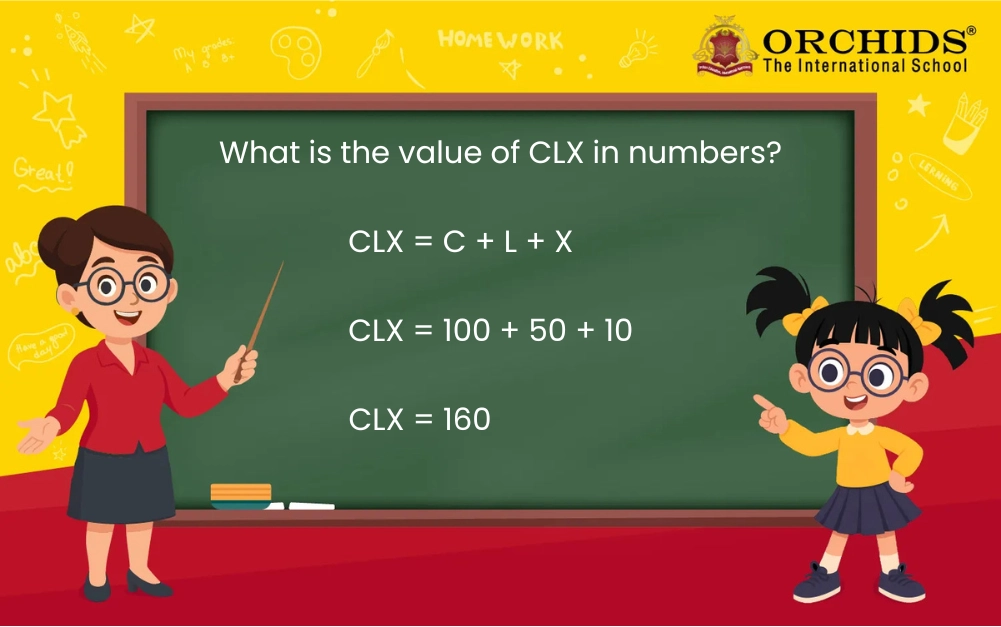
In Roman numerals, each letter has a fixed numerical value:
-
C stands for 100
-
L stands for 50
-
X stands for 10
Since these symbols are written from the largest value to the smallest value, we simply add all the values together.
Calculation of CLX Roman Numerals
-
CLX = C + L + X
-
CLX = 100 + 50 + 10
-
CLX = 160
-
CLX Roman Numerals = 160

Numbers Related to CLX Roman Numerals
|
Number |
Expanded Form |
Roman Numeral Expression |
Final Roman Numeral |
|
155 |
100 + 50 + 5 |
C + L + V |
CLV |
|
156 |
100 + 50 + 6 |
C + L + VI |
CLVI |
|
157 |
100 + 50 + 7 |
C + L + VII |
CLVII |
|
158 |
100 + 50 + 8 |
C + L + VIII |
CLVIII |
|
159 |
100 + 50 + 9 |
C + L + IX |
CLIX |
|
160 |
100 + 50 + 10 |
C + L + X |
CLX |
|
161 |
100 + 50 + 11 |
C + L + XI |
CLXI |
|
162 |
100 + 50 + 12 |
C + L + XII |
CLXII |
|
163 |
100 + 50 + 13 |
C + L + XIII |
CLXIII |
|
164 |
100 + 50 + (5 - 1) |
C + L + IV |
CLXIV |
|
165 |
100 + 50 + 10 + 5 |
C + L + X + V |
CLXV |
Know more about related topics:
Solved Examples on CLX Roman Numerals
Example 1: Convert CLX into numbers.
Solution:
-
C = 100, L = 50, X = 10
-
Total = 100 + 50 + 10 = 160
-
Hence, CLX = 160.
Example 2: Write 160 in Roman numerals.
Solution:
-
160 = 100 + 50 + 10
-
160 = C + L + X = CLX
Example 3: What comes before and after CLX in Roman numerals?
Solution:
-
Before CLX = CLV (155)
-
After CLX = CLXV (165)
Example 4: Find the difference between CLX (160) and C (100).
Solution:
-
160 - 100 = 60
-
The Roman numeral for 60 is LX.
Example 5: Add LXX (70) + XC (90) using Roman numerals.
Solution:
-
70 + 90 = 160
-
Hence, the Roman numeral is CLX.
Practice Questions on CLX Roman Numerals
1. Convert CLXV into numbers.
2. Write 155 in Roman numerals.
3. Identify the rule used in forming CLX.
4. What is the Roman numeral after CLXXX?
5. Subtract L (50) from CLX and write the result in Roman numerals.
Conclusion
CLX Roman numerals equal 160. It is formed by combining C (100), L (50), and X (10) using the Roman numeral addition rule. This numeral shows how different symbol values are added together to represent a larger number clearly and logically. Roman numerals like CLX are still widely used today on clocks, book chapters, monuments, and important historical records. Learning CLX and similar numerals helps students understand number systems better and recognize their importance in both mathematics and history.
Learn CLX Roman numerals in a simple and structured way at Orchids International School.
Numbers make sense when they're taught right. To see how Orchids The International School turns Maths from intimidating to intuitive, reach out to our admissions team.
Frequently Asked Questions on CLX Roman Numerals
1. What is the value of CLX in numbers?
Answer: CLX = 160. It combines C (100) + L (50) + X (10).
2. How do you write 160 in Roman numerals step-by-step?
Answer:
Step 1: Write 100 as C.
Step 2: Write 50 as L.
Step 3: Write 10 as X.
Step 4: Combine C + L + X = CLX
3. What does CLX mean in Roman numerals?
Answer: CLX means 160, formed by adding the values of C, L, and X according to the Roman numeral addition rule.
4. How is CLX different from CXL?
Answer:
-
CLX = 160 (100 + 50 + 10) uses addition.
-
CXL = 140 (100 + (50 - 10)) uses subtraction.
5. Where do we find Roman numerals like CLX in real life?
Answer: Roman numerals like CLX can be seen:
-
On book chapter numbers (e.g., Chapter CLX)
-
On monuments
-
In movie release years and royal titles
Related Links


Admissions Open for 2026-27
What type of concept pages would you prefer?
CBSE Schools In Popular Cities
- CBSE Schools in Bangalore
- CBSE Schools in Mumbai
- CBSE Schools in Pune
- CBSE Schools in Hyderabad
- CBSE Schools in Chennai
- CBSE Schools in Gurgaon
- CBSE Schools in Kolkata
- CBSE Schools in Indore
- CBSE Schools in Sonipat
- CBSE Schools in Delhi
- CBSE Schools in Rohtak
- CBSE Schools in Bhopal
- CBSE Schools in Aurangabad
- CBSE Schools in Jabalpur
- CBSE Schools in Jaipur
- CBSE Schools in Jodhpur
- CBSE Schools in Nagpur
- CBSE Schools in Ahmednagar
- CBSE School In Tumkur











Orchids The International School is one of India's leading chains of CBSE and ICSE schools, with 110+ schools across the country.