

66 in Roman Numerals
66 in Roman numerals is written as LXVI in the ancient Roman number system. To convert it, we break the number into smaller parts: 66 = 50 + 10 + 5 + 1. Here, L = 50, X = 10, V = 5, and I = 1. Writing these symbols from highest to lowest value forms LXVI. Learning 66 in Roman numerals helps students understand the addition rule and improves number recognition. Roman numerals like LXVI are commonly seen on clocks, books, and historical timelines, making them useful in everyday learning.
Table of Contents
- How to Write 66 in Roman Numerals?
- Roman Numerals for Numbers Related to 66
- Solved Examples on 66 in Roman Numerals
- Fun Facts on 66 in Roman Numerals
- Practice Questions on 66 in Roman Numerals
- Conclusion
- Frequency Asked Questions on 66 in Roman Numerals
How to Write 66 in Roman Numerals?
To find 66 in Roman numerals, we convert the number by using basic Roman numeral values and arranging them in the correct order.
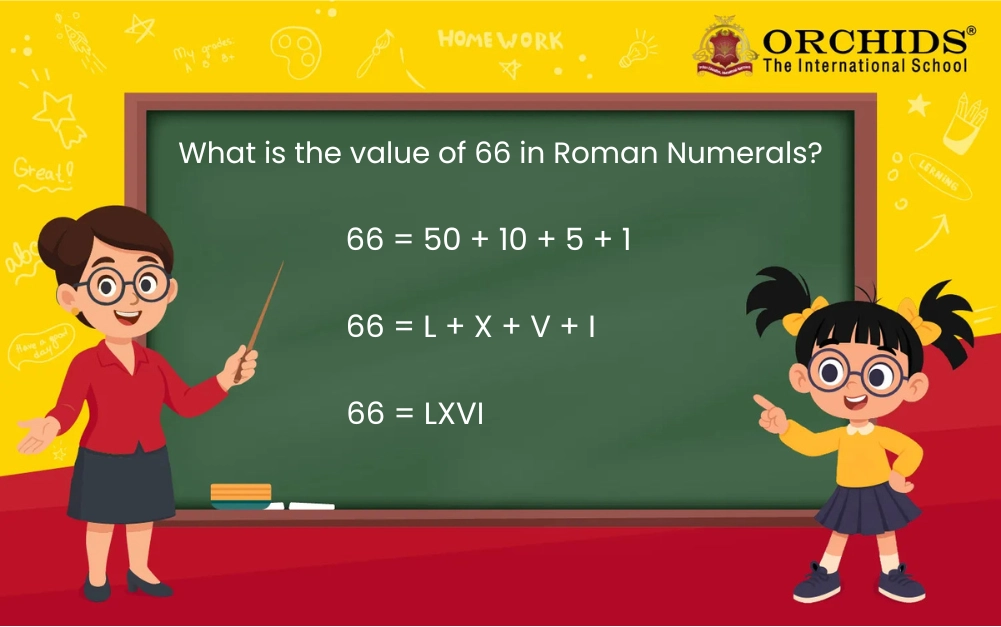
Step-by-step method:
-
First, split 66 into simpler parts: 60 + 6
-
60 is written using Roman symbols as L (50) + X (10)
-
6 is written as V (5) + I (1)
Now, write the symbols together in order from highest to lowest value:
-
L + X + V + I = LXVI
-
66 in Roman numerals = LXVI

Roman Numerals for Numbers Related to 66
|
Number |
Roman Numeral |
|
60 |
LX |
|
61 |
LXI |
|
62 |
LXII |
|
63 |
LXIII |
|
64 |
LXIV |
|
65 |
LXV |
|
66 |
LXVI |
|
67 |
LXVII |
|
68 |
LXVIII |
|
69 |
LXIX |
|
70 |
LXX |
Know more about related topics:
Solved Examples on 66 in Roman Numerals
Example 1: Add XXXIII (33) and XXXIII (33). Express the sum in Roman numerals.
Solution:
-
XXXIII + XXXIII = 33 + 33 = 66
-
66 in Roman numerals = LXVI
Example 2: Subtract XXIV (24) from XC (90). Write the result in Roman numerals.
Solution:
-
XC = 90, XXIV = 24
-
90 - 24 = 66
-
66 in Roman numerals = LXVI
Example 3: Multiply XI (11) by VI (6). Express the product in Roman numerals.
Solution:
-
11 × 6 = 66
-
Therefore, 66 in Roman numerals is LXVI.
Example 4: A wall clock shows LX (60) minutes. If another 6 minutes pass, what is the total time in Roman numerals?
Solution:
-
LX = 60, plus 6 minutes = 66
-
Total = LXVI
Example 5: Divide CXXXII (132) by II (2). Express the quotient in Roman numerals.
Solution:
-
132 ÷ 2 = 66
-
Quotient = LXVI
Fun Facts on 66 in Roman Numerals
-
LXVI = 66 is formed by adding L (50), X (10), V (5), and I (1).
-
Roman numeral LXVI uses only additive rules; no subtraction is required.
-
In ancient inscriptions, Roman numerals such as LXVI often appear in dates or numbering sequences.
-
There is no zero in Roman numerals, so each number is formed using a combination of seven symbols.
-
On many antique clocks, Roman numerals such as LXVI (66 minutes or seconds) may be part of the design sequence.
Practice Questions on 66 in Roman Numerals
1. Add XXXIII (33) and XXXIII (33). Express the sum in Roman numerals.
2. Subtract XXIV (24) from XC (90). What is the result in Roman numerals?
3. A Roman tablet shows LX (60). Add VI (6). What is the sum in Roman numerals?
4. Multiply XI (11) by VI (6). Express the result in Roman numerals.
5. Convert 68 to Roman numerals and compare it to 66.
Conclusion
66 in Roman numerals is written as LXVI, formed by adding L (50), X (10), V (5), and I (1). Since the values are arranged from highest to lowest, it follows the addition rule. Learning to write 66 in Roman numerals helps students understand number patterns and read Roman numerals found on clocks, books, and historical records.
Learn Roman numerals easily with clear explanations at Orchids International School.
Numbers make sense when they're taught right. To see how Orchids The International School turns Maths from intimidating to intuitive, reach out to our admissions team.
Frequency Asked Questions on 66 in Roman Numerals
1. What is the easiest way to remember 66 in Roman numerals?
Answer: Think of 66 as 60 + 6.
-
60 = LX
-
6 = VI
-
Join them. LX + VI = LXVI
2. What is the sum of the Roman numeral values in LXVI?
Answer: In LXVI, L = 50, X = 10, V = 5, and I = 1. Adding them: 50 + 10 + 5 + 1 = 66.
3. What would 660 be if 66 in Roman numerals is LXVI?
Answer: To represent 660, multiply 100 (C) by 6 and add LX. Hence, 660 = DCLX in Roman numerals.
4. How is 66 in Roman numerals used in modern contexts?
Answer: You might see LXVI on clock faces, book chapters, film titles, or sports event editions (like Super Bowl LXVI).
5. What happens if I write 66 as XLXVI in Roman numerals?
Answer: That would be incorrect because Roman numerals must follow a descending order. The correct form is LXVI, not XLXVI.
Related Links


Admissions Open for 2026-27
What type of concept pages would you prefer?
CBSE Schools In Popular Cities
- CBSE Schools in Bangalore
- CBSE Schools in Mumbai
- CBSE Schools in Pune
- CBSE Schools in Hyderabad
- CBSE Schools in Chennai
- CBSE Schools in Gurgaon
- CBSE Schools in Kolkata
- CBSE Schools in Indore
- CBSE Schools in Sonipat
- CBSE Schools in Delhi
- CBSE Schools in Rohtak
- CBSE Schools in Bhopal
- CBSE Schools in Aurangabad
- CBSE Schools in Jabalpur
- CBSE Schools in Jaipur
- CBSE Schools in Jodhpur
- CBSE Schools in Nagpur
- CBSE Schools in Ahmednagar
- CBSE School In Tumkur











Orchids The International School is one of India's leading chains of CBSE and ICSE schools, with 110+ schools across the country.