

7000 in Roman Numerals
7000 in Roman numerals is written as V̅I̅I̅. In Roman numeral rules, placing a bar over a symbol multiplies its value by 1000. The symbol V represents 5, and with a bar (V̅), it becomes 5000. The symbol 'I' represents 1, and with a bar (I̅) above it, it becomes 1000. So, V̅I̅I̅ means 5000 + 1000 + 1000 = 7000. Learning how to write 7000 in Roman numerals using the bar notation helps students understand how larger numbers are formed in the Roman system and how multiplication by 1000 is applied. This makes the concept of Roman numerals clearer and more structured.
Table of Contents
- How to Write 7000 in Roman Numerals?
- Roman Numerals for Numbers Related to 7000
- Solved Examples on 7000 in Roman Numerals
- Fun Facts on 7000 in Roman Numerals
- Practice Questions on 7000 in Roman Numerals
- Conclusion
- Frequently Asked Questions on 7000 in Roman Numerals

How to Write 7000 in Roman Numerals?
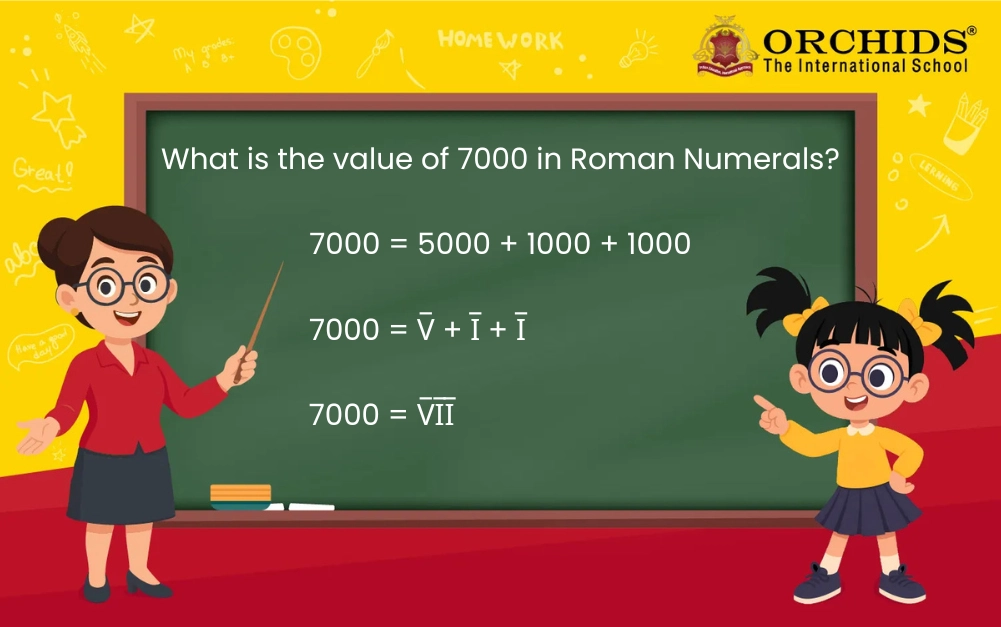
Writing 7000 in Roman numerals requires understanding how large numbers are shown in the Roman numeral system.
Step 1: First, write the number 7 in Roman numerals.
-
7 = VII
Step 2: In Roman numerals, a horizontal line placed above a symbol is called a 'vinculum'.
The vinculum means that the value of the Roman numeral is multiplied by 1000.
So,
-
V̅ = 5 × 1000 = 5000
-
I̅ = 1 × 1000 = 1000
Step 3: Apply the Vinculum to 7
Since:
-
7 = VII
To make it 7000, we multiply 7 by 1000:
-
7 × 1000 = 7000
Now place a bar over each letter in VII: V̅I̅I̅
Know more about related topics:
Roman Numerals for Numbers Related to 7000
|
Number |
Roman Numeral |
|
6995 |
V̅I̅C̅M̅XCV |
|
6996 |
V̅I̅C̅M̅XCVI |
|
6997 |
V̅I̅C̅M̅XCVII |
|
6998 |
V̅I̅C̅M̅XCVIII |
|
6999 |
V̅I̅C̅M̅XCIX |
|
7000 |
V̅I̅I̅ |
|
7001 |
V̅I̅I̅I |
|
7002 |
V̅I̅I̅II |
|
7003 |
V̅I̅I̅III |
|
7004 |
V̅I̅I̅IV |
|
7005 |
V̅I̅I̅V |
Solved Examples on 7000 in Roman Numerals
Example 1: Find the Value of (20 − 6850) + 7000 in Roman Numerals.
Solution:
First solve inside the bracket:
-
20 − 6850 = −6830
Now add 7000:
-
− 6830 + 7000 = 170
Now convert 170 into Roman numerals:
170 = 100 + 50 + 20
= C + L + XX
= CLXX
Therefore, the answer in Roman numerals is CLXX.
Example 2: Find the Value of 7890 − 7000 in Roman Numerals.
Solution:
-
7890 − 7000 = 890
Now convert 890 into Roman numerals:
890 = 800 + 90
= DCCC + XC
= DCCCXC
So, 7890 − 7000 written in Roman numerals is DCCCXC.
Example 3: What is the Remainder When V̅I̅I̅ is Divided by IV?
Solution:
-
IV = 4
-
V̅I̅I̅ = 7000
Now divide:
-
7000 ÷ 4 = 1750 remainder 0
Since the remainder is 0, there is no Roman numeral for the remainder.
Therefore, when 7000 is divided by IV, the remainder is 0.
Example 4: Find the Difference Between 7456 and 7000 in Roman Numerals.
Solution:
-
7456 − 7000 = 456
Now convert 456 into Roman numerals:
456 = 400 + 50 + 6
= CD + L + VI
= CDLVI
Hence, the difference written in Roman numerals is CDLVI.
Example 5: Add 7000 and 325. Write the answer in Roman numerals.
Solution:
-
7000 + 325 = 7325
Now express 7325 in Roman numerals:
-
7000 = V̅I̅I̅
-
300 = CCC
-
20 = XX
-
5 = V
So,
7325 = V̅I̅I̅ + CCC + XX + V = V̅I̅I̅CCCXXV
Fun Facts on 7000 in Roman Numerals
-
7000 in Roman numerals is written as V̅I̅I̅. The bar placed above the letters means the number is multiplied by 1000.
-
In basic Roman numeral rules, numbers usually go up to 3999 (MMMCMXCIX). To write larger numbers like 7000, a special bar notation is used.
-
The symbol V̅ represents 5000, and I̅I̅ represents 2000. When combined, they form 7000.
-
Roman numerals do not have a separate symbol for 7000. Instead, it is formed by combining symbols logically.
-
Large Roman numerals such as 7000 are rarely used in daily life today, but they are important for understanding how the Roman number system worked.
Practice Questions on 7000 in Roman Numerals
1. Subtract 6995 from 7000 and convert the answer into Roman numerals.
2. Write the next 5 numbers after 7000 in Roman numerals.
3. Add 7000 and 48. Express the result in Roman numerals.
4. If V̅II + M = ? Write the answer in Roman numerals.
5. Subtract II (2000) from V̅I̅I̅. Express the result in Roman numerals.
Conclusion
7000 in Roman numerals is written as V̅I̅I̅. In the Roman number system, a line placed above a numeral increases its value by 1,000 times. Since VII represents 7, adding a bar above it changes the value to 7,000. This rule makes it possible to express large numbers clearly using Roman symbols. Understanding 7000 in Roman numerals (V̅I̅I̅) helps students see how Roman notation extends beyond basic numbers. Exploring related values like 5000 (V̅), 6000 (V̅I̅), 8000 (V̅I̅I̅I̅), and 9000 (I̅X̅) builds pattern recognition and improves confidence in writing bigger numerals. Learning such concepts strengthens number sense and makes it easier to read Roman numerals used in historical dates, inscriptions, and formal numbering systems.
Understand 7000 in Roman numerals in a simple and clear way with step-by-step lessons at Orchids International School.
Numbers make sense when they're taught right. To see how Orchids The International School turns Maths from intimidating to intuitive, reach out to our admissions team.
Frequently Asked Questions on 7000 in Roman Numerals
1. What is 7000 in Roman numerals?
7000 in Roman numerals is written as V̅I̅I̅. The bar placed above the symbols (called a vinculum) means the number is multiplied by 1,000. Since VII equals 7, adding a bar makes it 7 × 1000 = 7000.
2. How is 7000 formed using Roman numeral rules?
-
First, write 7 as VII.
Then place a horizontal line over the entire numeral.
-
V̅I̅I̅ = 7 × 1000 = 7000
This method is used for large numbers greater than 3,999 in the Roman numeral system.
3. Can we write 7000 as MMMMMMM?
Although writing M seven times equals 7000 (because M = 1000), Roman numeral rules usually avoid repeating a symbol more than three times in a row. That is why the standard way to write 7000 in Roman numerals is V̅I̅I̅, not MMMMMMM.
4. What does the bar above the Roman numerals mean?
The horizontal bar, known as a vinculum, multiplies the value by 1,000.
For example:
-
VII = 7
-
V̅I̅I̅ = 7000
So, the bar is what changes a small number into a larger value in Roman numeral notation.
5. What are the Roman numerals close to 7000?
Here are some numbers near 7000 written in Roman numerals:
-
6000 = V̅I̅
-
7000 = V̅I̅I̅
-
8000 = V̅I̅I̅I̅
-
7001 = V̅I̅I̅I
Related Links


Admissions Open for 2026-27
What type of concept pages would you prefer?
CBSE Schools In Popular Cities
- CBSE Schools in Bangalore
- CBSE Schools in Mumbai
- CBSE Schools in Pune
- CBSE Schools in Hyderabad
- CBSE Schools in Chennai
- CBSE Schools in Gurgaon
- CBSE Schools in Kolkata
- CBSE Schools in Indore
- CBSE Schools in Sonipat
- CBSE Schools in Delhi
- CBSE Schools in Rohtak
- CBSE Schools in Bhopal
- CBSE Schools in Aurangabad
- CBSE Schools in Jabalpur
- CBSE Schools in Jaipur
- CBSE Schools in Jodhpur
- CBSE Schools in Nagpur
- CBSE Schools in Ahmednagar
- CBSE School In Tumkur











Orchids The International School is one of India's leading chains of CBSE and ICSE schools, with 110+ schools across the country.