

8000 in Roman Numerals
8000 in Roman numerals is written as V̅I̅I̅I̅. In the Roman numeral system, a horizontal bar placed above a symbol multiplies its value by 1000. The symbol V represents 5, and when a bar is added above it (V̅), its value becomes 5000. Similarly, the symbol I represents 1, and with a bar above it (I̅), it becomes 1000. Therefore, V̅I̅I̅I̅ represents 5000 + 1000 + 1000 + 1000, which equals 8000. Understanding 8000 in Roman numerals helps students learn how large numbers are formed using bar notation and how multiplication by 1000 is applied in the Roman number system. This knowledge makes the concept of Roman numerals clearer and helps build a strong foundation in number systems.
Table of Contents
- How to Write 8000 in Roman Numerals?
- Roman Numerals for Numbers Related to 8000
- Solved Examples on 8000 in Roman Numerals
- Fun Facts on 8000 in Roman Numerals
- Practice Questions on 8000 in Roman Numerals
- Conclusion
- Frequently Asked Questions on 8000 in Roman Numerals

How to Write 8000 in Roman Numerals?
Writing 8000 in Roman numerals involves understanding how large values are represented in the Roman numeral system. Since basic Roman symbols usually go up to 1000 (M), we use a special method for bigger numbers.
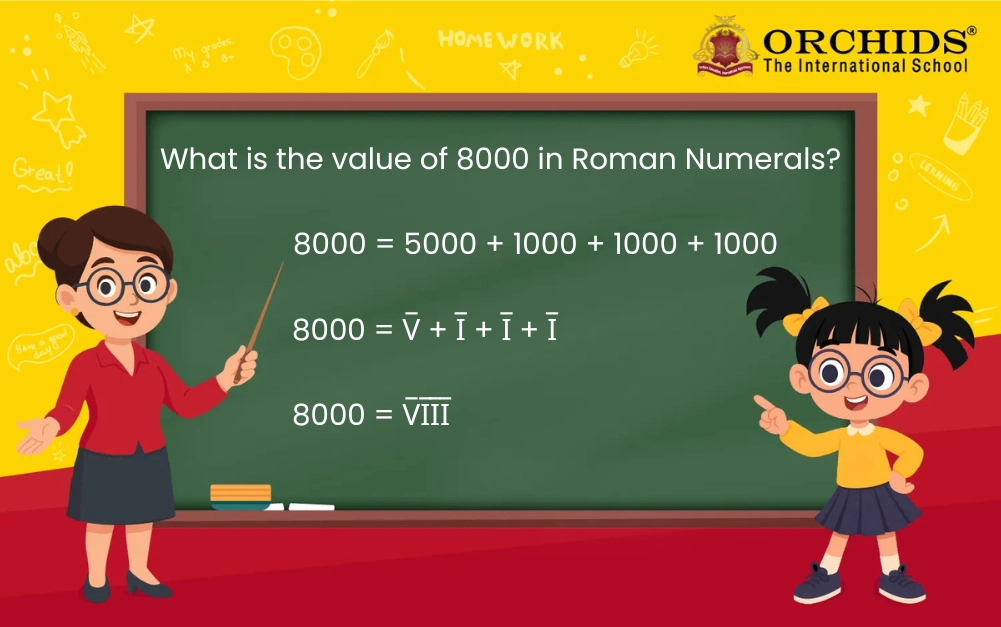
Step 1: Break 8000 into Parts
First, expand the number:
-
8000 = 5000 + 1000 + 1000 + 1000
Now we will write each part in Roman numerals.
Step 2: Convert Each Value into Roman Form
In Roman numerals:
-
5 = V
-
1 = I
When we place a bar above these symbols, their value becomes 1000 times bigger:
-
V̅ = 5 × 1000 = 5000
-
I̅ = 1 × 1000 = 1000
Step 3: Combine the Symbols
Now combine all the values:
-
5000 + 1000 + 1000 + 1000 = V̅ + I̅ + I̅ + I̅
-
So, 8000 in Roman numerals is written as: V̅I̅I̅I̅
Know more about related topics:
Roman Numerals for Numbers Related to 8000
|
Number |
Roman Numeral |
|
7995 |
V̅I̅I̅CMXCV |
|
7996 |
V̅I̅I̅CMXCVI |
|
7997 |
V̅I̅I̅CMXCVII |
|
7998 |
V̅I̅I̅CMXCVIII |
|
7999 |
V̅I̅I̅CMXCIX |
|
8000 |
V̅I̅I̅I̅ |
|
8001 |
V̅I̅I̅I̅I |
|
8002 |
V̅I̅I̅I̅II |
|
8003 |
V̅I̅I̅I̅III |
|
8004 |
V̅I̅I̅I̅IV |
|
8005 |
V̅I̅I̅I̅V |
Solved Examples on 8000 in Roman Numerals
Example 1: Find the Value of 8200 − 8000 in Roman Numerals.
Solution:
First, subtract the numbers:
-
8200 − 8000 = 200
Now convert 200 into Roman numerals.
200 = 100 + 100
= C + C
= CC
Therefore, 8200 − 8000 written in Roman numerals is CC.
Example 2: Find the sum of 8000 and 75 in Roman numerals.
Solution:
-
8000 + 75 = 8075
Now express 8075 in expanded form:
-
8075 = 8000 + 70 + 5
-
8000 = V̅I̅I̅
-
70 = LXX
-
5 = V
So, 8075 in Roman numerals is V̅I̅I̅ILXXV.
Thus, the sum of 8000 and 75 in Roman numerals is V̅I̅I̅ILXXV.
Example 3: Convert (8500 − 8000) into Roman numerals.
Solution:
-
8500 − 8000 = 500
Now convert 500 into Roman numerals.
-
500 = D
Hence, the value of (8500 − 8000) in Roman numerals is D.
Example 4: If V̅I̅I̅I is increased by XXX, what is the result in Roman numerals?
Solution:
-
V̅I̅I̅I = 8000
-
XXX = 30
Now add:
-
8000 + 30 = 8030
Write 8030 in expanded form:
-
8030 = 8000 + 30 = V̅I̅I̅I + XXX
So, 8030 in Roman numerals is V̅I̅I̅I̅XXX.
Example 5: What is the Remainder When 8000 is Divided by 21? Write the answer in Roman numerals.
Solution:
Divide 8000 by 21:
-
8000 ÷ 21 = 380 remainder 20
Now convert 20 into Roman numerals:
-
20 = X + X = XX
Therefore, when 8000 is divided by 21, the remainder written in Roman numerals is XX.
Fun Facts on 8000 in Roman Numerals
-
8000 in Roman numerals is written as V̅I̅I̅I, where the bar (vinculum) means the number is multiplied by 1000.
-
It is formed from VIII (8), and adding a bar makes it 8 × 1000 = 8000.
-
Standard Roman numerals usually go up to 3999, so larger numbers like 8000 use special bar notation.
-
Large Roman numerals were useful in ancient times for trade and records.
-
Learning 8000 in Roman numerals helps students understand number patterns and multiplication clearly.
Practice Questions on 8000 in Roman Numerals
1. What is 8000 + 90? Write your final answer in Roman numerals.
2. Subtract 8000 from 8450 and express the result in Roman numerals.
3. Write the Roman numeral that comes immediately after 8000.
4. Convert 7999 into Roman numerals and compare it with 8000 in Roman form.
5. Find the remainder when 8000 is divided by 25. Write the remainder in Roman numerals.
Conclusion
8000 in Roman numerals is written as V̅I̅I̅I̅. In the Roman numeral system, a bar placed above a symbol multiplies its value by 1,000. Since VIII equals 8, adding a bar above it changes the value to 8,000. Learning 8000 in Roman numerals (V̅I̅I̅I̅) helps students understand how large numbers are formed in Roman notation. Looking at related values like 5000 (V̅), 6000 (V̅I̅), 7000 (V̅I̅I̅), and 9000 (I̅X̅) builds pattern recognition and strengthens number skills. Roman numerals are still seen in history, monuments, and formal numbering systems today.
Explore 8000 in Roman numerals in a clear and easy way with guided lessons at Orchids International School.
Numbers make sense when they're taught right. To see how Orchids The International School turns Maths from intimidating to intuitive, reach out to our admissions team.
Frequently Asked Questions on 8000 in Roman Numerals
1. What is 8000 in Roman numerals?
8000 in Roman numerals is written as V̅I̅I̅I̅.
2. How do you represent 8000 in Roman numerals?
To represent 8000, we place a bar (called a 'vinculum') over the Roman numeral VIII. Since VIII equals 8, adding a bar multiplies it by 1000. Therefore, 8 × 1000 = 8000, written as V̅I̅I̅I̅.
3. What does the bar over V̅I̅I̅I̅ mean?
The bar placed over Roman numerals means the number is multiplied by 1000. So, when VIII has a bar over it, the value becomes 8000.
4. Why is 8000 not written as MMMM in Roman numerals?
Traditional Roman numerals usually go up to 3999 using M repeatedly. For numbers greater than 3999, a vinculum (bar) is used. That is why 8000 is written as V̅I̅I̅I̅ instead of repeating M eight times.
5. Where are large Roman numerals like 8000 used?
Large Roman numerals are sometimes used in historical records, inscriptions, book numbering, and special documents. The vinculum rule helps represent big numbers clearly in the Roman number system.
Related Links


Admissions Open for 2026-27
What type of concept pages would you prefer?
CBSE Schools In Popular Cities
- CBSE Schools in Bangalore
- CBSE Schools in Mumbai
- CBSE Schools in Pune
- CBSE Schools in Hyderabad
- CBSE Schools in Chennai
- CBSE Schools in Gurgaon
- CBSE Schools in Kolkata
- CBSE Schools in Indore
- CBSE Schools in Sonipat
- CBSE Schools in Delhi
- CBSE Schools in Rohtak
- CBSE Schools in Bhopal
- CBSE Schools in Aurangabad
- CBSE Schools in Jabalpur
- CBSE Schools in Jaipur
- CBSE Schools in Jodhpur
- CBSE Schools in Nagpur
- CBSE Schools in Ahmednagar
- CBSE School In Tumkur











Orchids The International School is one of India's leading chains of CBSE and ICSE schools, with 110+ schools across the country.