

Table of 553
The Table of 553 helps learners observe how numbers change consistently when using 553. Studying this table improves number fluency and supports quicker problem-solving with larger figures. Learners can download the Table of 553 PDF for convenient learning.
Table of 553 Chart
In the Table of 553 chart, numbers are arranged logically to show consistent growth at each step. This format supports better concentration and makes it easier to remember the sequence of values.
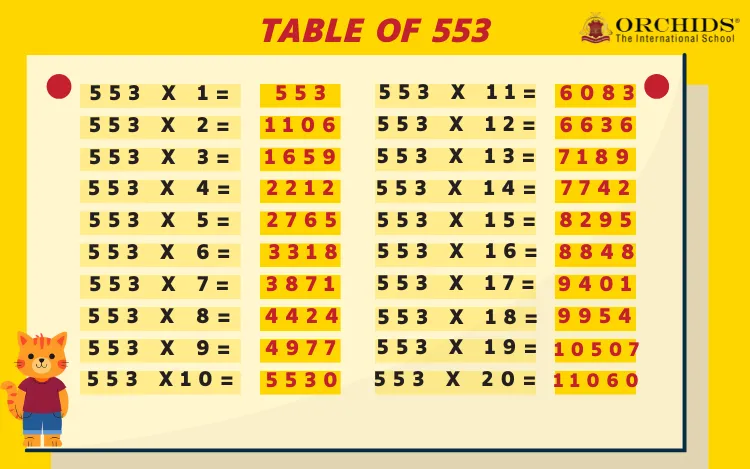

Multiplication Table of 553
In the multiplication table of 553, the values increase in a consistent order, making patterns easier to recognise. This layout supports better focus and helps learners apply the table correctly during practice.
| Multiplicand | Operation | Multiplier | Result | |
| 553 | x | 1 | = | 553 |
| 553 | x | 2 | = | 1106 |
| 553 | x | 3 | = | 1659 |
| 553 | x | 4 | = | 2212 |
| 553 | x | 5 | = | 2765 |
| 553 | x | 6 | = | 3318 |
| 553 | x | 7 | = | 3871 |
| 553 | x | 8 | = | 4424 |
| 553 | x | 9 | = | 4977 |
| 553 | x | 10 | = | 5530 |
| 553 | x | 11 | = | 6083 |
| 553 | x | 12 | = | 6636 |
| 553 | x | 13 | = | 7189 |
| 553 | x | 14 | = | 7742 |
| 553 | x | 15 | = | 8295 |
| 553 | x | 16 | = | 8848 |
| 553 | x | 17 | = | 9401 |
| 553 | x | 18 | = | 9954 |
| 553 | x | 19 | = | 10507 |
| 553 | x | 20 | = | 11060 |
The Table of 553 PDF offers a convenient way to practise the table without screens, supporting focused learning.
Know more about related topics:
Download PDF - Table of 553
How do you read the multiplication table of 553?
Read each row slowly and compare it with the previous one to observe the change in values. This comparison-based approach helps learners recognise consistency and avoid calculation mistakes.
553 times 1 is 553
553 times 2 is 1106
553 times 3 is 1659
553 times 4 is 2212
553 times 5 is 2765
553 times 6 is 3318
553 times 7 is 3871
553 times 8 is 4424
553 times 9 is 4977
553 times 10 is 5530
553 times 11 is 6083
553 times 12 is 6636
553 times 13 is 7189
553 times 14 is 7742
553 times 15 is 8295
553 times 16 is 8848
553 times 17 is 9401
553 times 18 is 9954
553 times 19 is 10,507
553 times 20 is 11,060
Table of 553 in Words
Here, the multiples of 553 are expressed in words to make large numbers easier to recognise. This approach supports careful reading and builds confidence in understanding number magnitude.
Five hundred fifty-three times one is five hundred fifty-three
Five hundred fifty-three times two is one thousand one hundred six
Five hundred fifty-three times three is one thousand six hundred fifty-nine
Five hundred fifty-three times four is two thousand two hundred twelve
Five hundred fifty-three times five is two thousand seven hundred sixty-five
Five hundred fifty-three times six is three thousand three hundred eighteen
Five hundred fifty-three times seven is three thousand eight hundred seventy-one
Five hundred fifty-three times eight is four thousand four hundred twenty-four
Five hundred fifty-three times nine is four thousand nine hundred seventy-seven
Five hundred fifty-three times ten is five thousand five hundred thirty
Five hundred fifty-three times eleven is six thousand eighty-three
Five hundred fifty-three times twelve is six thousand six hundred thirty-six
Five hundred fifty-three times thirteen is seven thousand one hundred eighty-nine
Five hundred fifty-three times fourteen is seven thousand seven hundred forty-two
Five hundred fifty-three times fifteen is eight thousand two hundred ninety-five
Five hundred fifty-three times sixteen is eight thousand eight hundred forty-eight
Five hundred fifty-three times seventeen is nine thousand four hundred one
Five hundred fifty-three times eighteen is nine thousand nine hundred fifty-four
Five hundred fifty-three times nineteen is ten thousand five hundred seven
Five hundred fifty-three times twenty is eleven thousand sixty
Table of 553 Using Repeated Addition
Using repeated addition for the table of 553 helps learners build results gradually. Adding the number multiple times improves understanding of number buildup and reduces confusion during practice.
|
Multiplication |
Repeated Addition |
Result |
|
553 × 1 |
553 |
553 |
|
553 × 2 |
553 + 553 |
1106 |
|
553 × 3 |
553 + 553 + 553 |
1659 |
|
553 × 4 |
553 + 553 + 553 + 553 |
2212 |
|
553 × 5 |
553 + 553 + 553 + 553 + 553 |
2765 |
|
553 × 6 |
553 + 553 + 553 + 553 + 553 + 553 |
3318 |
|
553 × 7 |
553 + 553 + 553 + 553 + 553 + 553 + 553 |
3871 |
|
553 × 8 |
553 + 553 + 553 + 553 + 553 + 553 + 553 + 553 |
4424 |
|
553 × 9 |
553 + 553 + 553 + 553 + 553 + 553 + 553 + 553 + 553 |
4977 |
|
553 × 10 |
553 + 553 + 553 + 553 + 553 + 553 + 553 + 553 + 553 + 553 |
5530 |
Solved Problems on Table of 553
1. A shopkeeper packs 553 chocolates in one box. How many chocolates are there in 9 boxes?
Solution: To find the total number of chocolates, multiply the number of chocolates in one box by the number of boxes: 553 × 9 = 4977 chocolates. This approach avoids repeated addition and gives the total quickly.
2. A printing press produces 553 posters per day. How many posters are produced in 5 days?
Solution: Multiply 553 × 5 = 2765 posters. Using multiplication allows the press to plan production efficiently without manually adding 553 each day.
3. A train carries 553 passengers in one coach. How many passengers are there in 6 coaches?
Solution: Total passengers = 553 × 6 = 3318 passengers. Multiplication helps calculate totals for multiple coaches accurately and quickly.
4. A school orders 553 desks for one block. How many desks are needed for 2 blocks?
Solution: Multiply 553 × 2 = 1106 desks. This ensures that ordering and planning are precise, showing the practicality of multiplication in real-life situations.
5. A company ships 553 items in one container. How many items are shipped in 8 containers?
Solution: Total items = 553 × 8 = 4424 items. Using multiplication avoids errors from repeated addition and helps in logistics planning efficiently.
Learn More Multiplication Tables
Numbers make sense when they're taught right. To see how Orchids The International School turns Maths from intimidating to intuitive, reach out to our admissions team.
Frequently Asked Questions on Table of 553
1. What skills does the Table of 553 strengthen?
The Table of 553 improves focus, calculation speed, and accuracy with odd three-digit numbers. It also builds confidence in handling larger values.
2. How can I verify answers in the Table of 553?
Break the number into parts, such as hundreds and tens, and multiply separately. Adding the results helps confirm accuracy.
3. Is reading the table aloud helpful?
Yes, reading values aloud improves memory and helps learners remember the correct order of results.
4. How does repeated addition help with the Table of 553?
Repeated addition shows how totals grow step by step, making the concept of multiplication easier to understand.
5. When is the Table of 553 commonly used?
It can be applied when calculating grouped quantities like boxes, passengers, or production units.
Related Links


Admissions Open for 2026-27
What type of concept pages would you prefer?
CBSE Schools In Popular Cities
- CBSE Schools in Bangalore
- CBSE Schools in Mumbai
- CBSE Schools in Pune
- CBSE Schools in Hyderabad
- CBSE Schools in Chennai
- CBSE Schools in Gurgaon
- CBSE Schools in Kolkata
- CBSE Schools in Indore
- CBSE Schools in Sonipat
- CBSE Schools in Delhi
- CBSE Schools in Rohtak
- CBSE Schools in Bhopal
- CBSE Schools in Aurangabad
- CBSE Schools in Jabalpur
- CBSE Schools in Jaipur
- CBSE Schools in Jodhpur
- CBSE Schools in Nagpur
- CBSE Schools in Ahmednagar
- CBSE School In Tumkur











Orchids The International School is one of India's leading chains of CBSE and ICSE schools, with 110+ schools across the country.