

Table of 568
The table of 568 highlights consistent number progression with each multiplication step. Practising this table strengthens understanding of number expansion and supports faster problem-solving skills. Learners can download the Table of 568 PDF to revise the table easily.
Table of 568 Chart
In the Table of 568 chart, each multiple is displayed step by step to demonstrate steady number progression. This visual arrangement strengthens pattern recognition and supports efficient learning.
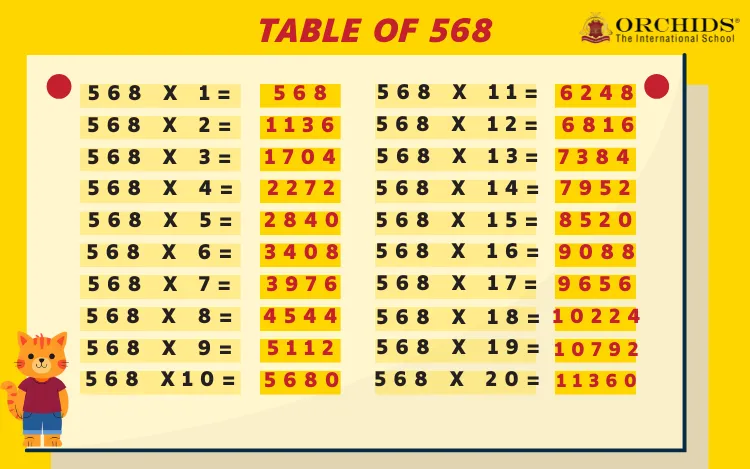

Multiplication Table of 568
In the multiplication table of 568, the outcomes show smooth numerical expansion with each step. This clarity strengthens pattern awareness and helps learners apply the table confidently in different calculations.
| Multiplicand | Operation | Multiplier | Result | |
| 568 | x | 1 | = | 568 |
| 568 | x | 2 | = | 1136 |
| 568 | x | 3 | = | 1704 |
| 568 | x | 4 | = | 2272 |
| 568 | x | 5 | = | 2840 |
| 568 | x | 6 | = | 3408 |
| 568 | x | 7 | = | 3976 |
| 568 | x | 8 | = | 4544 |
| 568 | x | 9 | = | 5112 |
| 568 | x | 10 | = | 5680 |
| 568 | x | 11 | = | 6248 |
| 568 | x | 12 | = | 6816 |
| 568 | x | 13 | = | 7384 |
| 568 | x | 14 | = | 7952 |
| 568 | x | 15 | = | 8520 |
| 568 | x | 16 | = | 9088 |
| 568 | x | 17 | = | 9656 |
| 568 | x | 18 | = | 10224 |
| 568 | x | 19 | = | 10792 |
| 568 | x | 20 | = | 11360 |
The Table of 568 PDF is provided for convenient reference, supporting repeated practice and better retention of multiplication facts.
Know more about related topics:
Download the Table of 568
How Do You Read the Multiplication Table of 568?
Read the table aloud from start to end while tracking the growth of numbers at each step. This method strengthens understanding and helps learners recall the table faster.
568 times 1 is 568
568 times 2 is 1136
568 times 3 is 1704
568 times 4 is 2272
568 times 5 is 2840
568 times 6 is 3408
568 times 7 is 3976
568 times 8 is 4544
568 times 9 is 5112
568 times 10 is 5680
568 times 11 is 6248
568 times 12 is 6816
568 times 13 is 7384
568 times 14 is 7952
568 times 15 is 8520
568 times 16 is 9088
568 times 17 is 9656
568 times 18 is 10,224
568 times 19 is 10,792
568 times 20 is 11,360
Table of 568 in Words
In the Table of 568 in Words, each multiple is expressed clearly to support better comprehension of numerical language. This method helps learners recognise values easily while reading and solving problems.
Five hundred sixty-eight times one is five hundred sixty-eight
Five hundred sixty-eight times two is one thousand one hundred thirty-six
Five hundred sixty-eight times three is one thousand seven hundred four
Five hundred sixty-eight times four is two thousand two hundred seventy-two
Five hundred sixty-eight times five is two thousand eight hundred forty
Five hundred sixty-eight times six is three thousand four hundred eight
Five hundred sixty-eight times seven is three thousand nine hundred seventy-six
Five hundred sixty-eight times eight is four thousand five hundred forty-four
Five hundred sixty-eight times nine is five thousand one hundred twelve
Five hundred sixty-eight times ten is five thousand six hundred eighty
Five hundred sixty-eight times eleven is six thousand two hundred forty-eight
Five hundred sixty-eight times twelve is six thousand eight hundred sixteen
Five hundred sixty-eight times thirteen is seven thousand three hundred eighty-four
Five hundred sixty-eight times fourteen is seven thousand nine hundred fifty-two
Five hundred sixty-eight times fifteen is eight thousand five hundred twenty
Five hundred sixty-eight times sixteen is nine thousand eighty-eight
Five hundred sixty-eight times seventeen is nine thousand six hundred fifty-six
Five hundred sixty-eight times eighteen is ten thousand two hundred twenty-four
Five hundred sixty-eight times nineteen is ten thousand seven hundred ninety-two
Five hundred sixty-eight times twenty is eleven thousand three hundred sixty
Table of 568 Using Repeated Addition
In the table of 568, repeated addition clearly illustrates how consistent addition leads to larger multiples. This technique improves clarity and supports a strong foundational understanding.
|
Multiplication |
Repeated Addition |
Result |
|
568 × 1 |
568 |
568 |
|
568 × 2 |
568 + 568 |
1136 |
|
568 × 3 |
568 + 568 + 568 |
1704 |
|
568 × 4 |
568 + 568 + 568 + 568 |
2272 |
|
568 × 5 |
568 + 568 + 568 + 568 + 568 |
2840 |
|
568 × 6 |
568 + 568 + 568 + 568 + 568 + 568 |
3408 |
|
568 × 7 |
568 + 568 + 568 + 568 + 568 + 568 + 568 |
3976 |
|
568 × 8 |
568 + 568 + 568 + 568 + 568 + 568 + 568 + 568 |
4544 |
|
568 × 9 |
568 + 568 + 568 + 568 + 568 + 568 + 568 + 568 + 568 |
5112 |
|
568 × 10 |
568 + 568 + 568 + 568 + 568 + 568 + 568 + 568 + 568 + 568 |
5680 |
Solved Examples on Table of 568
1. A farmer packs 568 oranges in one crate. How many oranges are packed in 5 crates?
Solution:
Total oranges = 568 × 5 = 2840 oranges.
This helps manage harvest storage.
2. A company manufactures 568 bottles per hour. How many bottles are made in 7 hours?
Solution:
Total bottles = 568 × 7 = 3976 bottles.
Multiplication helps track hourly production.
3. A warehouse loads 568 cartons in one truck. How many cartons are loaded in 4 trucks?
Solution:
Total cartons = 568 × 4 = 2272 cartons.
This supports transport planning.
4. A school buys 568 notebooks for one grade. How many notebooks are required for 9 grades?
Solution:
Total notebooks = 568 × 9 = 5112 notebooks.
This avoids shortages during distribution.
5. A stadium has 568 seats in one stand. How many seats are there in 6 stands?
Solution:
Total seats = 568 × 6 = 3408 seats.
Multiplication ensures accurate seating counts.
Learn More Multiplication Tables
Numbers make sense when they're taught right. To see how Orchids The International School turns Maths from intimidating to intuitive, reach out to our admissions team.
Frequently Asked Questions on Table of 568
1. How does the Table of 568 help in understanding multiplication?
It shows how numbers grow step by step, helping learners clearly see multiplication patterns.
2. Why should learners practise the Table of 568 regularly?
Regular practice improves accuracy and helps recall values quickly during exams.
3. Can repeated addition be used for the Table of 568?
Yes, adding 568 repeatedly makes it easier to understand how each multiple is formed.
4. Where is the Table of 568 useful outside the classroom?
It helps in calculating totals in packing, storage, and distribution situations.
5. How can mistakes be reduced while learning the Table of 568?
Practising slowly at first and checking answers helps avoid calculation errors.
Related Links


Admissions Open for 2026-27
What type of concept pages would you prefer?
CBSE Schools In Popular Cities
- CBSE Schools in Bangalore
- CBSE Schools in Mumbai
- CBSE Schools in Pune
- CBSE Schools in Hyderabad
- CBSE Schools in Chennai
- CBSE Schools in Gurgaon
- CBSE Schools in Kolkata
- CBSE Schools in Indore
- CBSE Schools in Sonipat
- CBSE Schools in Delhi
- CBSE Schools in Rohtak
- CBSE Schools in Bhopal
- CBSE Schools in Aurangabad
- CBSE Schools in Jabalpur
- CBSE Schools in Jaipur
- CBSE Schools in Jodhpur
- CBSE Schools in Nagpur
- CBSE Schools in Ahmednagar
- CBSE School In Tumkur











Orchids The International School is one of India's leading chains of CBSE and ICSE schools, with 110+ schools across the country.