

777 in Roman Numerals
777 in Roman numerals is written as DCCLXXVII. Roman numerals follow an ancient number system that uses letters like I, V, X, L, C, D, and M to represent numbers. To convert 777 into Roman numerals, we break the number into parts: 777 = 700 + 70 + 7. These values are written as DCC (700), LXX (70), and VII (7). We can also see it step-by-step as 777 = D + C + C + L + X + X + V + I + I, which combines to form DCCLXXVII. Learning how to write 777 in Roman numerals helps students understand how numbers are formed using addition rules in the Roman number system, improving their number skills and confidence in working with larger Roman numerals.
Table of Contents
- How to Write 777 in Roman Numerals?
- Roman Numerals for Numbers Related to 777
- Solved Examples on 777 in Roman Numerals
- Fun Facts on 777 in Roman Numerals
- Practice Questions on 777 in Roman Numerals
- Conclusion
- Frequently Asked Questions on 777 in Roman Numerals

How to Write 777 in Roman Numerals?
To convert 777 in Roman numerals, we carefully break the number into smaller place values and then change each value into its correct Roman symbol. This step-by-step method makes Roman numeral conversion simple and easy to understand.
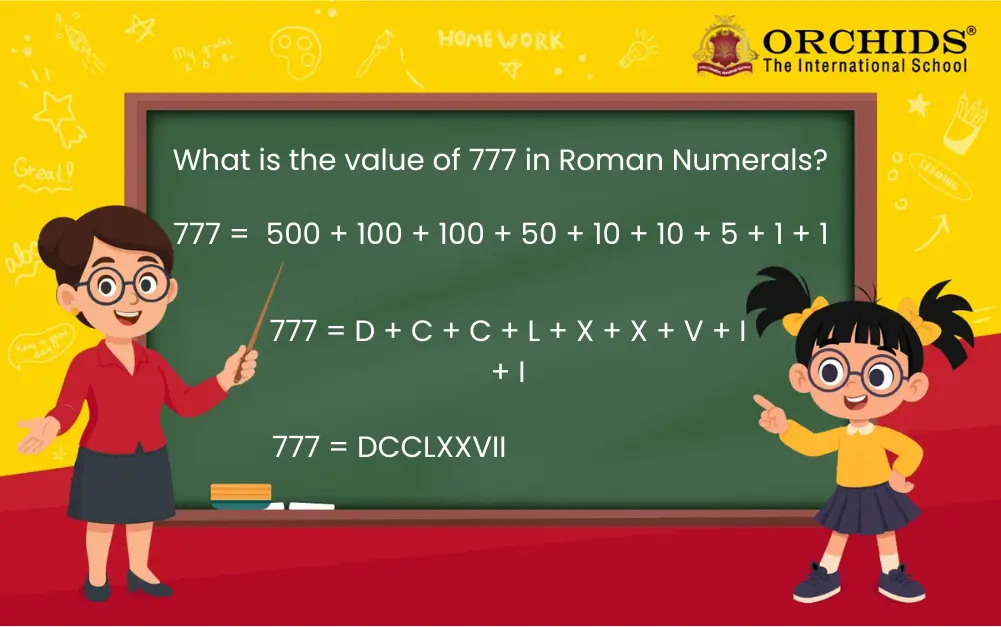
Step 1: Expand the Number Clearly
First, write 777 in expanded form:
-
777 = 500 + 100 + 100 + 50 + 10 + 10 + 5 + 1 + 1
Here, we are separating the number into hundreds, tens, and ones so that each value can be written using Roman letters.
Step 2: Convert Each Value into Roman Symbols
Now, replace each number with its Roman numeral:
-
500 = D
-
100 = C
-
50 = L
-
10 = X
-
5 = V
-
1 = I
Step 3: Combine the Symbols
Next, write all the Roman symbols together in the same order:
-
777 = D + C + C + L + X + X + V + I + I
When combined, it becomes:
-
777 = DCCLXXVII
Know more about related topics:
Roman Numerals for Numbers Related to 777
|
Number |
Roman Numeral |
|
771 |
DCCLXXI |
|
772 |
DCCLXXII |
|
773 |
DCCLXXIII |
|
774 |
DCCLXXIV |
|
775 |
DCCLXXV |
|
776 |
DCCLXXVI |
|
777 |
DCCLXXVII |
|
778 |
DCCLXXVIII |
|
779 |
DCCLXXIX |
|
780 |
DCCLXXX |
Solved Examples on 777 in Roman Numerals
Example 1: What is the remainder when DCCLXXVII is divided by XVI?
Solution:
First, convert the Roman numerals into numbers:
-
DCCLXXVII = 777
-
XVI = 16
Now divide:
-
777 ÷ 16 = 48 remainder 9
Convert the remainder into Roman numerals:
-
9 = IX
Therefore, when DCCLXXVII is divided by XVI, the remainder is IX.
Example 2: Find the Value of (25 − 40) + 777 in Roman Numerals.
Solution:
First, solve inside the bracket:
-
25 − 40 = −15
Now add 777:
-
−15 + 777 = 762
Convert 762 into Roman numerals:
762 = 700 + 60 + 2
= DCC + LX + II
= DCCLXII
So, the final answer in Roman numerals is DCCLXII.
Example 3: A museum recorded DCCLXXVII visitors in one day. If 100 visitors left early, how many visitors remained? Write the answer in Roman numerals.
Solution:
First, convert the Roman numeral:
-
DCCLXXVII = 777
Now subtract:
-
777 − 100 = 677
Convert 677 into Roman numerals:
677 = 600 + 70 + 7
= DC + LXX + VII
= DCLXXVII
Therefore, the remaining visitors are DCLXXVII.
Example 4: A school library has 777 books. If 50 new books are added, what is the total number of books in Roman numerals?
Solution:
-
777 + 50 = 827
Convert 827 into Roman numerals:
827 = 800 + 20 + 7
= DCCC + XX + VII
= DCCCXXVII
So, the total number of books is DCCCXXVII.
Example 5: Calculate 3000 − 777 and write the answer in Roman numerals.
Solution:
-
3000 − 777 = 2223
Convert 2223 into Roman numerals:
2223 = 2000 + 200 + 20 + 3
= MM + CC + XX + III
= MMCCXXIII
Hence, the answer in Roman numerals is MMCCXXIII.
Fun Facts on 777 in Roman Numerals
-
The Roman numeral for 777 is DCCLXXVII, and it is formed only by using addition rules (no subtraction like IV or IX).
-
In DCCLXXVII, the letter C appears twice, X appears twice, and V appears once. This shows how Roman numerals combine repeated symbols to build larger numbers.
-
777 is made up of 700 + 70 + 7. In Roman numerals, this becomes DCC + LXX + VII, which clearly shows its place value structure.
-
The number 777 looks the same forward and backward in digits, but its Roman form DCCLXXVII has a completely different pattern.
-
Roman numerals like DCCLXXVII are still seen today in book chapters, clocks, monuments, and special events.
-
Since 777 does not use subtraction rules, it is a good example for beginners learning how to write numbers in Roman numerals step by step.
Practice Questions on 777 in Roman Numerals
1. What is 777 + 23? Write the final answer in Roman numerals.
2. Find the value of 900 − 777 and express the result in Roman numerals.
3. Add 777 and 100. Write your answer in Roman numeral form.
4. What number comes just after DCCLXXVII in Roman numerals?
5. Subtract 50 from 777 and convert the answer into Roman numerals.
Conclusion
777 in Roman numerals is written as DCCLXXVII, formed by adding 500 (D) + 200 (CC) + 70 (LXX) + 7 (VII). Understanding 777 in Roman numerals helps students see how larger numbers are built by arranging symbols from greatest to smallest. Practising nearby numbers like 776 (DCCLXXVI) and 778 (DCCLXXVIII) improves pattern recognition and strengthens Roman numeral skills used in clocks, dates, and book chapters.
Master 777 in Roman numerals easily with clear, step-by-step learning at Orchids International School.
Frequently Asked Questions on 777 in Roman Numerals
1. What is 777 in Roman Numerals?
777 in Roman numerals is written as DCCLXXVII. It is formed by combining the Roman symbols for 700, 70, and 7.
2. How is 777 written as DCCLXXVII?
Roman numerals are formed by adding values from largest to smallest.
For 777:
-
D = 500
-
CC = 200
-
L = 50
-
XX = 20
-
VII = 7
Adding them together gives 777. Therefore, 777 is written as DCCLXXVII in Roman numerals.
3. What is the place value breakdown of 777 in Roman numerals?
To convert 777 into Roman numerals, we separate it into hundreds, tens, and ones:
-
Hundreds: 700 = DCC
-
Tens: 70 = LXX
-
Ones: 7 = VII
So, 777 = DCC + LXX + VII = DCCLXXVII.
4. What comes just before and after 777 in Roman numerals?
-
Before: 776 in Roman numerals is DCCLXXVI
-
After: 778 in Roman numerals is DCCLXXVIII
5. Why Is It Important to Learn 777 in Roman Numerals?
Learning how to write 777 in Roman numerals helps students understand number patterns and Roman numeral rules. It also improves basic number conversion skills and builds confidence in working with different number systems.
Numbers make sense when they're taught right. To see how Orchids The International School turns Maths from intimidating to intuitive, reach out to our admissions team.


Admissions Open for 2026-27
What type of concept pages would you prefer?
CBSE Schools In Popular Cities
- CBSE Schools in Bangalore
- CBSE Schools in Mumbai
- CBSE Schools in Pune
- CBSE Schools in Hyderabad
- CBSE Schools in Chennai
- CBSE Schools in Gurgaon
- CBSE Schools in Kolkata
- CBSE Schools in Indore
- CBSE Schools in Sonipat
- CBSE Schools in Delhi
- CBSE Schools in Rohtak
- CBSE Schools in Bhopal
- CBSE Schools in Aurangabad
- CBSE Schools in Jabalpur
- CBSE Schools in Jaipur
- CBSE Schools in Jodhpur
- CBSE Schools in Nagpur
- CBSE Schools in Ahmednagar
- CBSE School In Tumkur











Orchids The International School is one of India's leading chains of CBSE and ICSE schools, with 110+ schools across the country.