

CCXX Roman Numerals: Rules, Solved Examples and Practice Questions
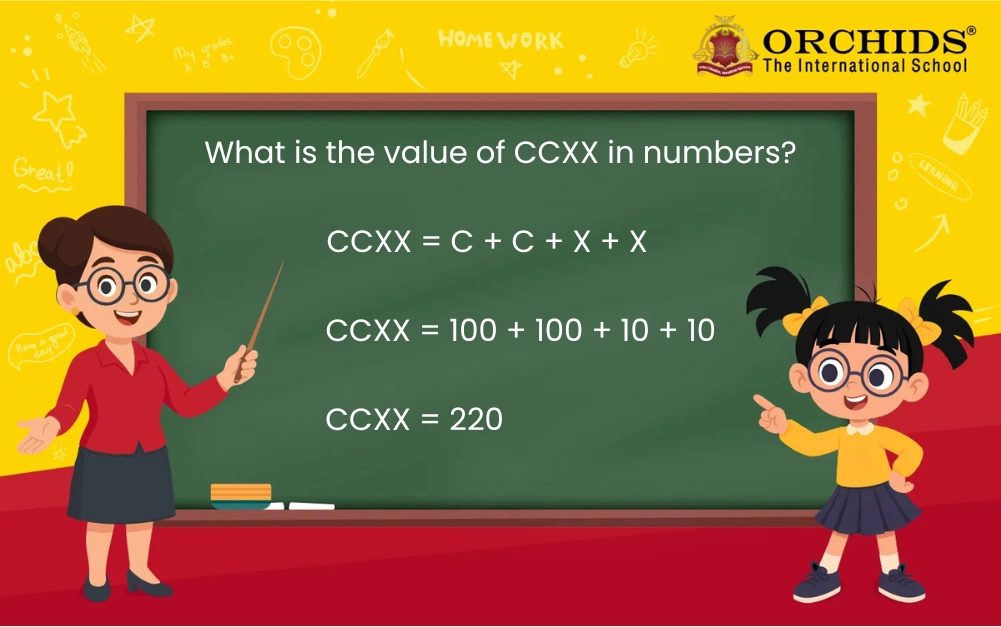
CCXX Roman numeral represent the number 220 in the ancient Roman number system. Roman numerals use letters to show values, and each letter has a fixed meaning. To understand CCXX, first write 220 in expanded form: 220 = 100 + 100 + 10 + 10. Now replace each value with its Roman symbol: 100 = C, 10 = X. So, C + C + X + X = CCXX. Learning Roman numerals like CCXX helps students understand how numbers are formed using addition. It also improves number sense and introduces learners to a historical way of writing numbers that is still used today in clocks, books, and important dates.
Table of Contents
- How to Write CCXX Roman Numeral in Numbers?
- Numbers Related to CCXX Roman Numerals
- Basic Rules for Writing Roman Numerals
- Solved Examples on CCXX Roman Numeral
- Practice Questions on CCXX Roman Numeral
- Conclusion
- Frequently Asked Questions on CCXX Roman Numerals

How to Write CCXX Roman Numeral in Numbers?
Follow the simple steps below to convert CCXX Roman numerals into numbers.
Step 1: Separate the Symbols
The Roman numeral CCXX contains four symbols:
C, C, X, and X
Step 2: Note the Value of Each Symbol
Each Roman letter represents a fixed number:
-
C stands for 100
-
X stands for 10
Step 3: Add the Values Together
All the symbols are written from highest to lowest value, so we add them:
-
CCXX = 100 + 100 + 10 + 10
-
CCXX = 220
Know more about related topics:
Numbers Related to CCXX Roman Numerals
|
Number |
Expanded Form |
Roman Numeral Expression |
Final Roman Numeral |
|
215 |
200 + 15 |
CC + XV |
CCXV |
|
216 |
200 + 16 |
CC + XVI |
CCXVI |
|
217 |
200 + 17 |
CC + XVII |
CCXVII |
|
218 |
200 + 18 |
CC + XVIII |
CCXVIII |
|
219 |
200 + 19 |
CC + XIX |
CCXIX |
|
220 |
200 + 20 |
CC + XX |
CCXX |
|
221 |
200 + 21 |
CC + XXI |
CCXXI |
|
222 |
200 + 22 |
CC + XXII |
CCXXII |
|
223 |
200 + 23 |
CC + XXIII |
CCXXIII |
|
224 |
200 + (20 + 4) |
CC + XXIV |
CCXXIV |
|
225 |
200 + 25 |
CC + XXV |
CCXXV |
Rules for Writing CCXX Roman Numerals
-
Repetition Rule: A symbol can be repeated up to three times in a row to add value (e.g., III = 3). C repeated twice gives 200.
-
Additive Rule: If a smaller or equal value follows a larger or equal one, add them (e.g., XX = 10 + 10 = 20). CCXX uses only addition.
-
Subtractive Rule: When a smaller numeral appears before a larger one, subtract the smaller (e.g., IV = 4). CCXX does not use subtraction.
-
Non-repetition Rule: V, L, and D are not repeated in succession.
-
Order Rule: Arrange numerals from largest to smallest unless using a subtractive pair.
Read more:
Solved Examples on CCXX Roman Numeral
Example 1: Convert CCXX to Hindu-Arabic number
Solution:
-
CC = 200
-
XX = 20
-
200 + 20 = 220.
Example 2: Write 220 as a Roman numeral
Solution:
-
200 = CC
-
20 = XX
Combine = CCXX.
Example 3: Convert 242 to Roman numerals.
Solution:
-
200 = CC
-
40 = XL
-
2 = II
Combine = CCXLII.
Example 4: Is CCXX the same as XXXXCC?
Solution: XXXXCC is invalid because X repeated four times is not allowed; the correct compact form is CCXX.
Example 5: Find the Roman numeral 220 + 30
Solution:
-
220 = CCXX
-
30 = XXX
-
220 + 30 = 250
Roman numeral = CCL.
Practice Questions on CCXX Roman Numeral
- Convert CCXX into numbers.
- Write 235 in Roman numerals.
- Break down CCXLV into its parts and give the numeric value.
- Which of the following is the correct Roman numeral for 220: CCCCXX, CCXX, or CXXC? Explain.
- Convert 199 into Roman numerals and explain the subtraction used.
- What is the sum of CCXX + XXX?
- Subtract XX from CCXX and express the answer in Roman numerals.
- What number comes just before CCXX? Write it in Roman numerals.
- If you add V to CCXX, what number do you get? Write the answer in both Roman and Hindu-Arabic numerals.
- Divide CCXX by X. Write the quotient in Roman numerals.
Conclusion
CCXX Roman numerals equal 220. It combines two C’s (100 each) and two X’s (10 each). These numerals demonstrate how the Roman system constructs larger numbers through addition. Roman numerals like CCXX are still used in page numbers, inscriptions, edition numbers, and formal documents. Understanding CCXX and similar numbers enhances number sense and provides insight into historical and cultural uses of the Roman numbering system.
Learn CCXX Roman numerals in a simple, structured, and historical way at Orchids International School.
Frequently Asked Questions on CCXX Roman Numerals
1. What number does CCXX represent?
CCXX = 220 (CC = 200, XX = 20).
2. Can CCXX be written another way in Roman numerals?
No. The standard and shortest form for 220 is CCXX. Forms like CCCCCXX or XXXXCC are invalid.
3. Why don’t we use CCXX on clocks?
Clock faces use I to XII (1-12). CCXX (220) is far beyond 12, so it won’t appear on normal analog clock dials.
4. How do I check if I converted CCXX correctly?
Split into groups: CC (100+100) and XX (10+10). Add: 200 + 20 = 220.
5. Is subtraction used in CCXX?
No. CCXX uses only addition (repeated C and X). Subtraction appears in forms like CM (900) or XL (40).
Numbers make sense when they're taught right. To see how Orchids The International School turns Maths from intimidating to intuitive, reach out to our admissions team.


Admissions Open for 2026-27
What type of concept pages would you prefer?
CBSE Schools In Popular Cities
- CBSE Schools in Bangalore
- CBSE Schools in Mumbai
- CBSE Schools in Pune
- CBSE Schools in Hyderabad
- CBSE Schools in Chennai
- CBSE Schools in Gurgaon
- CBSE Schools in Kolkata
- CBSE Schools in Indore
- CBSE Schools in Sonipat
- CBSE Schools in Delhi
- CBSE Schools in Rohtak
- CBSE Schools in Bhopal
- CBSE Schools in Aurangabad
- CBSE Schools in Jabalpur
- CBSE Schools in Jaipur
- CBSE Schools in Jodhpur
- CBSE Schools in Nagpur
- CBSE Schools in Ahmednagar
- CBSE School In Tumkur











Orchids The International School is one of India's leading chains of CBSE and ICSE schools, with 110+ schools across the country.