

93 in Roman numerals
93 in Roman numerals is written as XCIII. Instead of digits, Romans used letters and symbols to track transactions. This number system was known as the Roman numeral system. Even today, these numerals are used on watches, book pages, and film names.
All Roman numerals are made from 7 basic letters: I(1), V(5), X(10), L(50), C(100), D(500), and M(1000). Let’s learn how to represent 93 in Roman numerals using basic rules and numbers related to 93, along with solved examples.
Table of Contents
- How to Write 93 in Roman Numerals?
- Roman Numerals Related to 93
- Basic Roman Numeral Rules
- Solved Examples on 93 in Roman Numerals
- Conclusion
- Frequently Asked Questions on 93 in Roman Numerals
How to Write 93 in Roman Numerals?
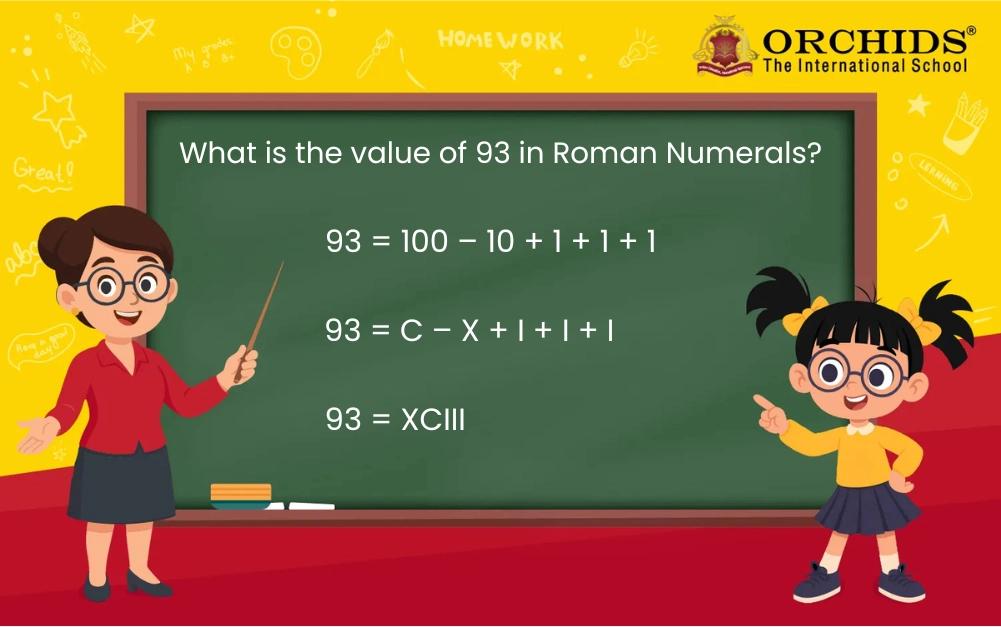
The number 93 in Roman Numerals is written as XCIII. Let's see step by step how we get this:
-
First, break the number 93 into simple form.
-
93 = (100 - 10) + 1 + 1 + 1
-
Now, write the Roman numerals for these numbers.
-
100 = C , 10 = X and 1 = I
-
When a smaller numeral comes before a bigger numeral, we subtract it.
-
So, (100 - 10) + 1 + 1 + 1 = C - X + I + I + I = XCIII

Roman Numerals Related to 93
Here are some numerals close to 93 written in Roman Numerals:
-
91 = (100 - 10) + 1 = C - X + I = XCI
-
92 = (100 - 10) + 1 + 1 = ( C - X ) + I + I = XCII
-
93 = (100 - 10) + 1 + 1 + 1 = ( C - X ) + I + I + I = XCIII
-
94 = (100 - 10) + ( 5 - 1) = ( C - X ) + ( V - I ) = XCIV
-
95 = (100 - 10) + 5 = ( C - X ) + V = XCV
-
96 = (100 - 10) + (5 + 1) = ( C - X ) + ( V + I ) = XC + VI = XCVI
-
97 = (100 - 10) + (5 + 1 + 1) = ( C - X ) + V + I + I = XCVII
-
98 = (100 - 10) + (5 + 1 + 1 + 1) = ( C - X ) + V + I + I + I = XCVIII
-
99 = (100 - 10) + (10 - 1) = ( C - X ) + ( X - I ) = CXIX
-
100 = C
Know more about related topics:
Basic Roman Numeral Rules
-
Repetition Rule: A symbol can be repeated only 3 times.
Example: XX = 20, CC = 200 -
A symbol is added to itself if repeated.
Example: III = 3, XXX = 30
-
Subtractive Rule: If a smaller symbol precedes a larger one, we subtract.
Example: IX = 10 - 1 = 9 -
Additive Rule: If a smaller symbol comes after a bigger one, we add.
Example: VI = 5 + 1 = 6 -
Symbols V (5), L (50), and D (500) are never repeated and never subtracted.
-
I can be subtracted only from V and X, and X can be subtracted only from L, C, and M
Solved Examples on 93 in Roman Numerals
Example 1: A book seller sold 45 English books and 48 Hindi books. How many total books did he sell? Write the total in Roman numerals.
Solution:
- 45 + 48 = 93
- 93 in Roman numerals is XCIII.
Example 2: Multiply XI(11) by IX (9). Express the answer in Roman numerals.
Solution:
- XI = 11
- IX = 9
- 11 * 9 = 99
So, 99 in Roman numerals = XCIX.
Example 3: What is the value of C - VII in Roman numerals?
Solution:
- C = 100
- VII = 7
- 100 - 7 = 93
So, 93 in Roman numerals = XCIII.
Example 4: Find the sum of LI(51) and XLII(42). Write the answer in Roman numerals.
Solution:
- LI = 51
- XLII = 42
So, 51 + 42 = 93
93 in Roman numerals is XCIII.
Conclusion
Roman Numerals conversion is a skill that helps you to link ancient history to modern learning. By learning to convert 93 in Roman numerals, you can easily understand the rules of writing and interpreting numbers like 93 in Roman numerals. Explore more such interesting topics like 93 in Roman numerals with Orchids the Internantional school.
Numbers make sense when they're taught right. To see how Orchids The International School turns Maths from intimidating to intuitive, reach out to our admissions team.
Frequently Asked Questions on 93 in Roman Numerals
1. How to Write 93 in Roman Numerals?
Answer: 93 in Roman numerals is XCIII.
2. What are Roman numerals?
Answer: Roman numerals are an ancient numbering system using letters like I, V, X, L, C, D, and M instead of modern digits.
3. What should be added to 33 to get 93 in Roman numerals?
Answer: In Roman numerals, 33 is represented as XXXIII. It is formed using the addition rule, where X (10) is added 3 times and I(1) is added 3 times, meaning 30 + 3 = 33. To get 93, we have to add 60, as 93 - 33 is 60, and 60 in Roman numerals is represented as LX.
4. Why is 90 in Roman numerals written as XC and CX?
Answer: 90 in Roman numerals is written as XC because when X(10) is placed before C(100) it follows the subtraction rule: C(100) - X(10) = 90(XC). When C(100) is place before X(10), it follows addition rule: C(100) + X(10) = 110(CX).
Related Links


Admissions Open for 2026-27
What type of concept pages would you prefer?
CBSE Schools In Popular Cities
- CBSE Schools in Bangalore
- CBSE Schools in Mumbai
- CBSE Schools in Pune
- CBSE Schools in Hyderabad
- CBSE Schools in Chennai
- CBSE Schools in Gurgaon
- CBSE Schools in Kolkata
- CBSE Schools in Indore
- CBSE Schools in Sonipat
- CBSE Schools in Delhi
- CBSE Schools in Rohtak
- CBSE Schools in Bhopal
- CBSE Schools in Aurangabad
- CBSE Schools in Jabalpur
- CBSE Schools in Jaipur
- CBSE Schools in Jodhpur
- CBSE Schools in Nagpur
- CBSE Schools in Ahmednagar
- CBSE School In Tumkur











Orchids The International School is one of India's leading chains of CBSE and ICSE schools, with 130+ schools across the country.