

95 in Roman Numerals: Steps, Solved Examples & Practice Questions
95 in Roman numeral is written as XCV, a traditional number system developed by the ancient Romans. To convert 95, we express it in expanded form: 95 = (100 - 10) + 5. Replacing these values with Roman symbols gives (C - X) + V = XCV. Understanding how to read and write numbers like 95 in Roman numerals helps learners recognize how subtraction and addition rules work together. It also builds logical thinking by showing how values combine to form a complete numeral. The study of XCV is not only a mathematical skill but also a link to historical counting methods, making number learning more engaging and meaningful for learners.
Table of Contents
- How to Write 95 in Roman Numeral?
- Roman Numerals for Numbers Related to 95
- Solved Examples on 95 in Roman Numeral
- Fun Facts on 95 in Roman Numerals
- Practice Questions on 95 in Roman Numeral
- Conclusion
- Frequently Asked Questions on 95 in Roman Numerals

How to Write 95 in Roman Numeral?
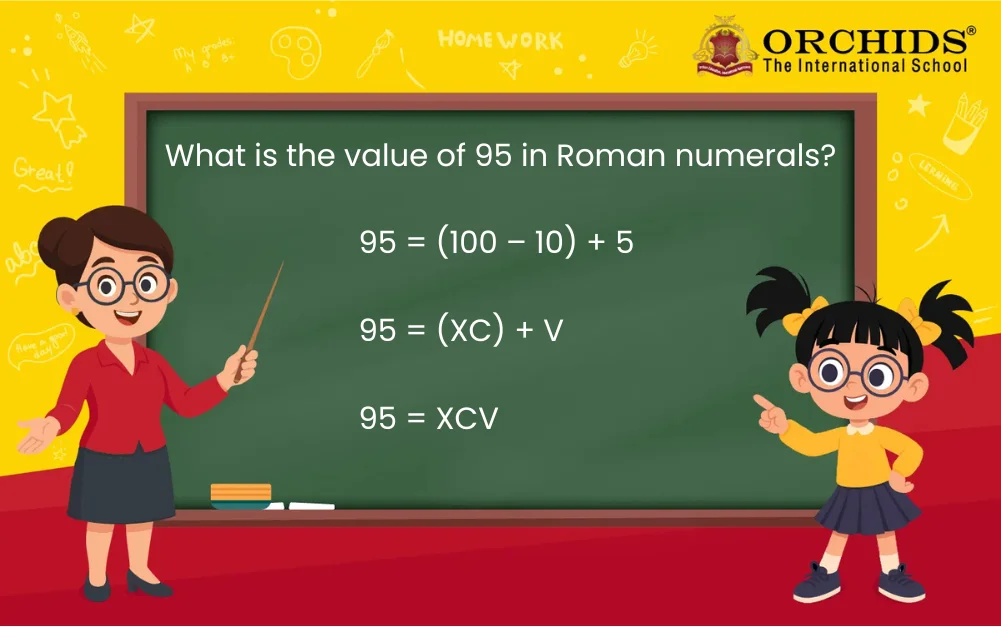
To convert 95 into Roman numerals, we break the number into parts based on the available symbols I, V, X, L, C, D, and M.
The simplest way to split 95 is 95 = 90 + 5
But since there is no single symbol for 90, we use the subtractive rule:
-
-
C = 100
-
X = 10
-
When a smaller numeral comes before a larger numeral, it is subtracted. So:
-
-
90 = 100 - 10 = C - X = XC
-
We already know 5 = V
Now combine both parts:
-
-
95 = 90 + 5 = XC + V
-
95 = XCV
-
Therefore, 95 in Roman numerals is written as XCV.
Know more about related topics:
Roman Numerals for Numbers Related to 95
|
Number |
Roman Numeral |
|
90 |
XC |
|
91 |
XCI |
|
92 |
XCII |
|
93 |
XCIII |
|
94 |
XCIV |
|
95 |
XCV |
|
96 |
XCVI |
|
97 |
XCVII |
|
98 |
XCVIII |
|
99 |
XCIX |
|
100 |
C |
|
101 |
CI |
Solved Examples on 95 in Roman Numeral
Example 1: Convert the sum of 50 (L) and XLV (45) to Roman numerals.
Solution:
-
L = 50, XLV = 45
-
50 + 45 = 95
Therefore, 95 is XCV in Roman numerals.
Example 2: Subtract V (5) from C (100). Write the answer in Roman numerals.
Solution:
-
C = 100, V = 5
-
100 - 5 = 95
So 95 in Roman numerals is XCV.
Example 3: Multiply XIX (19) by V (5). Express the result in Roman numerals.
Solution:
-
19 × 5 = 95
Therefore, 95 in Roman numerals is XCV.
Example 4: Add L (50), XL (40), and V (5). Write the total in Roman numerals.
Solution:
-
50 + 40 + 5 = 95
Therefore, 95 = XCV.
Example 5: Find the Roman numeral for (C - V).
Solution:
-
C = 100, V = 5
-
100 - 5 = 95
Therefore, the result is XCV.
Fun Facts on 95 in Roman Numerals
-
There is no symbol for zero in Roman numerals.
-
The numeral XCV uses both the subtractive rule (XC = 90) and the additive rule (V = 5).
-
Roman numerals were widely used in ancient Roman clocks, buildings, and official documents.
-
Numbers in the 90s begin with XC, which represents 90 in Roman numerals.
Practice Questions on 95 in Roman Numeral
- Write 95 in Roman numerals.
- Convert XCV into Hindu-Arabic numerals.
- Express 95 as the sum of Roman numeral values.
- Which is greater: XCV or XC?
- Write the Roman numeral that comes just before XCV.
- Write the Roman numeral that comes just after XCV.
- Simplify and write the answer in Roman numerals: XCV + V
- Simplify and write the answer in Roman numerals: XCV − XV
- Divide XCV by V and write the answer in Roman numerals.
- A class scored XCV marks in a test. If V more marks are added, what is the total? Write in Roman numerals.
Conclusion
95 in Roman numerals is written as XCV, where XC represents 90 using the subtraction rule, and V represents 5 using the addition rule. By breaking 95 into simple parts and applying Roman numeral rules step-by-step, learners can easily understand how the numeral XCV is formed. Learning numbers like 95 in Roman numerals strengthens number sense, improves logical thinking, and helps students confidently read and write Roman numerals used in clocks, books, and everyday life.
Learn 95 in Roman numerals in a detailed and easy conversion method at Orchids International School.
Frequently Asked Questions on 95 in Roman Numerals
1. How is 95 formed in Roman numerals?
95 is written as XCV using the subtraction rule.
Here, X (10) is placed before C (100), so it becomes 100 - 10 = 90, and adding V (5) gives 95.
2. Why is 95 written as XCV and not as VC?
Writing VC is incorrect because Roman numerals do not allow placing V before C for subtraction.
Instead, the correct form is XC (90) + V (5) = XCV (95).
3. What rule is used to write 95 in Roman numerals?
The subtractive rule is used. When a smaller numeral (X) appears before a larger numeral (C), it is subtracted: 100 - 10 = 90. Then, add V (5) to get 95 = XCV.
4. Where do we see 95 written in Roman numerals today?
You may find XCV on clock faces, monuments, book chapters, or movie titles, representing the number 95 in Roman form.
5. How do you quickly convert 95 to Roman numerals?
-
Break down 95 = 90 + 5
-
Write in Roman symbols: 90 = XC, 5 = V
-
Combine them: XC + V = XCV
Numbers make sense when they're taught right. To see how Orchids The International School turns Maths from intimidating to intuitive, reach out to our admissions team.


Admissions Open for 2026-27
What type of concept pages would you prefer?
CBSE Schools In Popular Cities
- CBSE Schools in Bangalore
- CBSE Schools in Mumbai
- CBSE Schools in Pune
- CBSE Schools in Hyderabad
- CBSE Schools in Chennai
- CBSE Schools in Gurgaon
- CBSE Schools in Kolkata
- CBSE Schools in Indore
- CBSE Schools in Sonipat
- CBSE Schools in Delhi
- CBSE Schools in Rohtak
- CBSE Schools in Bhopal
- CBSE Schools in Aurangabad
- CBSE Schools in Jabalpur
- CBSE Schools in Jaipur
- CBSE Schools in Jodhpur
- CBSE Schools in Nagpur
- CBSE Schools in Ahmednagar
- CBSE School In Tumkur











Orchids The International School is one of India's leading chains of CBSE and ICSE schools, with 110+ schools across the country.