

98 in Roman Numerals
98 in Roman numerals is written as XCVIII, a traditional number system used by the ancient Romans. To convert 98, we express it in expanded form: 98 = (100 - 10) + (5 + 1 + 1 + 1). Replacing these values with Roman symbols gives (C - X) + (V + I + I + I) = XCVIII. Understanding how to read and write numbers like 98 in Roman numerals helps learners recognize patterns in addition and subtraction. It also strengthens logical thinking by showing how values combine to form a complete numeral. The study of XCVIII is not only a mathematical skill but also a connection to historical number systems, making number learning more engaging and meaningful in everyday life.
Table of Contents
- How to Write 98 in Roman Numerals?
- Roman Numerals for Numbers Related to 98
- Basic Rules of Writing Roman Numerals
- Solved Examples on 98 in Roman Numerals
- Fun Facts on 98 in Roman Numerals
- Practice Questions on 98 in Roman Numerals
- Conclusion
- Frequently Asked Questions on 98 in Roman Numerals
How to Write 98 in Roman Numerals?
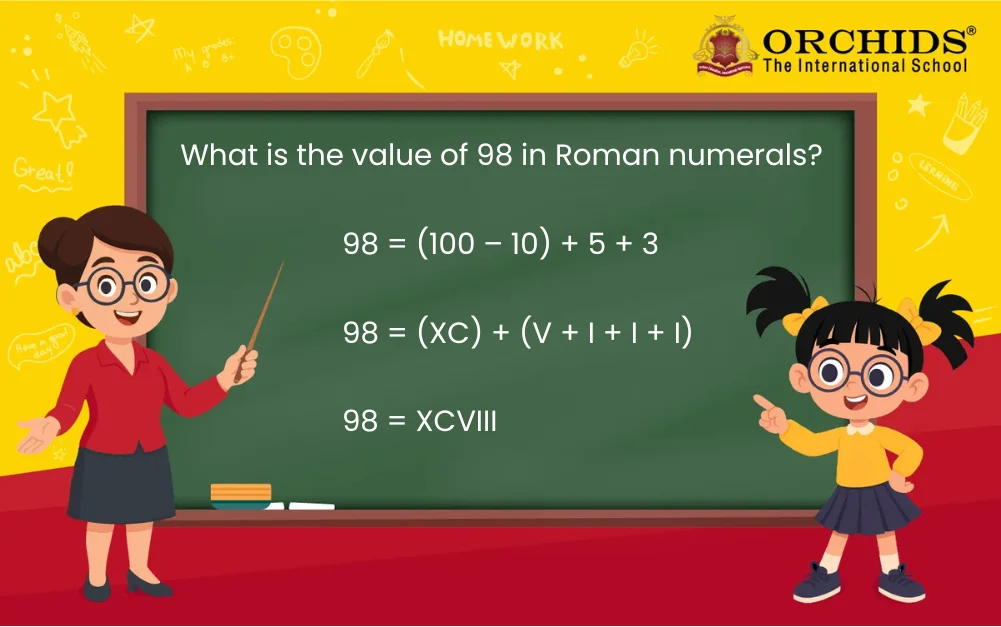
To write 98 in Roman numerals, we need to break it into parts using the basic Roman symbols (I, V, X, L, C, D, M).
Step 1: Split the number
-
The easiest way to split 98 is:
-
98 = 90 + 8
Step 2: Write each part in Roman numerals
-
90 = XC (Because 90 = 100 - 10 = C - X)
-
8 = VIII (Because 8 = 5 + 1 + 1 + 1 = V + I + I + I)
Step 3: Add both parts
-
98 = XC + VIII = XCVIII

Roman Numerals for Numbers Related to 98
|
Number |
Roman Numeral |
|
93 |
XCIII |
|
94 |
XCIV |
|
95 |
XCV |
|
96 |
XCVI |
|
97 |
XCVII |
|
98 |
XCVIII |
|
99 |
XCIX |
|
100 |
C |
|
101 |
CI |
Know more about related topics:
Basic Rules of Writing Roman Numerals
-
Repetition Rule: A symbol can be repeated only 3 times.
Example: XX = 20, CC = 200 -
A symbol is added to itself if repeated.
Example: III = 3, XXX = 30 -
Subtractive Rule: If a smaller symbol precedes a larger one, we subtract.
Example: IX = 10 - 1 = 9 -
Additive Rule: If a smaller symbol comes after a bigger one, we add.
Example: VI = 5 + 1 = 6 - Symbols V (5), L (50), and D (500) are never repeated and never subtracted.
I can be subtracted only from V and X and X can be subtracted only from L, C, and M.
Solved Examples on 98 in Roman Numerals
Example 1: Write the sum of XLVIII (48) and L (50) in Roman numerals.
Solution:
-
48 + 50 = 98
-
So 98 in Roman numerals = XCVIII
Example 2: What is the product of VII (7) and XIV (14) in Roman numerals?
Solution:
-
VII = 7, XIV = 14
-
7 × 14 = 98
-
Therefore, 98 in Roman numerals = XCVIII
Example 3: If a student has scored 90 marks in mathematics and 8 marks in bonus, what is the total in Roman numerals?
Solution:
-
90 + 8 = 98
-
Then 98 = XCVIII
Example 4: Subtract II (2) from C (100). Write the result in Roman numerals.
Solution:
-
100 - 2 = 98
-
98 in Roman numerals = XCVIII
Example 5: Find the difference between XCIX (99) and I (1).
Solution:
-
99 - 1 = 98
-
Therefore, 98 in Roman numerals = XCVIII
Fun Facts on 98 in Roman Numerals
-
XCVIII = 98 uses both the rules of subtraction (XC = 100 - 10) and addition (VIII = 5 + 1 + 1 + 1) together.
-
There is no zero in Roman numerals.
-
They were commonly used on clock faces, buildings, book chapters, and royal titles.
-
The numbers 91 to 99 follow a pattern that starts with "XC".
Practice Questions on 98 in Roman Numerals
1. Write 98 in Roman numerals.
2. Add LXXX (80) and XVIII (18). Express the result in Roman numerals.
3. Subtract II from C. Write the answer in Roman numerals.
4. Multiply VII (7) by XIV (14). Write the result in Roman numerals.
5. What are the next two numbers after 98 in Roman numerals?
Conclusion
98 in Roman numerals is written as XCVIII. By breaking 98 into 90 (XC) and 8 (VIII), we can easily understand how both subtraction and addition rules work together in Roman numerals. Learning numbers like 98 helps students build a strong foundation in number systems, improve logical thinking, and recognize common patterns in Roman numerals. With regular practice and step-by-step learning, students can confidently read and write Roman numerals in both classroom lessons and real-life situations.
Discover 98 in Roman numerals in a student-friendly way with solved examples at Orchids International School.
Numbers make sense when they're taught right. To see how Orchids The International School turns Maths from intimidating to intuitive, reach out to our admissions team.
Frequently Asked Questions on 98 in Roman Numerals
1. Why is 98 written as XCVIII in Roman numerals?
Answer: In Roman numerals, XC = 90 (100 - 10) and VIII = 8 (5 + 3). In addition, XC + VIII = 98. Therefore, 98 = XCVIII.
2. How to write 98 in Roman numerals step by step?
Answer:
-
Break 98 = 90 + 8
-
90 = XC, 8 = VIII
-
Combine them XCVIII
3. What is XCIX in Roman numerals?
Answer: XCIX represents 99. It is made up of XC (90) + IX (9) = 99.
4. What is the Roman number before 98?
Answer: The number before 98 is XCVII, which is equal to 97.
5. How to write numbers from 90 to 100 in Roman numerals?
Answer: Here is the list:
-
90 = XC
-
91 = XCI
-
92 = XCII
-
93 = XCIII
-
94 = XCIV
-
95 = XCV
-
96 = XCVI
-
97 = XCVII
-
98 = XCVIII
-
99 = XCIX
-
100 = C
Related Links


Admissions Open for 2026-27
What type of concept pages would you prefer?
CBSE Schools In Popular Cities
- CBSE Schools in Bangalore
- CBSE Schools in Mumbai
- CBSE Schools in Pune
- CBSE Schools in Hyderabad
- CBSE Schools in Chennai
- CBSE Schools in Gurgaon
- CBSE Schools in Kolkata
- CBSE Schools in Indore
- CBSE Schools in Sonipat
- CBSE Schools in Delhi
- CBSE Schools in Rohtak
- CBSE Schools in Bhopal
- CBSE Schools in Aurangabad
- CBSE Schools in Jabalpur
- CBSE Schools in Jaipur
- CBSE Schools in Jodhpur
- CBSE Schools in Nagpur
- CBSE Schools in Ahmednagar
- CBSE School In Tumkur











Orchids The International School is one of India's leading chains of CBSE and ICSE schools, with 110+ schools across the country.