

990 in Roman Numerals
990 in Roman numerals is written as CMXC, a classic number system used by the Romans. To convert 990, we express it as 990 = (1000 - 10) + (100 - 10). Replacing these values with Roman symbols gives (M - C) + (C - X) = CMXC. Learning 990 in Roman numerals helps students understand how subtraction and addition work together, strengthens logical reasoning, and connects mathematical skills with historical context. CMXC is useful for reading dates, book chapters, and other real-life applications.
Table of Contents
- How to Write 990 in Roman Numerals?
- Roman Numerals for Numbers Related to 990
- Solved Examples on 990 in Roman Numerals
- Fun Facts on 990 in Roman Numerals
- Practice Questions on 990 in Roman Numerals
- Conclusion
- Frequently Asked Questions on 990 in Roman Numerals
How to Write 990 in Roman Numerals?
The number 990 can be written in Roman numerals by using the combination of letters representing 1000, 100, and 10 while following Roman numeral rules.
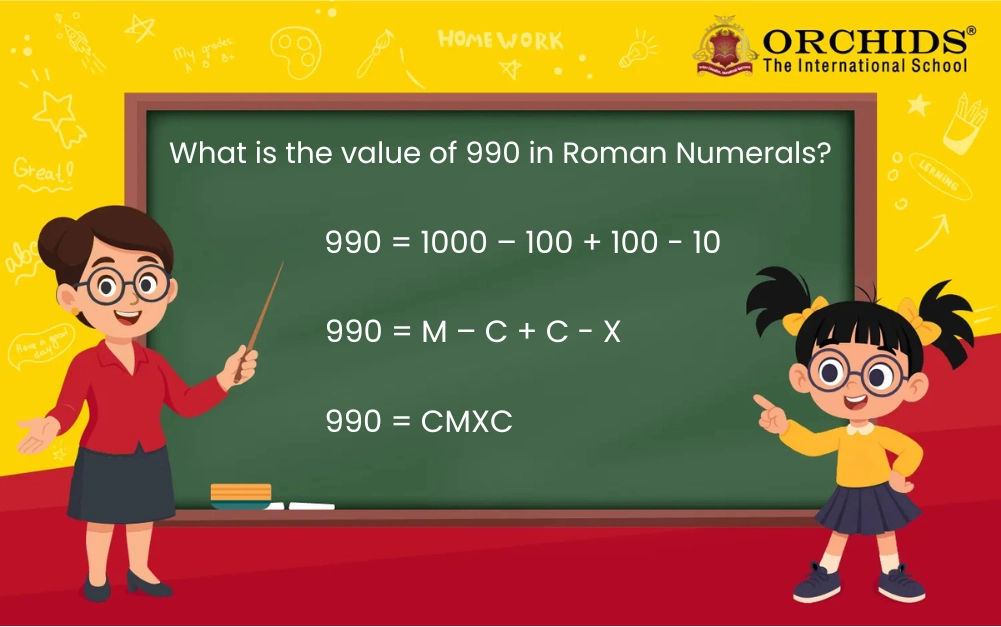
Step 1: Break the number using Roman numeral rules
-
We know the main symbols are
-
M = 1000
-
C = 100
-
X = 10
-
Roman numerals cannot repeat a letter more than three times.
-
To write 900, we use the subtraction rule: 1000 - 100 = CM
-
To write 90, we also use subtraction: 100 - 10 = XC
Step 2: Combine the values
-
990 = 900 + 90
-
990 = CM + XC
Step 3: Final Roman numeral
-
Therefore, 990 in Roman numerals = CMXC

Roman Numerals for Numbers Related to 990
|
Number |
Roman Numeral |
|
981 |
CMLXXXI |
|
982 |
CMLXXXII |
|
983 |
CMLXXXIII |
|
984 |
CMLXXXIV |
|
985 |
CMLXXXV |
|
986 |
CMLXXXVI |
|
987 |
CMLXXXVII |
|
988 |
CMLXXXVIII |
|
989 |
CMLXXXIX |
|
990 |
CMXC |
Know more about related topics:
Solved Examples on 990 in Roman Numerals
Example 1: Express 990 in Roman numerals.
Solution:
-
Break the number: 990 = 900 + 90
-
Write each in Roman numerals: 900 = CM, 90 = XC
-
Combine: CM + XC = CMXC
-
So, 990 = CMXC
Example 2: A clock on a historical monument shows the year 990 engraved in Roman numerals. What is written on it?
Solution:
-
The year 990 = CMXC
-
Hence, the clock engraving reads CMXC.
Example 3: Convert the sum of CM (900) and XC (90) into a Roman numeral.
Solution:
-
CM = 900, XC = 90
-
900 + 90 = 990
-
Therefore, 990 = CMXC
Example 4: Subtract X (10) from M (1000) and write the result in Roman numerals.
Solution:
-
1000 - 10 = 990
-
990 in Roman numerals = CMXC
Example 5: A museum recorded 990 ancient coins. Represent the number of coins in Roman numerals.
Solution:
-
Number of coins = 990
-
In Roman numerals = CMXC
Fun Facts on 990 in Roman Numerals
-
The Roman numeral for 990, CMXC, uses two subtraction rules:
-
CM (1000 - 100) for 900
-
XC (100 - 10) in 90
-
There is no symbol for zero (0) in Roman numerals.
-
Roman numerals are still seen on clocks, monuments, and ancient manuscripts.
-
The year CMXC (990) falls in the early medieval period.
-
You cannot repeat symbols more than three times with Roman numerals.
Practice Questions on 990 in Roman Numerals
1. Write 990 in Roman numerals.
2. Add CM (900) and XC (90). Express the result in Roman numerals.
3. What is 1000 - 10 in Roman numerals?
4. Write the next three numbers after 990 in Roman numerals.
5. Convert the year 999 to Roman numerals.
Conclusion
990 in Roman numerals is written as CMXC, using the subtraction rule: 100 (C) before 1000 (M) for 900, and 10 (X) before 100 (C) for 90. Understanding CMXC shows how Roman numerals combine addition and subtraction to form numbers. Practicing nearby numbers like 981 (CMLXXXI), 985 (CMLXXXV), 989 (CMLXXXIX), and 991 (CMXCI) helps students recognize patterns, improve number sense, and read Roman numerals on clocks, books, monuments, and historical records.
Learn 990 in Roman numerals easily with guided lessons at Orchids International School.
Numbers make sense when they're taught right. To see how Orchids The International School turns Maths from intimidating to intuitive, reach out to our admissions team.
Frequently Asked Questions on 990 in Roman Numerals
1. What is 990 in Roman numerals?
Answer: In Roman numerals, 990 is written as CMXC.
2. How do you write 990 in Roman numerals step by step?
Answer: Break 990 as 900 + 90 = 900 = CM, 90 = XC. CM + XC = CMXC.
3. What comes before and after 990 in Roman numerals?
Answer: Before 990 is CMLXXXIX (989), and after 990 is CMXCI (991).
4. Why is 990 written as CMXC and not XM?
Answer: Because Roman numerals follow the subtraction rule correctly: 900 = CM (1000 - 100) and 90 = XC (100 - 10). XM is not a valid combination.
5. How is the number 1000 written in Roman numerals?
Answer: 1000 is written as "M" in Roman numerals.
Related Links


Admissions Open for 2026-27
What type of concept pages would you prefer?
CBSE Schools In Popular Cities
- CBSE Schools in Bangalore
- CBSE Schools in Mumbai
- CBSE Schools in Pune
- CBSE Schools in Hyderabad
- CBSE Schools in Chennai
- CBSE Schools in Gurgaon
- CBSE Schools in Kolkata
- CBSE Schools in Indore
- CBSE Schools in Sonipat
- CBSE Schools in Delhi
- CBSE Schools in Rohtak
- CBSE Schools in Bhopal
- CBSE Schools in Aurangabad
- CBSE Schools in Jabalpur
- CBSE Schools in Jaipur
- CBSE Schools in Jodhpur
- CBSE Schools in Nagpur
- CBSE Schools in Ahmednagar
- CBSE School In Tumkur











Orchids The International School is one of India's leading chains of CBSE and ICSE schools, with 110+ schools across the country.