

Area of Parallelogram: Questions and Solutions
Area of Parallelogram Questions with solutions presents methods and worked examples for finding the area of one of the important quadrilaterals. This guide reviews the standard formula: area of a parallelogram = base × height and demonstrates its use through solved problems involving slanted bases, heights from oblique sides and unit conversions. From straightforward computations to composite-shape and application problems, each solution focuses on clear steps, geometric reasoning and helpful shortcuts. Worked examples with brief explanations help strengthen understanding and exam preparation.
Table of Contents
- Methods to Find the Area of a Parallelogram
- Solved Examples on the Area of a Parallelogram
- Frequently Asked Questions of Area of Parallelogram Questions

Methods to Find the Area of a Parallelogram
1. When base & height are given
A = b × h
h is the perpendicular height, not the slanting side.
2. When two sides and included angle are given
A = a × b × sin θ
Useful when no height is directly given but you know both adjacent sides and the angle between them.
3. When both diagonals and the angle between them are given
A = ½ × d₁ × d₂ × sin θ
Solved Examples on the Area of a Parallelogram
Example 1: The base of a parallelogram is 12 cm and its height is 9 cm. Find its area.
Solution: Given b = 12 cm and h = 9 cm.
Area = Base × Height = 12 × 9 = 108 cm²
Example 2: The base of a parallelogram is (3x + 1) cm, its height is 5 cm, and its area is 80 cm². Find the value of x and the actual base length.
Solution: Given, Base = (3x + 1) cm, Height = 5 cm and Area = 80 cm².
Base × Height = Area
(3x + 1) × 5 = 80
3x + 1 = 16
3x = 15
⇒x = 5
Base = 3(5) + 1 = 16 cm
Example 3: Two adjacent sides of a parallelogram are 8 cm and 6 cm, and the angle between them is 30°. Find its area.
Solution:
Area = a × b × sin θ = 8 × 6 × sin 30° = 48 × 0.5 = 24 cm²
Example 4: The diagonals of a parallelogram are 18 cm and 14 cm, and they intersect at an angle of 60°. Find the area.
Solution: d₁ = 18 cm, d₂ = 14 cm
Area = ½ × d₁ × d₂ × sin θ = ½ × 18 × 14 × sin 60°
= ½ × 252 × 0.866 ≈ 109.1 cm²
Example 5: A parallelogram-shaped park has a base of 24 m and a height of 15 m. If it costs ₹50 per square metre to lay grass, find the total cost.
Solution: Given b = 24m and h = 15 m
Area = 24 × 15 = 360 m²
Total cost = 360 × 50 = ₹18,000
Example 6: If the base of a parallelogram is doubled while the height stays the same, the area:
(a) Stays the same
(b) Doubles
(c) Becomes half
(d) Becomes four times
Solution:
(b) Doubles, since area is directly proportional to the base when height is fixed.
Example 7: A landscape architect is designing a parallelogram-shaped flower bed for a school garden. The base of the flower bed is 18 m and its height (the perpendicular distance to the opposite side) is 10 m. One of the slanting sides measures 13 m. The gardener needs to fence the entire boundary and also calculate how the area would change if the design were later adjusted.
(i) What is the area of the flower bed?
Solution:
Area = base × height = 18 × 10 = 180 m²
(ii) If fencing costs ₹200 per metre, and the two slanting sides are each 13 m, find the total cost of fencing the flower bed.
Solution:
Perimeter = 2(18 + 13) = 2 × 31 = 62 m
Total cost = 62 × 200 = ₹12,400
(iii) The architect later reduces the height to 8 m, keeping the base at 18 m. By how much does the area decrease?
Solution:
New area = 18 × 8 = 144 m²
Decrease = 180 − 144 = 36 m²
(iv) If a second flower bed is designed as a rectangle with the same base and height as the original parallelogram bed, how would its area compare?
Solution:
The rectangle would also have an area of 18 × 10 = 180 m², exactly equal, since both figures share the same base and the same perpendicular height.
Example 8: In parallelogram ABCD, E is a point on side DC such that DE : EC = 1 : 2. If the area of ABCD is 90 cm², find the area of triangle ADE.
Solution:
DE = ⅓ of DC = ⅓ of the base AB (since DC = AB in a parallelogram).
Triangle ADE has base DE and the same perpendicular height (h) as the parallelogram, since both A and the line DC lie between the same parallels.
Area of △ADE = ½ × DE × h
= ½ × (⅓ × base) × h
= ⅙ × (base × h)
= ⅙ × 90 = 15 cm²
Example 9: A painter is painting a decorative design on the outer wall of a school building. The design consists of four identical parallelograms, as shown below. Each can of paint costs ₹120 and covers an area of 2.5 m². How much will it cost to paint the entire design?
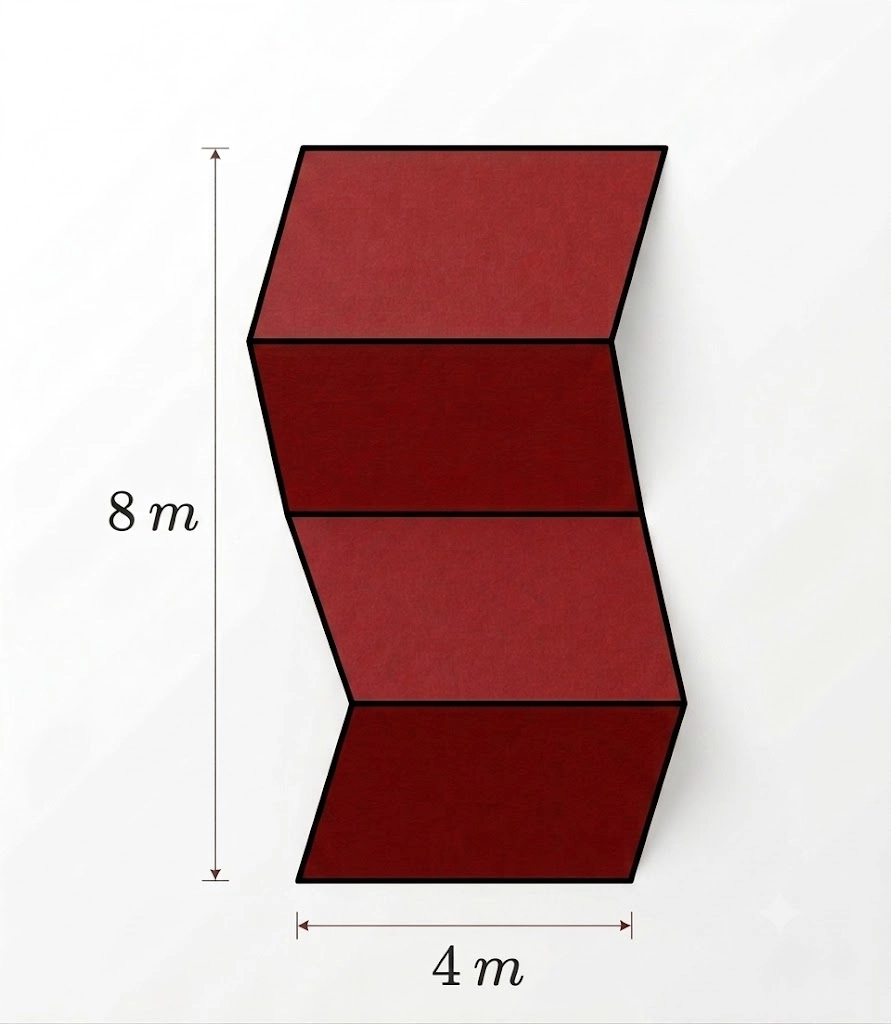
Solution: Base = 4 m
Perpendicular height = 2 m (since 8 ÷ 4 = 2 m for each parallelogram)
Area of a parallelogram = Base × Perpendicular Height
Since there are 4 identical parallelograms in the design, we multiply the area by 4.
Area of one parallelogram = 4 × 2 = 8 m²
Area of the logo = 4 × (Base × Perpendicular Height)
= 4 × (4 × 2)
= 32 m²
Since each can of paint covers 2.5 m², we divide:
32 ÷ 2.5 = 12.8 cans
Since we cannot buy 0.8 of a can, we round up to 13 cans.
Each can costs ₹120, so:
13 × 120 = ₹1560
Therefore, the total cost of painting the logo is ₹1560.
Frequently Asked Questions of Area of Parallelogram Questions
1. What is the formula for the area of a parallelogram?
The area of a parallelogram is Base × Height, where the height is the perpendicular distance between the base and its opposite side.
2. Can we find the area of a parallelogram using only its two sides?
You also need the angle between them. The formula is Area = a × b × sin θ, where a and b are adjacent sides and θ is the included angle.
3. Is the area of a parallelogram the same as the area of a rectangle drawn on the same base?
Yes, if both shapes stand on the same base and lie between the same pair of parallel lines, they have equal area.
4. How do you find the height of a parallelogram if you know the area and base?
Divide the area by the base: Height = Area ÷ Base. Make sure both values are in the same unit before dividing.
Numbers make sense when they're taught right. To see how Orchids The International School turns Maths from intimidating to intuitive, reach out to our admissions team.


Admissions Open for 2026-27
What type of concept pages would you prefer?
CBSE Schools In Popular Cities
- CBSE Schools in Bangalore
- CBSE Schools in Mumbai
- CBSE Schools in Pune
- CBSE Schools in Hyderabad
- CBSE Schools in Chennai
- CBSE Schools in Gurgaon
- CBSE Schools in Kolkata
- CBSE Schools in Indore
- CBSE Schools in Sonipat
- CBSE Schools in Delhi
- CBSE Schools in Rohtak
- CBSE Schools in Bhopal
- CBSE Schools in Aurangabad
- CBSE Schools in Jabalpur
- CBSE Schools in Jaipur
- CBSE Schools in Jodhpur
- CBSE Schools in Nagpur
- CBSE Schools in Ahmednagar
- CBSE School In Tumkur











Orchids The International School is one of India's leading chains of CBSE and ICSE schools, with 130+ schools across the country.